
In vitro fertilization brings numerous benefits and allows individuals struggling with fertility to have children. Still, the process is relatively new and raises concerns regarding certain conditions, such as autism.
How common is autism among children conceived through IVF, and what does the research say about the risk?
Let’s understand whether autism can be detected during IVF and what steps you can take to give your child the best possible start in life in this guide.
Can IVF cause autism? Examining the evidence
Based on the most comprehensive and recent large-scale studies, IVF procedures themselves are not a direct cause of autism.
The vast majority of research indicates that any small, observed increase in the likelihood of autism is almost certainly due to the underlying reasons parents need IVF in the first place, such as:
Parental age
Genetic factors
Specific causes of infertility

Source: Kenan Zhang
Initially, scientists explored a few ideas about how IVF might influence neurodevelopment, but these were never proven. Here are some of them:
Epigenetic changes: The idea was that procedures like growing embryos in a lab or freezing and thawing them might cause subtle changes in how genes are expressed.
Intracytoplasmic sperm injection (ICSI): This technique, used for male factor infertility, involves using a single sperm to inject directly into an egg. The theory was that bypassing natural selection might inadvertently allow the use of lower-quality sperm.
Hormonal treatments: Scientists considered if the medications used to stimulate egg production and prepare the uterine lining might impact development in ways that are not yet understood.
The link between IVF and autism: What modern research shows
Multiple credible studies have found that the minor increase in statistical risk of autism during IVF is associated with infertility itself, not the treatment for it.
For instance, a 2020 study in Massachusetts looked at over 460,000 births. It concluded that children born using assisted reproductive technology (ART), like IVF, are not at increased risk of autism spectrum disorder (ASD) compared to children born to fertile women.
In addition, a 2023 Canadian study of 1.3 million children found similar rates of autism diagnosis:
1.9 of 1,000 children conceived without fertility help
2.5 of 1,000 children born to parents with infertility who did not get treatment
2.7 of 1,000 children conceived with fertility treatments like IVF
The rate is higher for the subfertile group who received no treatment than for the general population, and only slightly higher for the IVF group. That strongly suggests that the underlying infertility is the factor, not IVF treatment.
This study also found that pregnancy-related issues, which are more common in subfertile and IVF pregnancies, play a much bigger role than the conception method. The table below shows how common pregnancy complications affect autism risk:
Complication | Influence on risk |
|---|---|
Cesarean birth | 29% |
Multiple pregnancy | 78% |
Preterm birth | 50% |
Severe neonatal morbidity | 25% |
Preeclampsia | <10% |
One study highlighted the potential paternal role in autism, finding that epigenetic changes in a father’s sperm, not only the DNA itself, were associated with a higher likelihood of autistic traits in their children.
Research on over 5.7 million births revealed a clear, independent link between a father’s age and autism risk. The study showed that the risk of autism in children increases consistently with advancing paternal age.
Can IVF prevent autism?
Unfortunately, you can’t definitively prevent autism with IVF.
ASD is a complex neurodevelopmental condition with a strong genetic basis. It isn’t linked to a single gene but influenced by a unique combination of hundreds of potential genetic variants, interacting with environmental factors.

Source: Alexander Dummer
Research shows that genetics contribute to an estimated 40–80% of autism risk. But this influence is not straightforward. Only about 30% of individuals on the spectrum have an identifiable genetic variant linked to their conditions.
So far, scientists have discovered at least 11 genes that can be involved in autism development, including:
ADNP
CHD2
ANK2
CHD8
ARIS1B
DYRK1A
POGZ
SHANK3
SYNGAP1
FMR1
AUTS2
Plus, some mutations may arise spontaneously (de novo) in the embryo, which has no traceable family history.
IVF doesn’t alter the fundamental genetic basis; it only aids in bringing all the genes together and creates an opportunity for advanced genetic screening that might be relevant for autism specific risk factors. It can also help you prioritize single embryo transfer and minimize the risk of multiple pregnancy and the complications it entails.
Through preimplantation genetic testing (PGT), a procedure that involves taking a few cells from the embryos’ outer layer to test for certain genetic conditions before transfer, you can identify healthy embryos with the highest chance of successful implantation, pregnancy, and normal development.
Can IVF detect autism? How can embryo genetic testing help?
While IVF itself can’t detect autism, the embryo genetic testing available alongside it can screen for certain chromosomal and genetic conditions to improve the chances of a healthy pregnancy.
The standard PGT tests and what they can tell you are presented in the table below:
PGT type | What it does | When it’s recommended |
|---|---|---|
|
| |
Screens embryos for specific single-gene disorders, such as:
|
| |
Looks for areas where pieces of chromosomes or whole chromosomes have swapped places, duplicated, or disappeared, which can lead to:
|
|
Since numerous genetic variants are involved in autism, each one contributing a small amount to the overall risk, none of these standard tests can screen for it. Environmental factors involved in autism development complicate matters further.
Source: Chokniti Khongchum
Still, there is hope—the latest advancements to embryo screening, such as preimplantation genetic testing for polygenic conditions (PGT-P) of embryos, can be combined with other PGT options to add deeper mental, physical, and cognitive health insights.
PGT-P screening looks at hundreds, even millions, of genes simultaneously and how they work together to impact the risk of numerous complex, chronic, and adult-onset conditions, including autism, ADHD, and schizophrenia, among others.
Bonus read: See how PGT-P compares to other embryo screening options in these guides:
How PGT-P in IVF can reduce autism risk
Unlike standard PGT tests that look for one specific issue at a time, PGT-P simultaneously checks for:
Single-gene mutations
Statistical predisposition for complex conditions
For autism, influenced by a combined effect of hundreds of genes, PGT-P calculates a polygenic risk score. This score places each embryo on a spectrum of statistical likelihood for developing ASD compared to the general population.
Here’s how PGT-P provides a broader picture of embryo health:
Identifying common mutations: PGT-P can detect common mutations with links to ASD, allowing parents to consider transferring an embryo with lower risk.
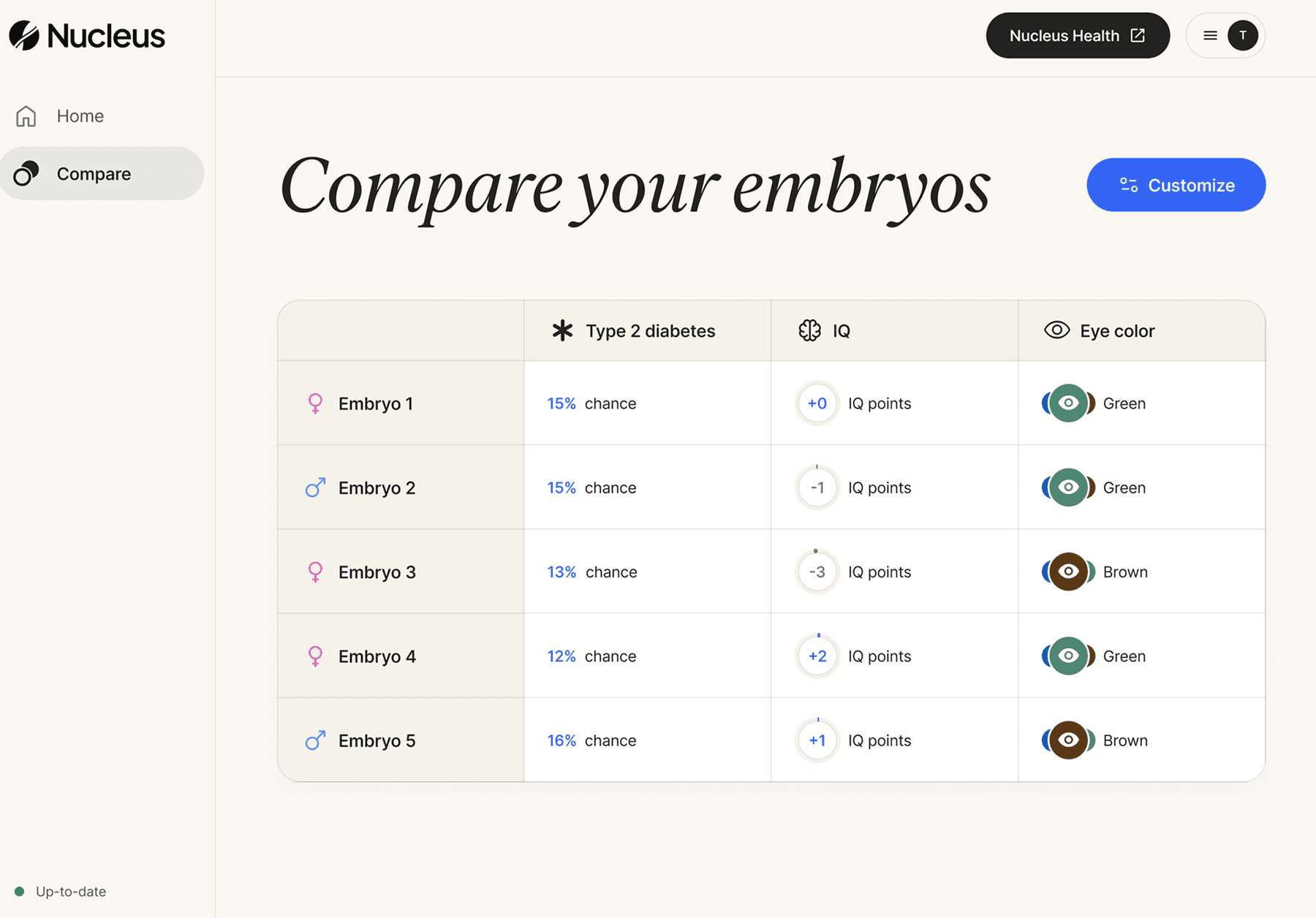
Understanding predisposition: Risk scores for autism and similar neurodevelopmental conditions let you compare embryos based on a broader set of genetic health factors, along with the standard morphological grading.
Making informed choices: PGT-P provides a detailed genetic report, so you can work with a genetic counselor to make informed decisions that align with your family planning goals.
While PGT-P is a significant advancement in predictive screening, it’s crucial to understand that it’s not a definitive diagnosis. These tests offer probabilities, not certainties. No test can offer a 100% accurate prediction for complex traits, such as ASD.
This type of screening should be a part of a comprehensive, holistic strategy. It’s most useful in combination with standard embryo viability assessments under the guidance of a medical team.
Nucleus can make sure you gain access to these advanced genetic insights and expert guidance necessary to understand them through an integrated, all-inclusive, and personalized IVF care package.
Nucleus IVF+: A redefined journey to parenthood
Going through IVF can be overwhelming, especially when faced with complex decisions. Nucleus IVF+ was created to change that. It’s the first all-inclusive IVF platform built for genetic optimization. It’s designed to give you unprecedented insight, control, and support on your journey to start a healthy family.

Nucleus IVF+ offers comprehensive, concierge-level IVF service for parents who want to use the most advanced genetic insights available to give their child the best possible start in life. It integrates world-class clinical treatment with cutting-edge genetic diagnostics and unlimited human expert support, all within a single, seamless experience.
Here’s what you get with the Nucleus IVF+ platform:
Access to a network of top-vetted IVF clinics so that you can connect with the right organization based on your needs and location
One full IVF cycle treatment package that includes full clinical cycle: consultation, medications, ovarian stimulation, egg retrieval, sperm collection, fertilization, and embryology
Comprehensive genetic screening for over 2,000 hereditary conditions with Nucleus Preview, so you can understand your health and prevent the transmission of known genetic risks
Genetic health screening with insights into your health and risk factors, and actionable tips to preserve your health
Donor selection for parents using donor eggs or sperm, so you find a genetically compatible donor, ensuring the best possible match for your family’s goals
IVF advanced embryo analysis and enhanced selection through a proprietary Nucleus platform that allows you to compare up to 20 embryos based on nearly 2,000 health conditions and traits
Expert-guided decision-making and unlimited support from genetic counselors to help you understand your results and make confident, informed choices
Carefully selected embryos that increase your chances of a successful pregnancy by 20%
Why choose Nucleus IVF+
Nucleus believes in empowerment; equipping you with knowledge and choice to make the decisions that are right for your family’s future.
The service was founded on a core set of beliefs:
Your agency is key: Every decision made during IVF is deeply personal. Nucleus provides science and clarity but trusts you to decide what’s best for your family’s well-being.
Science should serve parents, not only providers: Nucleus reports in clear, understandable language, without complex scientific jargon.
Look beyond viability: Reproductive care should be about more than a successful birth. It should be about nurturing a lifetime of health.
Scientific rigor should go hand in hand with human care: Nucleus technology is based on validated, peer-reviewed research, but the approach is always human, supportive, and personalized.
Nucleus IVF+ is excellent for any parent who dreams of a healthy child and wants the peace of mind that comes from having the most information, the best technology, and unwavering support every step of the way.

If you’re ready to explore Nucleus’ all-inclusive IVF package, schedule a call with our team to discuss your goals and logistics and get answers to any questions you may have.
You may also like…
Featured image source: Alexander Grey