

If you’re researching IVF success rates in New York, you’ve likely noticed that the numbers vary from one clinic to another.
Some centers report higher live birth rates or shorter time to pregnancy, while others emphasize their expertise in treating complex cases. We’ll help you understand how each clinic defines and measures success to make sense of their data and find the right team for you.
What are IVF success rates in New York?
IVF clinic success rates in New York range from 19.4% to 68.5% per IVF cycle for women under 35, depending on the clinic. That’s nearly a 50-point difference between providers.
The variation can be explained in two ways:
How a particular clinic reports its success rates
What factors influence New York City IVF success rates

Source: Arina Krasnikova
Bonus read: Compare New York IVF outcomes with San Francisco IVF success rates.
How New York City IVF success rates are reported
Most clinics report success as the percentage of IVF cycles that result in a live birth, but there are several ways to present this data:
Per intended retrieval: Success is based on one egg retrieval cycle, regardless of the number of embryo transfers that result from it. This piece of information provides a realistic representation of your overall chances of conceiving a baby from a single stimulation.
Per transfer: Success is based on the number of cycles where an embryo was actually transferred. It can appear higher because it excludes cancelled or unsuccessful retrievals.
Cumulative success rate: Measures the chance of a live birth after using all embryos from a single retrieval, fresh or frozen. It gives the most comprehensive view of success per cycle.
Because reporting methods differ, comparing clinics by headline numbers alone can be misleading. A clinic with a slightly lower percentage may actually have stronger outcomes for your specific profile, especially if it works with older parents or those with complex fertility histories.
Many clinics also report pregnancy rates, which can be defined in two ways:
Positive pregnancy test: An elevated hCG level after embryo transfer is an early indicator, but it doesn’t always lead to a viable pregnancy.
Clinical pregnancy: The pregnancy is confirmed by ultrasound, and a heartbeat is detected. It’s a huge success, but there’s still a risk of pregnancy loss.
What factors influence IVF success rates in New York
New York City’s IVF clinics vary in patient demographics and size, treatment protocols, and specialization. Some factors that can impact a cycle's success include:
Age and egg quality: As success rates gradually decline after the mid-30s and more sharply after 40, age is the primary predictor of IVF success. Many fertility clinics in New York specialize in advanced maternal age and offer tailored protocols, egg banking, or donor options to improve outcomes.
Diagnosis and treatment history: Endometriosis, diminished ovarian reserve, PMOS (formerly known as PCOS), and male factor infertility all impact success. Some centers have dedicated specialists for such conditions, offering tailored treatments to improve your chances.
Embryology lab expertise: In a city known for medical innovation, lab quality is a major differentiator. Clinics with on-site, state-of-the-art embryology labs that use technologies like time-lapse incubators and AI embryo selection tend to achieve consistent results.
Treatment type and technology used: Success can depend on whether fresh or frozen transfers are performed, own/donor eggs are used, or genetic testing is done. Advanced genetic screening and cryopreservation methods can improve the accuracy of embryo selection based on viability.
Patient population and case complexity: Many New York clinics work with patients with complex fertility backgrounds, those who may have failed cycles elsewhere or who are pursuing IVF after cancer treatment. These cases can lower reported success rates but reflect inclusivity rather than poor performance.
Lifestyle and support systems: The demands of living in a city like NYC, such as longer commutes, high stress, and limited downtime, can play a subtle role. Access to holistic support that involves nutrition guidance, mental health support, and fertility coaching can improve IVF outcomes.

Source: Karola G.
Bonus read: Understand New York’s fertility treatment landscape through our guides to:
Clinics with the best IVF success rates in New York
NYC has numerous fertility clinics, from renowned academic hospitals to boutique IVF clinics, each reporting different levels of success. To help you get a clearer idea of IVF success rates in New York, check out singleton delivery data per intended retrieval from clinics across these three boroughs:
Brooklyn
Queens
Manhattan
1. IVF success rates in Brooklyn clinics
Brooklyn has become a thriving hub of fertility care, offering a mix of nationally recognized IVF centers and newer clinics that prioritize accessibility and patient-centered support. The area’s clinics show strong outcomes:
Clinic | Under 35 | Ages 35 to 37 | Ages 38 to 40 | Over 40 |
|---|---|---|---|---|
Kofinas Fertility Group | 58.5% | 47.7% | 23.5% | 11% |
RMA of New York | 52.1% | 42.5% | 31% | 12.2% |
Genesis Fertility and Reproductive Medicine | 43.9% | 29.3% | 18.5% | 4.5% |
NYU Langone Fertility Center | 48.4% | 38.3% | 27.6% | 13.8% |
2. Queens IVF success rates
In Queens, only the New York Fertility Center currently reports detailed success rates to the CDC (As the primary reporting clinic site). Its outcomes are lower compared to some larger programs, but it’s an accessible local option and has excellent patient reviews.
The clinic also has an office in Manhattan, and according to Google reviews, patients feel heard and supported every step of the way.
Here are The New York Fertility Center’s singleton live birth deliveries per intended retrieval:
Under 35 | Ages 35 to 37 | Ages 38 to 40 | Over 40 |
|---|---|---|---|
19.1% | 15.3% | 7.4% | 1.9% |
3. IVF success rates in Manhattan clinics
Some of the most well-known fertility networks operate in Manhattan, offering advanced technology, specialized protocols, and extensive donor and genetic testing options.
Clinic | Under 35 | Ages 35 to 37 | Ages 38 to 40 | Over 40 |
|---|---|---|---|---|
CCRM New York | 39.1% | 30.7% | 26.4% | 9.2% |
Global Fertility and Genetics | 38.7% | 53.8% | 20% | 8.1% |
Generation Next Fertility | 23.8% | 6.6% | 16.4% | 1.3% |
Columbia University Fertility Center | 48.6% | 35.6% | 24.1% | 5.9% |
Extend Fertility | 45% | 22.9% | 18.2% | 10.4% |
Shady Grove Fertility New York | 49.6% | 30% | 15.8% | 7.1% |
Northwell Health Fertility NYC | 51.6% | 31% | 21.4% | 11.4% |
Weill Cornell Medicine | 43.5% | 32.1% | 22% | 7.2% |
Kindbody New York | 52.6% | 37.5% | 23.6% | 13% |

Source: Jonathan Borba
Bonus read: Explore some of the largest IVF service networks in the U.S.:
How to compare NYC fertility clinics' success rates
To compare New York fertility clinics fairly, look at the numbers that apply to your age group. Ask your clinic these questions:
Under 35: Clinics often report higher IVF success rates because of better egg quality. Ask what live birth rate per egg retrieval is for your age, and what percentage of parents achieve a live birth after one complete cycle in your age group.
35 to 40: Outcomes depend heavily on ovarian response and embryo testing. Ask what treatment protocols the clinic recommends for your diagnosis, whether PGT-A screening is available, what the approach is if your ovarian reserve is lower than expected, and whether the clinic reports all cycles, including those that didn’t reach retrieval or transfer.
Over 40 or using donor eggs: Look at per transfer success rates rather than per retrieval. Donor egg age is what matters most. Ask what live birth rate per embryo transfer is for parents using donor eggs, how donor screening is performed, and the average age of donors in the program.
If it’s your first cycle, focus on cumulative success rates, namely, how many live births result from one complete stimulation cycle, including all embryo transfers. You should also check if the clinic prioritizes single embryo transfers to minimize the risk of multiple births.
Remember that a single high percentage doesn’t mean much without context. Clinics that perform hundreds of cycles a year have more reliable patterns. It’s important to consider year-over-year consistency that attests to stable lab performance and experienced staff.

Source: Vidal Balielo Jr.
Evaluating IVF services across multiple considerations can be draining, especially when decisions need to be made quickly. You can benefit from professional guidance to find a clinic with a proven track record that fits your needs and goals.
Nucleus IVF+ can help you make sense of all variables and connect with a compatible clinic for your situation. From the first consultation to embryo selection, Nucleus provides personalized insights and one-on-one support for care and coordination at every IVF stage.
Nucleus IVF+: Improve your chances of success with advanced genetic science and personalized care
Nucleus IVF+ combines scattered aspects of your IVF treatment into a seamless, cohesive experience. It’s also the first all-in-one IVF program with genetic optimization and human-centered care.
Here’s what you get:
Clinic matching: Receive personalized recommendations tailored to your medical history, age, and fertility goals. Nucleus’s proprietary methodology analyzes clinic performance data and patient outcomes to help you find the best fit.
Donor support: Tap into credible donor networks and find genetically compatible options.
Cycle planning and guidance: Work with fertility experts who help you understand timelines, medication protocols, and testing options (eligible costs covered by the program), so you never feel lost or rushed in the process.
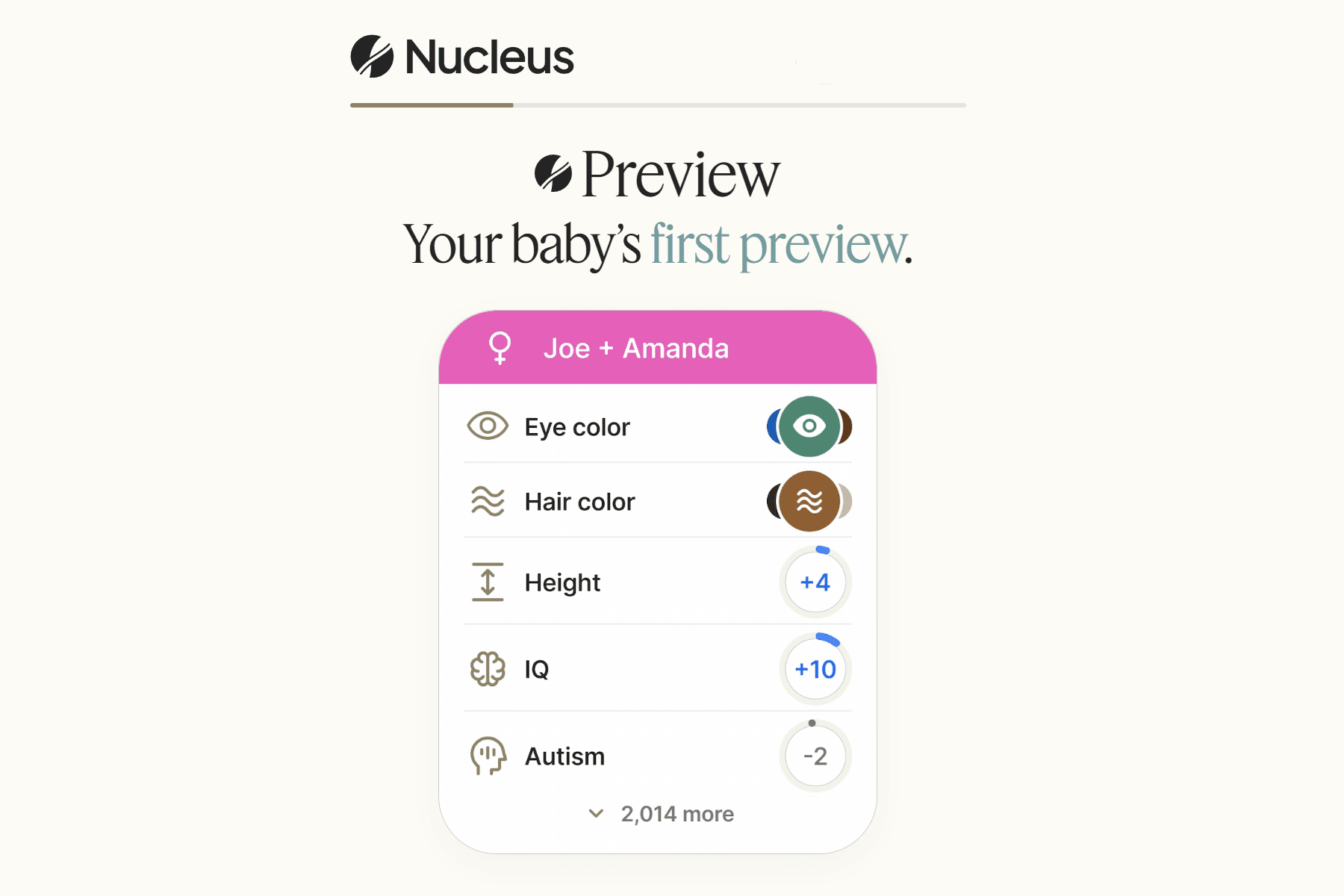
Genetic insights: Go through parental carrier screening with Nucleus Preview and screen embryos with the latest technologies.
Access advanced genetic interpretation software powered by Nucleus Embryo. Get interactive reports that translate complex genetic testing results into long-term health and well-being traits, helping you and make informed embryo selection decisions.
Concierge-like support: Receive dedicated ongoing support, including genetic counseling, physician consultations, well-being resources, financial navigation, and clear explanations of every test, procedure, and result.
Book a call to start your fertility journey with Nucleus.
Featured image source: Anna Shvets