
9 in 10
parents are carriers for a genetic condition¹

2.8 million
children in the US have a genetic condition²

2 in 3
couples are likely to have children at higher risk for at least one common disease³
Discover a more complete view
of your future child
One cheek swab.
[NUM_CONDITIONS_SCREENED]+ screenings.
And more
Genetic diseases, conditions, traits
Learn more from the Nucleus team



Is Preview
right for you?

check
check
check
check
Helping couples plan their family, earlier


We feature a mix of creators, some may receive free or discounted Nucleus services, compensation, or other benefits, while others are sharing their experience on their own. Their stories and opinions are their own.

FSA/HSA eligible
Preview your
future child

Nucleus Preview
check
2 DNA kits (for you and yours)
check
Sync partner results
[PRICE.KIT_AND_MEMBERSHIP.TWO]
[PRICE.KIT_AND_MEMBERSHIP.TWO_NO_DISCOUNT]
What is Nucleus Preview?
add
Nucleus Preview is an advanced preconception genetic test, designed for couples. Through a simple cheek swab, it looks at 2,000+ conditions and traits that you could pass on to your future child, including cancers, heart disease, diabetes, eye color, and IQ.
It provides a broader view than traditional genetic tests, helping you understand and plan earlier with more information.
What genetic insights will Preview give me?
add
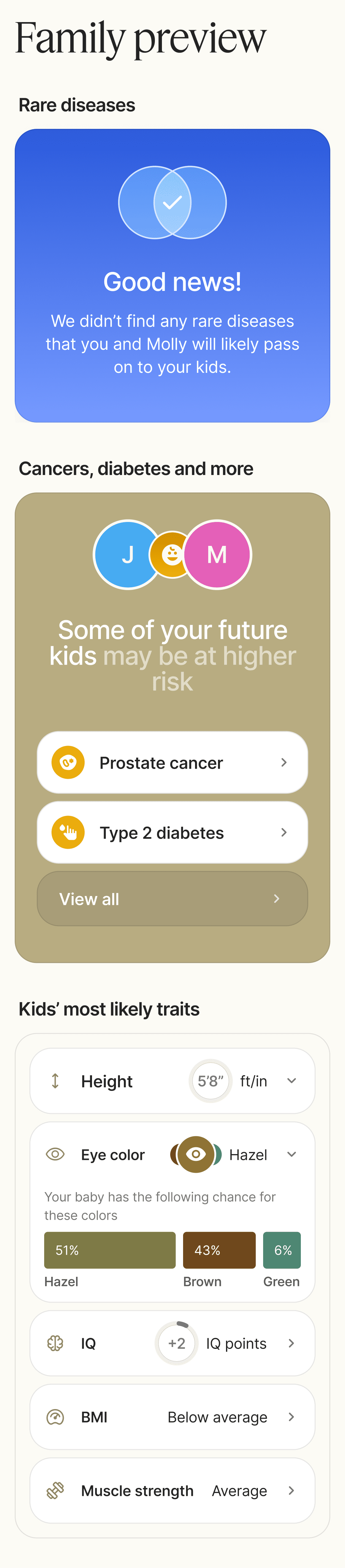
Preview helps you understand what your future child could inherit, including:
Rare inherited conditions, like cystic fibrosis and spinal muscular atrophy (SMA)
Risk for common conditions, like heart disease and Alzheimer’s disease
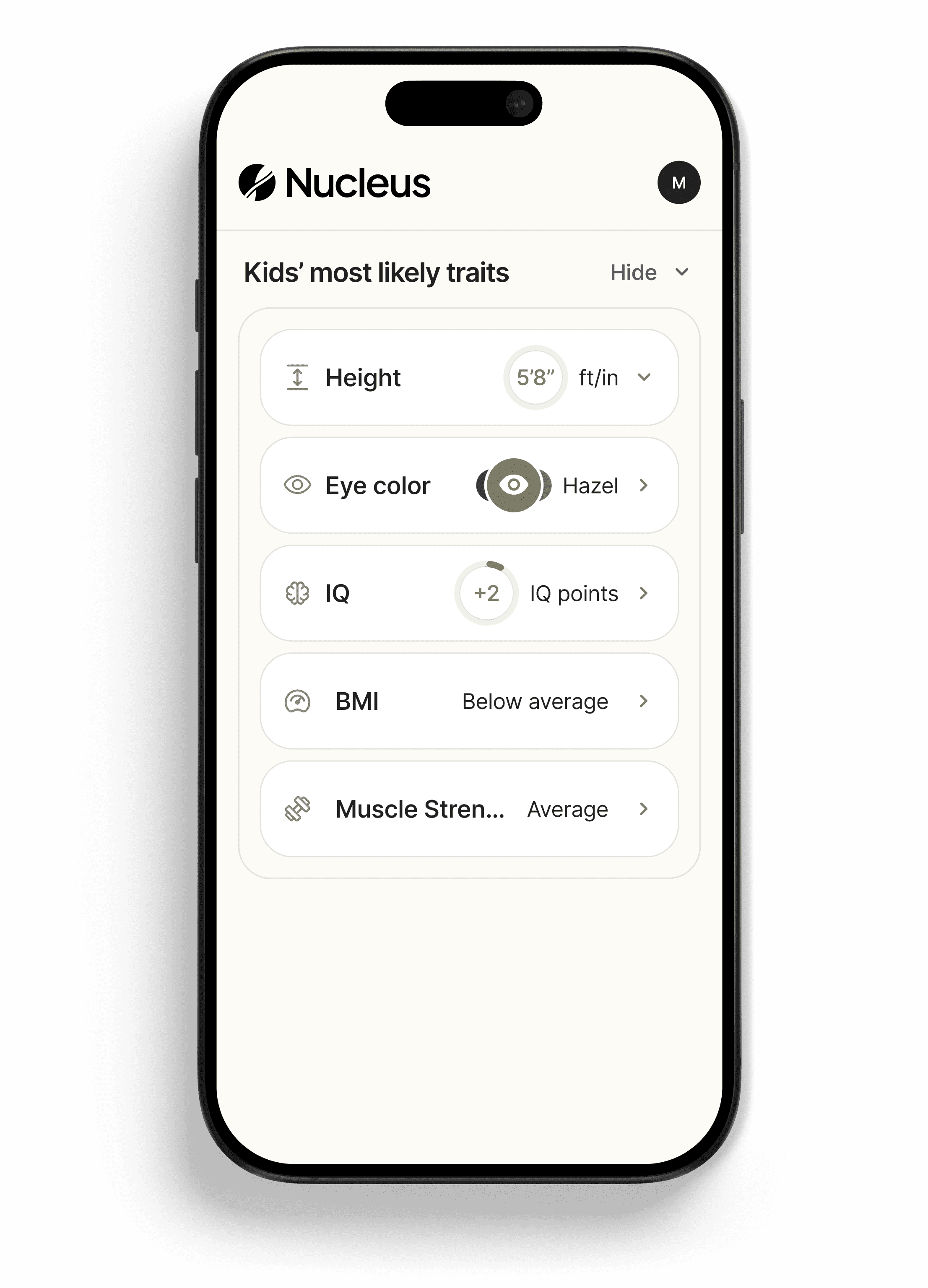
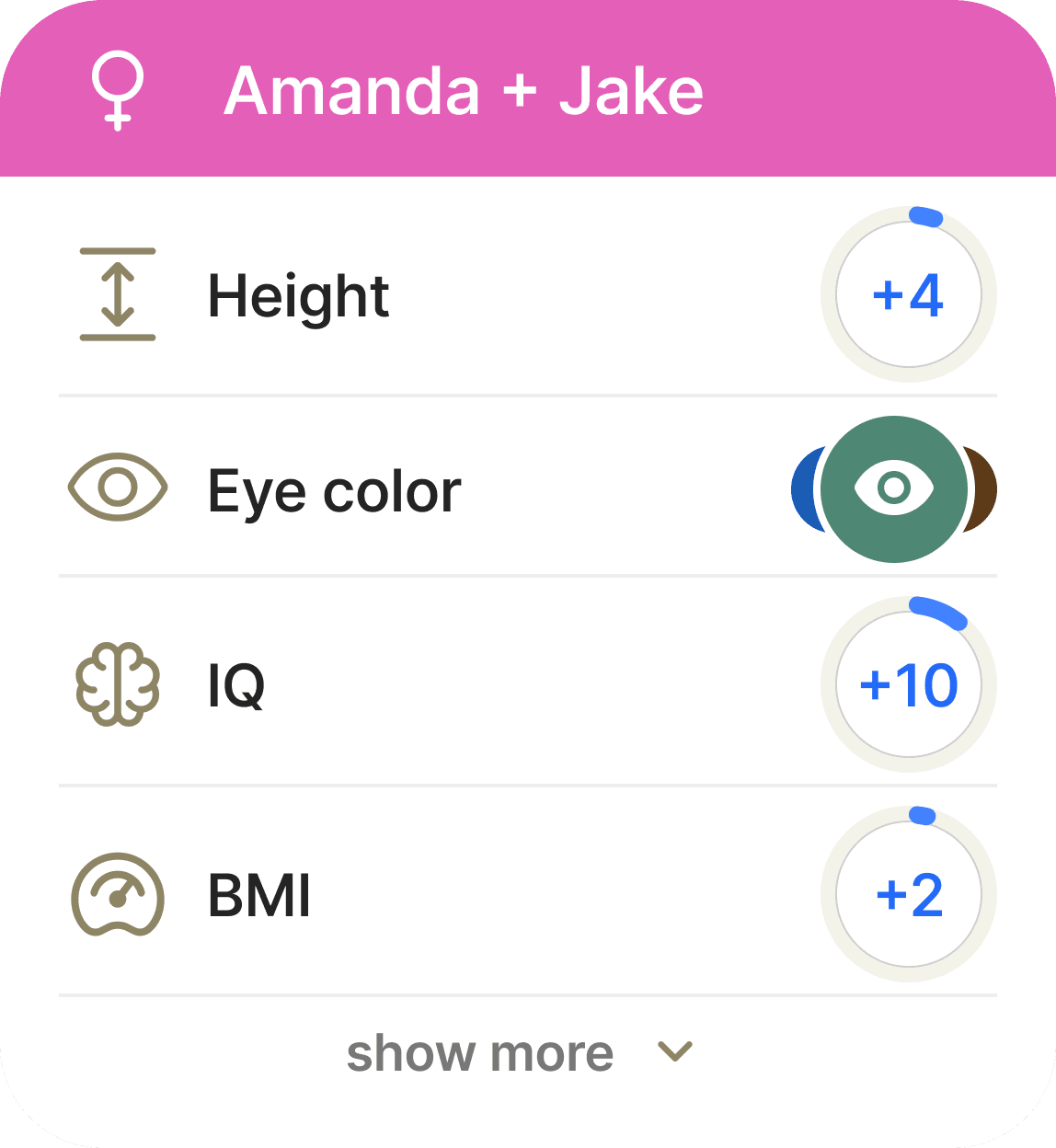
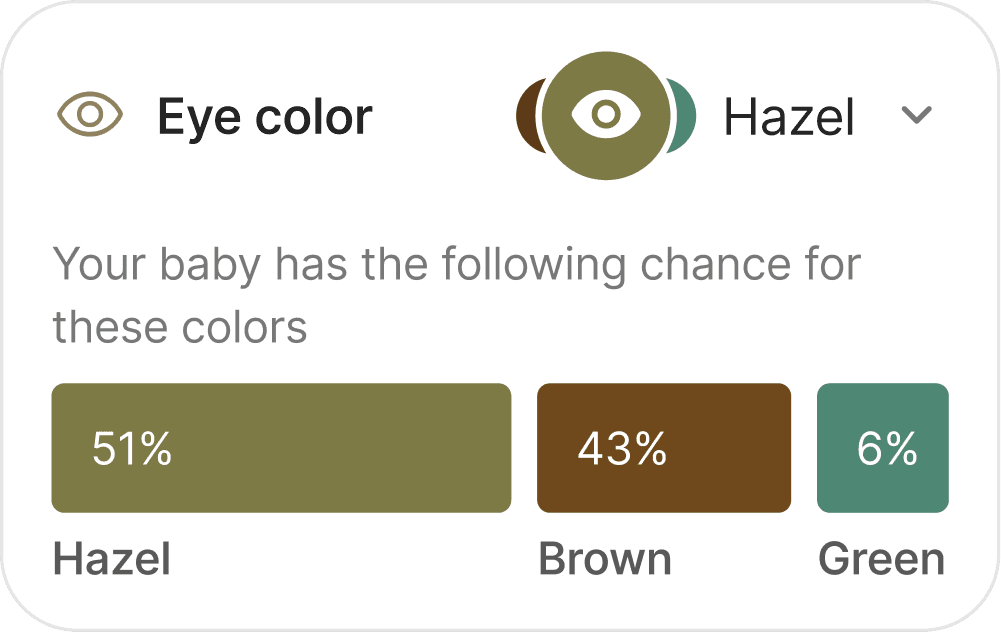
Traits, like height, eye color, and IQ
You’ll also receive insights into your own health.
How is Preview different from what's offered in clinics?
add
Preview gives you a broader look at what your future child could inherit, screening 2,000+ diseases, conditions, and traits. It’s directly available to prospective parents, but it’s also a clinical-grade genetic test that’s already used in many IVF clinics too.
Most traditional preconception genetic tests (often called carrier screening) focus on a defined set of serious single-gene conditions and diseases that both parents are carriers for. That matters, but it doesn’t reflect the full range of questions many parents have today. Many significant conditions like hereditary breast and ovarian cancer (HBOC) and Lynch syndrome have a 50% chance of being passed on, even if only one parent has it.
Preview includes that rare disease screening focused on both partners and expands beyond it.
It estimates likelihood for common health risks that either parent could be a carrier for like cancer, diabetes, and heart disease, along with likely traits such as eye color, height, and IQ.
How can Preview tell me about things like diabetes or cancer?
add
Preview looks at your DNA to understand genetic patterns linked to common conditions like diabetes, heart disease, and many cancers.
Unlike rare diseases that are caused by a single gene, most common health conditions are influenced by many genes working together. So instead of searching for one rare mutation, Preview looks at lots of small genetic factors that, together, shape likelihood.
How can Preview estimate traits like IQ and height?
add
Traits like height, IQ, and eye color aren’t determined by a single gene. They’re shaped by many genes working together. Preview analyzes how those genes combine in you and your partner to estimate what’s more or less likely in a future child.
Will this tell me if my child will definitely have a health condition or trait?
add
Not exactly, it depends on the type of condition.
For many rare, single-gene conditions (like cystic fibrosis), genetics can give a very clear answer. If both parents are carriers, there is a known probability (for example, a 1 in 4 chance) that a child will have the condition.
For more common conditions and traits, like heart disease, diabetes, height, or IQ, the results reflect likelihood, not certainty. These are influenced by many genes working together, as well as environment and lifestyle over time.
Nucleus Preview brings both together: clear insight where genetics is decisive, and probabilistic insight where risk is shaped by many factors.
Do I need a partner to do Preview?
add
It helps, but you don’t have to. You can do Preview on your own to understand what you might pass on. If a partner tests too (even later on), you can easily pair your results and see the combined genetic picture, which is the most complete view.
If you’re looking for individual insights, visit: https://mynucleus.com/health/shop
Do I have to be doing IVF to do Preview?
add
Not at all. Many couples do Preview as their first step in family planning, whether IVF is already in the cards for them, or they’re hoping to conceive naturally. The goal is to get more information at the earliest point, so you can take steps to reduce risk and make decisions that support your future child’s long-term health.
Is Preview available to order internationally?
add
Shipping is available for certain Nucleus products to the United States, Canada, the Czech Republic, Germany, India, Ireland, Italy, New Zealand, Switzerland, the United Arab Emirates, and the United Kingdom.
If you live outside of these countries and want to be notified when we ship to more countries, join the waitlist here.

The New England Journal of Medicine. Nationwide, Couple-Based Genetic Carrier Screening
Lichstein J, Riley C, Keehn A, Lyon M, Maiese D, Sarkar D, Scott J. Children with genetic conditions in the United States: Prevalence estimates from the 2016-2017 National Survey of Children's Health. Genet Med. 2022. Epub 2021 Nov 30. PMID: 34906507.
Percent calculated based on parents together being at above average risk for at least one of 15 common diseases.