

For the millions of couples and individuals considering IVF, the most burning question is also the most complex one: How successful is IVF?
IVF outcome might seem easy to measure; you either have a baby at the end, or you don’t. But success can be defined in various ways. Clinics present their numbers differently, and individual factors like age, embryo quality, and overall health can dramatically shift the odds.
It’s easy to get overwhelmed by statistics that may not reflect your personal situation. That’s why understanding what the stats really mean allows you to ask the right questions during your first appointment with a fertility clinic, set realistic expectations, and create a personalized path forward. It also helps you increase your chances in IVF.
What counts as success in IVF?
When people talk about IVF success, they don’t always refer to the same thing. Clinics, studies, and parents may use different benchmarks, including:
Biochemical pregnancy: A positive pregnancy test based on hCG hormone levels, usually measured around two weeks after transfer. Not all biochemical pregnancies progress further.
Clinical pregnancy: A pregnancy confirmed by ultrasound (usually around 6–7 weeks after transfer), showing a gestational sac or fetal heartbeat. While it is a major milestone, not all clinical pregnancies end in live birth.
Live birth: The birth of a living baby is the ultimate measure of IVF success and the outcome that matters most to parents.
Live births are the optimal way to define IVF success because they are the desired result of any couple or person undergoing in vitro fertilization. Other metrics, such as higher pregnancy rates, are still encouraging and used to track progress.

Source: Pixabay
Cumulative live birth rate per retrieval: The key metric to watch
The cumulative live birth rate per retrieval is the most useful information for parents because it represents their chances of having at least one live birth from all the embryos created during a single egg retrieval cycle, including both fresh and frozen transfers.
A single retrieval can produce multiple embryos, so even if the first transfer is unsuccessful, subsequent frozen embryo transfers can lead to success. Looking only at the per-transfer success rate underestimates the true odds. The cumulative rate paints a more realistic, and usually more encouraging, picture.
If you look at IVF success rates shared in national databases like CDC or Society for Assisted Reproductive Technology (SART) reports, you’ll find that they reflect averages across all reporting clinics, from the most advanced to those with lower performance. These numbers provide a general perspective, but your personal chance depends on your specific clinic, treatment, and unique biology.
Some clinics might also be selective regarding patients, choosing only to work with younger couples. That can significantly boost their success rates. Others may specialize in older patients (women above 40), which might reduce their overall success rates, even though the clinics may perform remarkably well for that age group.
What is the IVF success rate? Top 6 metrics
According to CDC data, there were 435,426 cycles in U.S. clinics in 2022. These resulted in 94,039 live birth deliveries. To help you understand IVF success rates per cycle and get a clearer picture of typical ranges, let’s look at statistics organized by key metrics:
IVF success rates per cycle by age
IVF success rates by age with mother’s eggs vs. donor eggs
IVF embryo transfer success rate
Fresh vs. frozen embryo transfer success rates
Single vs. multiple embryo transfer success rate
Outcomes of clinical pregnancies resulting from IVF
1. IVF success rates per cycle by age
IVF success rates by age count every cycle started and examine how often they result in a live birth.
Below are the most recent numbers from CDC data for the year 2022:
Parent age group | Live births |
|---|---|
Under 35 | 42.8% |
35–37 | 39.9% |
38–40 | 34.9% |
Over 40 | 27.7% |
All ages | 37.5% |
The drop in IVF success increases with age. These statistics include patients who used donor eggs (predominantly older patients), so the use of higher-quality eggs may influence the higher success rates in these groups.
2. IVF success rates by age with mother’s eggs vs. donor eggs
Cycles using a mother’s eggs show a clear age-related decline in success, since egg quality and chromosomal health decrease over time.
Cycles using donor eggs or embryos tend to have consistently higher and more stable success rates across all age categories because donors are typically in their 20s and early 30s, a time of peak fertility. They are also carefully screened for health and fertility factors.
This contrast shows why IVF with donor eggs can be an excellent option for parents in their late 30s and 40s who face lower success rates with their own eggs.
Here’s what the statistics show:
Age | IVF with own eggs or embryos | IVF with donor eggs or embryos |
|---|---|---|
Under 30 | 43.6% | 41.3% |
30 | 43.3% | 45.6% |
31 | 43.1% | 40.3% |
32 | 43.1% | 42.4% |
33 | 42.3% | 45.4% |
34 | 41.7% | 44.5% |
35 | 40.8% | 41.1% |
36 | 39.8% | 41.9% |
37 | 38.8% | 39.6% |
38 | 36.4% | 43% |
39 | 43.2% | 40.7% |
40 | 31.6% | 41.4% |
41 | 28.3% | 41.2% |
42 | 24.6% | 41.7% |
43 | 20.2% | 39% |
44 | 15.8% | 37.7% |
45 | 13.8% | 37.8% |
Over 45 | 10.4% | 37% |
3. IVF embryo transfer success rate
Embryo transfer outcomes are measured not only by whether a live birth occurred, but also by whether the birth involved a singleton, twins, triplets, or more. While multiple births were once a common outcome of IVF, that has changed dramatically in recent years.

Source: Greta Fotografía
The shift primarily comes from the growing adoption of single embryo transfer (SET). By transferring only one carefully selected embryo at a time, clinics have reduced the risk of multiple-fetus pregnancies. It’s a significant step forward because carrying twins or higher-order multiples increases the chances of complications, such as:
Preterm delivery
Low birth weight
Maternal health risks
The table below shows embryo transfer cycles that resulted in live-birth delivery of singletons, twins, and triplets or more over a period of ten years up to 2022:
Year | Singletons | Twins | Triplets or more |
|---|---|---|---|
2013 | 25% | 7.9% | 0.3% |
2014 | 25.7% | 7.1% | 0.2% |
2015 | 26.2% | 6.3% | 0.2% |
2016 | 28.1% | 5.3% | 0.1% |
2017 | 30.5% | 4.5% | 0.1% |
2018 | 32.6% | 3.6% | 0.1% |
2019 | 34.4% | 2.8% | 0.1% |
2020 | 34.5% | 2.4% | 0% |
2021 | 35.2% | 2.1% | 0% |
2022 | 35.8% | 1.7% | 0% |
4. Fresh vs. frozen embryo transfer success rates
Clinics may recommend either a fresh embryo transfer (ET), performed immediately after egg retrieval, or a frozen embryo transfer (FET), where embryos are frozen and transferred in a subsequent menstrual cycle.
The advantage of an FET is that it offers flexibility, letting the mother rest after ovarian stimulation and prepare the endometrial lining better for implantation. It also allows time to screen embryos for:
Chromosomal abnormalities (PGT-A and PGT-SR)
Inherited genetic disorders or PGT-M, if both parents are confirmed carriers of conditions like cystic fibrosis, hemophilia, or muscular dystrophy
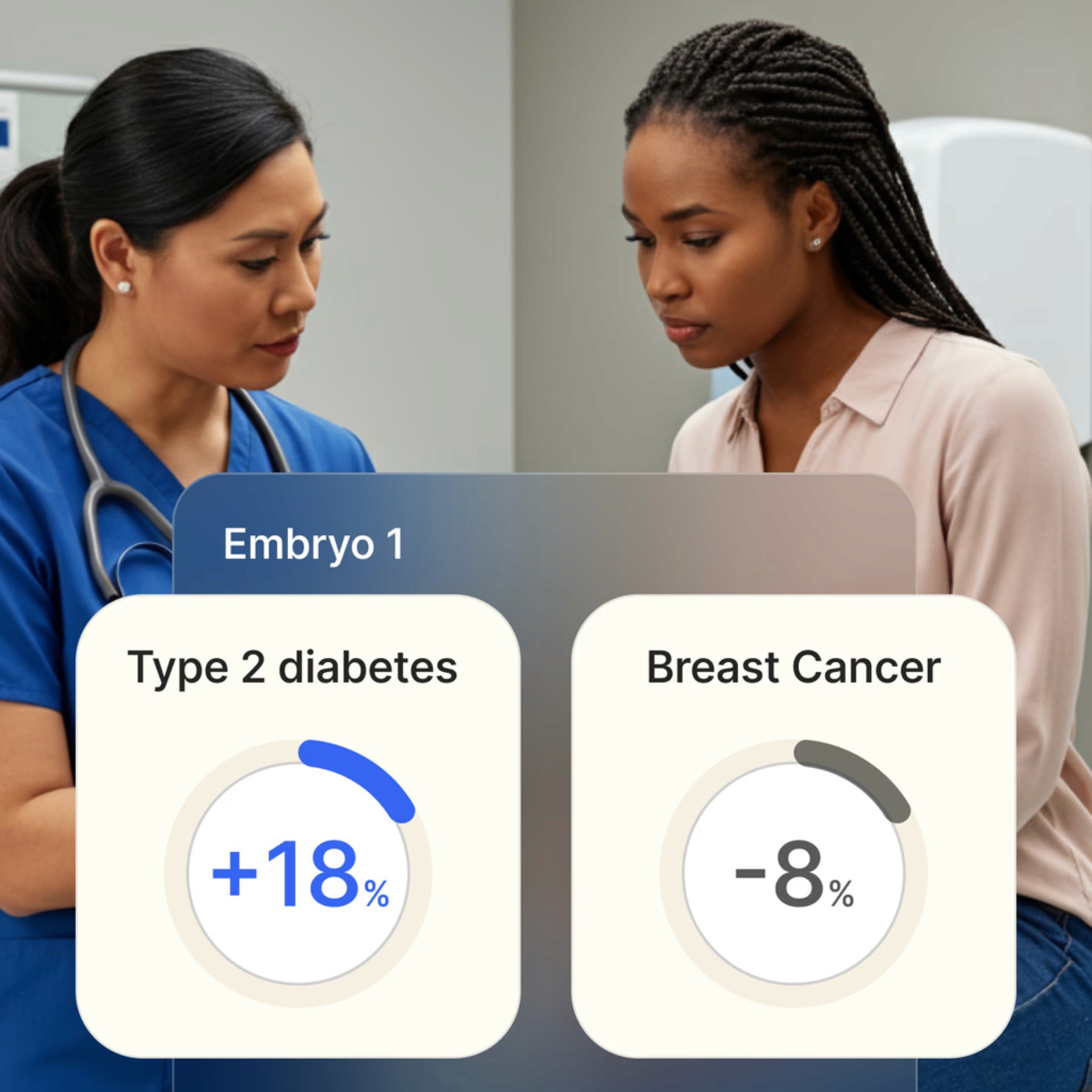
Risk of late-onset chronic conditions such as diabetes and heart disease via PGT-P
Genetic testing in IVF helps select the strongest embryo for transfer, increasing the chances of success, which is why FET may have higher success rates.
Some studies have found that women aged 36–42 who used frozen embryos with comprehensive chromosomal screening had a live birth rate of 74.5%, compared to 53.7% for fresh transfers. Miscarriage rates were also lower, at 2.8% compared to 18.5%.
Still, a large study of first blastocyst transfers without PGT-A showed comparable live birth, clinical pregnancy, and miscarriage rates between fresh and frozen transfers, when accounting for:
Age
BMI
Ovarian reserve
Basal follicle-stimulating hormone levels
Progesterone levels
Estradiol levels
Number of eggs retrieved
Primary diagnosis
Another study of nearly 83,000 IVF patients found that high responders to stimulation (mothers who produced 15 or more eggs) may benefit from frozen transfers. By giving the uterus time to return to a stable state, it helps avoid hormone-related uterine receptivity issues (high estrogen and progesterone levels) and lowers the risk of ovarian hyperstimulation syndrome.
While fresh can still be effective for some low to intermediate responders (those who produce fewer eggs), many clinics now favor frozen transfer as it allows the flexibility to conduct advanced embryo testing such as PGT (preimplantation genetic testing), which potentially improves success rates.

Source: Yan Krukau
5. Single vs. multiple embryo transfer success rate
Transferring multiple embryos may seem like it would increase the chance of pregnancy, but research shows that elective single-embryo transfer (eSET) is often the safest and most effective strategy.
A 2023 study comparing 564 women who underwent eSET and 3,668 who underwent double-embryo transfer (DET) found:
Live birth rate for fresh eSET was 41.3%
Live birth rate for DET was 32.6%
Sequential eSET (fresh + thaw after failed first eSET) cumulative live birth rate was 47.9%
The odds of achieving a live birth were 24% lower for DET compared to sequential eSET.
6. Outcomes of clinical pregnancies resulting from IVF
Not every clinical pregnancy achieved through IVF results in a live birth. Two of the main risks are miscarriage and stillbirth, which are defined by pregnancy loss time:
Miscarriage or spontaneous abortion is the loss of an embryo or fetus before 20 weeks of gestation.
Stillbirth or fetal death is a pregnancy loss that occurs at 20 weeks or later.
Tracking these outcomes provides a clearer picture of how successful IVF is beyond initial pregnancy rates.
According to CDC data from 2022, here’s how IVF pregnancies progressed, whether they resulted in singleton or multiple live births, or ended in pregnancy loss:
Outcomes | Number of pregnancies | Percentages |
|---|---|---|
Singleton live births | 89,850 | 78.1% |
Multiple live births | 4,189 | 3.6% |
Miscarriage | 17,673 | 15.4% |
Stillbirth | 572 | 0.5% |
Other/unknown | 2,811 | 2.4% |
How many rounds of IVF does it take to get pregnant?
The answer to this question is highly individual. Some patients achieve success on the first try, while others need multiple attempts. On average, two to three cycles can be quite normal.

Source: RDNE stock project
Looking at the data by age group for 2022 provided by the SART, you can see how live birth rates shift across the first, second, and additional frozen transfers:
Age of the mother | First transfer | Second transfer | Additional transfers |
|---|---|---|---|
Under 35 | 39.4% | 45.8% | 48.2% |
35–37 | 30.6% | 43.4% | 46.9% |
38–40 | 20.9% | 40.4% | 45% |
41–42 | 11.2% | 36.6% | 42.5% |
Over 42 | 3.9% | 25.5% | 35% |
How common is IVF?
IVF is no longer considered a rare or last resort treatment, and hundreds of thousands of cycles are performed every year. 2.6% of all children born in the U.S were conceived using assisted reproductive technology (ART) such as IVF (2022 data).
The reasons for pursuing IVF vary widely, from age-related infertility to male factor infertility or the need for PGT.
Younger women make up the largest group of IVF patients, but a significant number of women over 40 also pursue treatment:
Age group | ART cycles |
|---|---|
Under 35 | 36% |
35–37 | 23% |
38–40 | 21% |
41–42 | 10% |
Over 42 | 10% |
Below is an overview of the percentage of ART cycles by reason, according to the CDC report. Note that more than one reason can be reported per cycle, so the total percentage adds up to more than 100%:
Reason | Percentage |
|---|---|
Egg or embryo banking | 42.6% |
Male factor infertility | 28% |
Diminished ovarian reserve | 26.2% |
Other infertility reasons | 25.6% |
Preimplantation genetic testing | 18.3% |
Ovulatory issues | 13.9% |
Unexplained infertility | 10.6% |
Tubal issues | 10.2% |
Reasons unrelated to infertility | 7% |
Recurrent pregnancy loss | 6.8% |
Endometriosis | 6.3% |
Uterine issues | 6% |
Use of a gestational carrier | 1.5% |
How to increase the chances of IVF success
IVF outcomes depend on many factors, including age, egg and embryo quality, pregnancy and medical history, cause of infertility, sperm quality, and lifestyle. Still, there are steps you can take to improve your chances, such as:
Choosing the right clinic that suits your needs and reports metrics that matter to you
Undergoing preconception genetic screening to see whether you carry a genetic disorder you may unknowingly pass on to your child
Identifying healthy embryos with advanced genetic screening
Optimizing health before treatment by maintaining a healthy weight, limiting alcohol, avoiding smoking, and managing chronic conditions
Opting for single-embryo transfer to reduce the risk of multiple births
Preparing mentally by establishing a support system and setting realistic expectations
Selecting a genetically compatible donor (if you need donor egg or sperm)

Source: RDNE stock project
These steps can feel overwhelming to manage, so you can consider working with experts throughout the entire journey. Platforms like Nucleus offer a streamlined and less stressful way to IVF.
Nucleus IVF+ is an all-in-one IVF package with genetic optimization at its core, helping you navigate every stage of fertility treatment without confusion.
Boost your IVF chances with Nucleus IVF+
Nucleus IVF+ eliminates the guesswork, stress, and fragmentation associated with fertility care. Instead of managing multiple clinics, labs, and testing providers on your own, Nucleus brings every part of the IVF journey into one coordinated package, with compassionate guidance and advanced science on your side.
With Nucleus IVF+, you get a personalized experience and support from preconception through pregnancy and beyond with benefits like:
Clinic matching so you connect with a vetted partner clinic with proven success rates that fits your needs and treatment preferences
Expert guidance during every IVF step, helping you understand your options, review test results, and make confident decisions
Complete IVF cycle management that frees you from multitasking and coordinating procedures during this demanding period
Unlimited genetic counseling
Donor network paired with genetic compatibility screening to improve outcomes
Embryo screening and analysis that goes beyond viability, giving you the deepest possible data about your embryos’ long-term health potential
Whole-genome carrier screening for over 2,000 genetic conditions through Nucleus Preview to minimize the risk of passing on inherited conditions
Comprehensive health reports with actionable lifestyle and health insights to optimize fertility and long-term well-being
Baby DNA sequencing so that tailored healthcare and preventive care can begin from day one
Schedule an onboarding call and discover how Nucleus can support you, allowing you to focus on the most important task: becoming parents.
Featured image source: Polina Tankilevitch