

Traditional egg freezing before or during IVF is often perceived as costly, and egg donation as overly transactional.
Cofertility came into the spotlight with a different promise, aiming to make egg freezing more accessible and to reimagine egg donation through a human-first, community-driven approach that also prioritizes the needs of the donor conceived child. Cofertility has designed a program that gives women the option of freezing their eggs at no cost when they also donate to intended parents.
In this review, we’ll explore what Cofertility is, how its programs work, and what sets it apart from other services. We’ll also share our honest assessment of the benefits and limitations of this model and evaluate whether it truly delivers on its promise to make fertility options more equitable.
The Cofertility company: An overview
Cofertility calls itself a “human-first fertility ecosystem”, emphasizing education, accessibility, and community support alongside its core programs for egg freezing and donation. Even the name reflects this ethos with the prefix “co” highlighting the focus on building fertility options together, not in isolation.
The company was founded by Lauren Makler, Halle Tecco, and Arielle Spiegel, three women who each faced fertility challenges on their own paths to motherhood. Their pitch is driven by empathy: Cofertility is the service they wish had existed during their fertility journey.

Source: Cofertility
The leadership also highlights that the company is female-founded, female-led, and female-funded, which is still relatively rare in the fertility tech landscape.
Cofertility frames egg freezing as a tool for gender equality, emphasizes inclusivity, and explicitly supports LGBTQ+ families, while advocating for the rights of donor-conceived children. The company refuses to accept egg donation as a “one and done” concept, instead promising long-term support, including resources, guidance, and community features that extend beyond the initial egg donation or freezing process.
While Cofertility’s values-driven stance is refreshing, much of its identity is still rooted in mission statements and aspirations. Terms like “ecosystem,” “community,” and “lifetime of support” are promising, but whether this vision turns into a consistent, lived experience for every participant remains to be seen.
Founded in 2022, Cofertility is a young company that is still growing, and its outcomes will depend on practical execution as much as on ideals.
Cofertility review: 6 key areas to explore
Prospective donors, intended parents, or anyone curious about Cofertility should understand how the programs work in practice, who they serve best, and where their strengths and limitations lie.
To give you a clearer picture, we will examine Cofertility across the following key areas:
Programs and eligibility
Costs
Credibility, leadership, and social proof
Funding and growth
Cofertility’s stance on donor anonymity
Cofertility customer reviews
1. Cofertility programs and eligibility
Cofertility has two platforms supporting individuals and families across different phases of the fertility journey:
Family: For intended parents seeking egg donors
Freeze: For women looking to freeze and/or donate their eggs
Family: The Cofertility Egg Donor Matching Platform
Cofertility's egg donation program is centered on its egg sharing model. Unlike traditional donor arrangements, where women receive compensation directly for donating eggs, Cofertility's egg sharing program allows donors to freeze and keep retrieved eggs for their own future use when they also donate to a family that otherwise can’t conceive.
This approach appeals to donors who are motivated by personal and altruistic reasons, rather than financial compensation alone.

Source: Cofertility
Cofertility offers two options:
Fresh donation cycles: The donor undergoes medical screening and retrieval after being matched with your family, at a clinic of your choice.
Frozen egg donation: The donor completes the cycle at a Cofertility partner clinic before matching. Frozen eggs are then shipped to your clinic, making the process more flexible and sometimes faster.
The process is fairly transparent. You can browse donor profiles for free, review medical history and personality details, get a sense of which donors may reflect your own background and values, and formally match when ready.
The Cofertility egg donation program is a viable option for:
Couples struggling with infertility
Single fathers exploring IVF surrogacy
Cancer survivors
Women with age-related fertility issues
Freeze: Cofertility’s egg freezing solutions
Women considering egg freezing can choose between the following two programs:
Program | How it works |
|---|---|
Split | Freeze and store your eggs (for up to 10 years) for free when you also donate to a family in need. |
Keep | Freeze and keep all retrieved eggs for your own use. |
There are no stringent eligibility requirements for the Keep program, other than most clinics' rule that you must be under 40.
Eligibility for the split program is determined through an initial online application and subsequent medical screening that includes blood work, a vaginal ultrasound, and carrier screening, to understand what heritable conditions a donor may be a carrier for without awareness or symptoms.
Donors must generally:
Have both ovaries
Have a BMI under 30
Be in good overall physical and emotional health
Be 21–33 at time of application
Meet baseline ovarian reserve criteria (e.g., AMH above 2.0 ng/ml)
Be a non-smoker and abstain from recreational drugs

Source: Cofertility
2. Cofertility costs
Cofertility's pricing is refreshingly transparent, and an intended parent will never pay more to match with a donor of a specific heritage or education or because she’s donated before. But egg sharing doesn't make the process entirely free. Intended parents must still cover the costs of the donor's cycle.
A benefit of Cofertility is its Embryo Guarantee policy, which promises matching up to three times at no additional Cofertility fee, if your donor cycle doesn't produce a minimum number of blastocysts.
A fresh donation cycle, even without cash compensation, can be $40k+. Here's a simplified breakdown of all the costs when using Cofertility's egg sharing program for a fresh egg donation:
Cost category | Price | What’s included |
|---|---|---|
Match initiation fee | $500 |
|
Cofertility’s coordination fee | $10,000 |
|
Third-party expenses | Around $6,500 |
|
Clinic-dependent screening and retrieval | From $15,000 |
|
Embryo development | From $5,000 |
|
Second cycle with the same donor | $5,000 + medical and admin expenses |
|
In addition to these expenses, you would also be responsible for your donor's travel expenses if you ask them to cycle at your clinic, and they don’t live locally.
With frozen egg donation, pricing follows a per-egg model and that match cost is the all-in fee for the cohort of frozen eggs, including screening, cycle costs, and travel:
Number of eggs | Price per egg |
|---|---|
6–9 | $3,500 |
10–15 | $3,300 |
16+ | $3,100 |
3. Credibility, leadership, and social proof
Deep medical expertise, capable leadership, and meaningful backing are crucial for building trust in fertility services, and Cofertility primarily delivers in all three aspects.
Lauren Makler, the CEO and co-founder, previously launched Uber Health, which demonstrates her ability to scale complex healthcare logistics. She now brings the same rigor to fertility, drawing inspiration from her rare disease and personal journey with fertility.
Joining her are Halle Tecco, founder of Natalist and digital health fund Rock Health, board director at Resolve, and an adjunct professor at Columbia Business School, and Arielle Spiegel, whose early work on Cofertility began as a fertility education platform.
Behind the founders is a robust medical advisory board, featuring:
Reproductive endocrinologists
Fertility specialists
Psychologists
Genetic counselors
Embryologists
On the social proof front, Maria Sharapova brought visibility and validation to Cofertility when she became an investor in 2024.
4. Cofertility Series A funding and growth
Beyond Sharapova, Cofertility’s funding roster includes several prominent backers. In April 2025, the company announced a Series A funding round, led by Next Ventures and Offline Ventures, with additional support from leading investors with extensive experience in the healthcare and technology sectors:
Initialized Capital
Arkitekt Ventures
Foreground Capital
Gratitude Railroad
How Women Invest
Gaingles
Everywhere Ventures
This mix of backers is noteworthy, since Next Ventures, founded by former professional cyclist Lance Armstrong, has deep roots in health and wellness, and How Women Invest and Gaingles bring a focus on gender equity and inclusivity.

Source: Cofertility
This blend of capital and value-driven investments demonstrate that Cofertility isn’t only chasing scale but is also actively aligning itself with communities that want to see systemic change in how family-building is supported.
Having closed the Series A funding round, the company has raised $16 million; a notable achievement in women’s health, where funding has historically lagged behind other healthcare sectors. Cofertility promises to invest the money in:
Expanding and improving the platform
Growing its team
Strengthening clinic and partner relationships
Expanding advocacy and awareness efforts
5. Cofertility’s stance on donor anonymity and family limits
Cofertility has recognized the growing demand for transparency in egg donation, so they have moved from the model of traditional anonymous donation to offer different disclosure options to donors and intended parents:
Disclosed donation: Both parties exchange contact information and can communicate directly.
Undisclosed donation: Identifying information is not shared between the donor and intended parents, but communication can occur through Cofertility.
Open ID: The donor-conceived child can access identifying information about the donor when they reach a certain age.
Cofertility cautions against agencies or egg banks that promise complete anonymity, believing that such assurance is unrealistic due to the increasing availability of DNA testing. Transparency can be beneficial for donor-conceived children because it gives them the option to access information about their genetic background.
Even though the Open ID option honors the rights of donor-conceived children, it may create uncertainty for donors who initially expected less involvement. Similarly, intended parents who prefer minimal future contact with donors may feel conflicted about which disclosure option is best for their child in the long term.
In practice, these choices carry emotional weight for everyone involved, so it's best to discuss all options with your partner and seek professional help to find the optimal solution.
Cofertility is also the only egg bank to publish a limit on the number of Cofertility intended parents that can match with a given Cofertility donor. More specifically, they have a three family limit, which means that every donor can only support building up to 3 Cofertility families. Limiting biological half siblings is one of the biggest pieces of feedback from the donor conceived community, and the Cofertility program has focused on ways to address this critique.
6. Cofertility reviews by actual clients
Praise-worthy vision and mission statements aside, it's important to see how actual users (both donor and intended parents) experience the Cofertility platform.
Many intended parents share highly positive stories, praising the accessibility, open communication, and ethical framework of Cofertility. Several reported responsive support, including personal outreach from the CEO, and quick responses from member advocates.
Families highlight the platform's diverse donor database and the ability to connect with them, and many share successful IVF outcomes.
Many donors have shared that they felt educated and supported throughout their donation journey. Some donors have, despite this, described the process as overwhelming at times, with their concerns or hesitations not fully acknowledged.
The Cofertility company management has earned some points for actively engaging with this feedback. CEO Lauren Makler has responded to both praise and critique, emphasizing the company’s commitment to creating a more human-centric egg donation and freezing experience, while acknowledging areas for improvement.
They work with 250+ clinics across the US and continue to track outcomes data underscoring their program’s impact.
The verdict: Is Cofertility’s egg donation model effective?
Cofertility has quickly established itself as a standout in the fertility sector, blending affordability, accessibility, and transparency in ways that many traditional programs haven’t. Still, it isn’t without flaws, and as with any fertility journey, weighing personal values and expectations against program structures is essential.
Here’s a quick overview of the crucial pros and cons:
Pros | Cons |
|---|---|
|
|
Cofertility can be a valuable partner during the egg donation or retrieval process, especially if you align with their model and values. It offers a sense of control and transparency in a process that can often feel uncertain.
Families seeking inclusive, personalized guidance can also consider broader IVF support offered by platforms like Nucleus IVF+.
Nucleus IVF+ provides expert, genetics-informed support at every stage of IVF, from embryo development to transfer.
Bonus read: Read about preimplantation genetic testing in these guides:
IVF to embryo genetic optimization: Nucleus has you covered
Nucleus gives parents clarity and confidence, leveraging advanced technology, science, and a personalized approach.
Depending on where you are on your fertility journey, the Nucleus IVF+ package can help you:
Get matched with trusted IVF partner clinics that align with your goals and needs
Discover whether you can pass on any inherited conditions to your child with Nucleus Preview carrier screening for over 2,000 genetic conditions
Access Nucleus’ preferred donor network with advanced compatibility matching
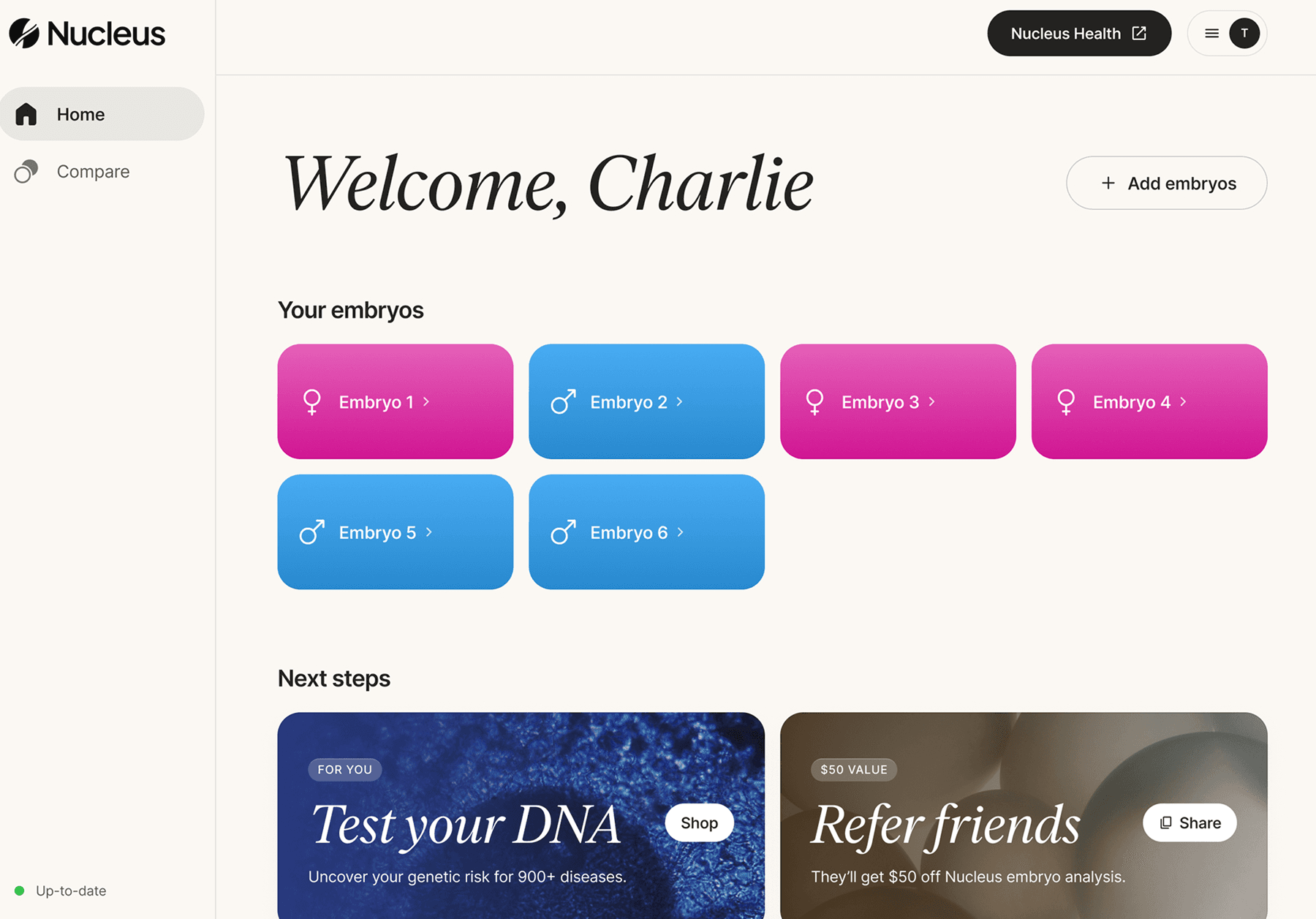
Go beyond traditional embryo screening (such as PGT-A, PGT-M, and PGT-SR), and use embryo optimization software. With this advanced tech, you can:
Compare embryos for hundreds of health, longevity, and well-being factors
Enjoy more transparency into which embryo you choose to transfer during IVF
Get 24/7 guidance from genetic counselors and a dedicated care team, so you never feel alone
Nucleus combines modern technology with a human touch to provide consistent support throughout the entire IVF process.
Book a call with our team to discuss how Nucleus IVF+ can support you on your fertility journey.

You may also like…
Featured image source: Karola G