Observar un embrión bajo el microscopio puede revelar cómo se está desarrollando, pero no proporciona un panorama completo de su salud genética. Es por eso que muchas personas y parejas que se someten a una FIV eligen incluir la prueba genética preimplantacional (PGT) como parte de este proceso.
La PGT ofrece una mirada más detallada a la composición genética de los embriones, lo que ayuda a identificar anomalías cromosómicas o afecciones hereditarias que podrían afectar la implantación, los resultados del embarazo o la salud de su hijo. Esta información ayuda a su especialista en fertilidad a identificar los embriones más sanos, permitiéndole tomar decisiones informadas sobre cuáles transferir y cuándo.
Aun así, hay mucho que considerar, ya que los diferentes tipos de PGT detectan diferentes afecciones.
Si se pregunta si la PGT es necesaria en su caso o qué tipo podría ser el adecuado, esta guía tiene como objetivo aclarar en qué consiste la PGT y qué tan precisa es. También exploraremos cuánto cuesta y cómo puede respaldar la toma de decisiones a lo largo del proceso de FIV.
¿Qué es la prueba genética preimplantacional?
La prueba genética preimplantacional (PGT) se refiere a un grupo de análisis realizados durante la FIV para examinar sus embriones en busca de afecciones genéticas o anomalías cromosómicas antes de la implantación.
La PGT puede evaluar:
Cromosomas faltantes o adicionales (como el síndrome de Down) – PGT-A
Trastornos monogénicos (como la fibrosis quística o la anemia de células falciformes) – PGT-M
Reordenamientos cromosómicos estructurales – PGT-SR
En el pasado, la PGT también se conocía como cribado genético preimplantacional (PGS) y diagnóstico genético preimplantacional (PGD):
Término | A qué se refiere |
|---|---|
Cribado genético preimplantacional (PGS) | Comprueba afecciones cromosómicas (cromosomas faltantes o adicionales) |
Diagnóstico genético preimplantacional (PGD) | Detecta trastornos genéticos específicos o afecciones hereditarias |
Hoy en día, la mayoría de las clínicas utilizan una terminología unificada bajo el concepto de PGT.
Extra: Conozca más sobre el cribado genético preimplantacional y en qué se diferencia del diagnóstico genético preimplantacional.
¿Por qué las personas se someten a pruebas genéticas preimplantacionales?
La PGT es beneficiosa por muchas razones diferentes en diversos escenarios, ya que proporciona información valiosa que orienta la selección de embriones y reduce el riesgo de aborto espontáneo o afecciones hereditarias.
Algunos escenarios específicos en los que resulta especialmente beneficiosa incluyen:
Edad materna mayor de 35 años
Antecedentes de ciclos fallidos de FIV
Ser portador conocido de una afección genética
Embarazos previos con anomalías cromosómicas
En las siguientes secciones, examinaremos estos escenarios más a fondo.
1. Edad materna mayor de 35 años
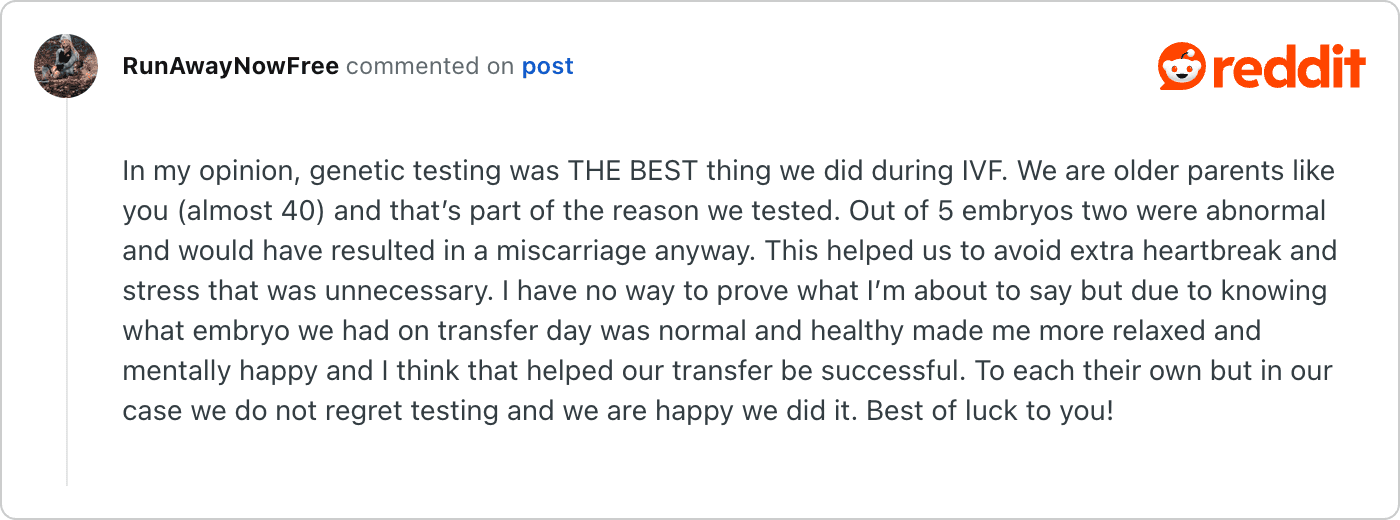
Si tiene 35 años o más, su médico podría recomendarle la PGT-A como parte de su plan de FIV. Esto se debe a que, con la edad, aumentan las probabilidades de anomalías cromosómicas en los embriones, especialmente en afecciones como el síndrome de Down o el síndrome de Turner.
Eso no significa que algo vaya a estar mal con sus embriones, solo que las probabilidades de ciertos problemas aumentan ligeramente. La PGT-A puede ayudar a identificar embriones con el número correcto de cromosomas (conocido como euploidía), lo que puede contribuir a una implantación exitosa.
Publicación completa: Reddit
2. Antecedentes de ciclos fallidos de FIV
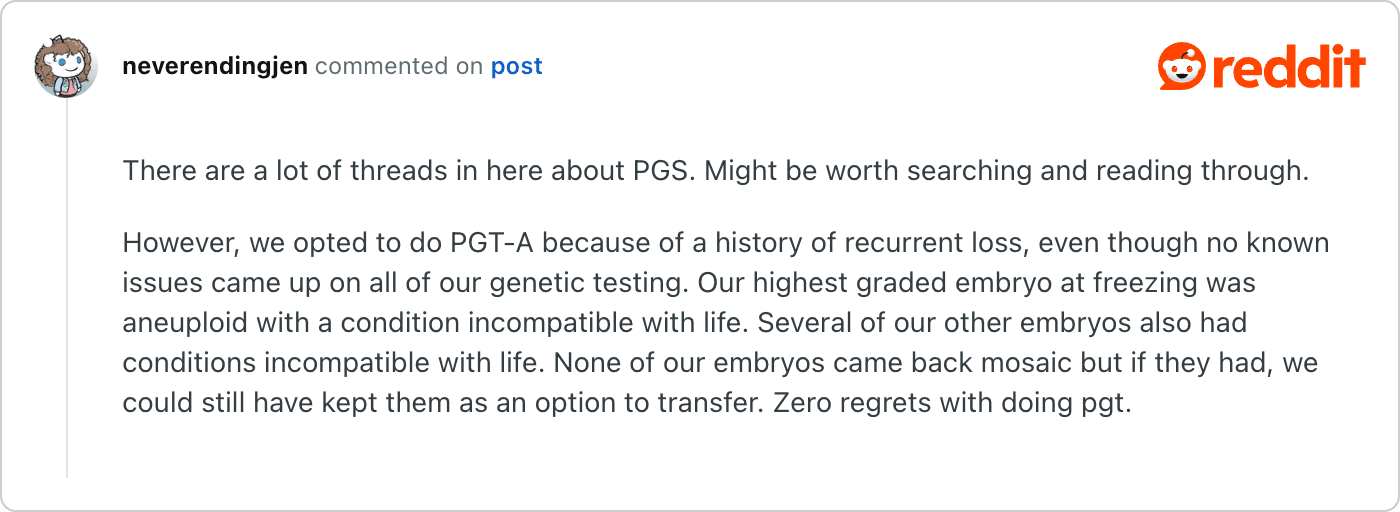
Si ya ha pasado por la FIV una (o varias veces) sin éxito, su médico podría sugerir la PGT-A como el siguiente paso. A veces, incluso cuando todo parece estar bien en el papel, los embriones pueden presentar problemas cromosómicos que les impiden implantarse o desarrollarse.
La PGT-A puede ayudar a determinar qué embriones son cromosómicamente normales y brindarle una imagen más clara de cuáles tienen mayores probabilidades de dar lugar a un embarazo saludable.
Publicación completa: Reddit
3. Ser portador conocido de una afección genética
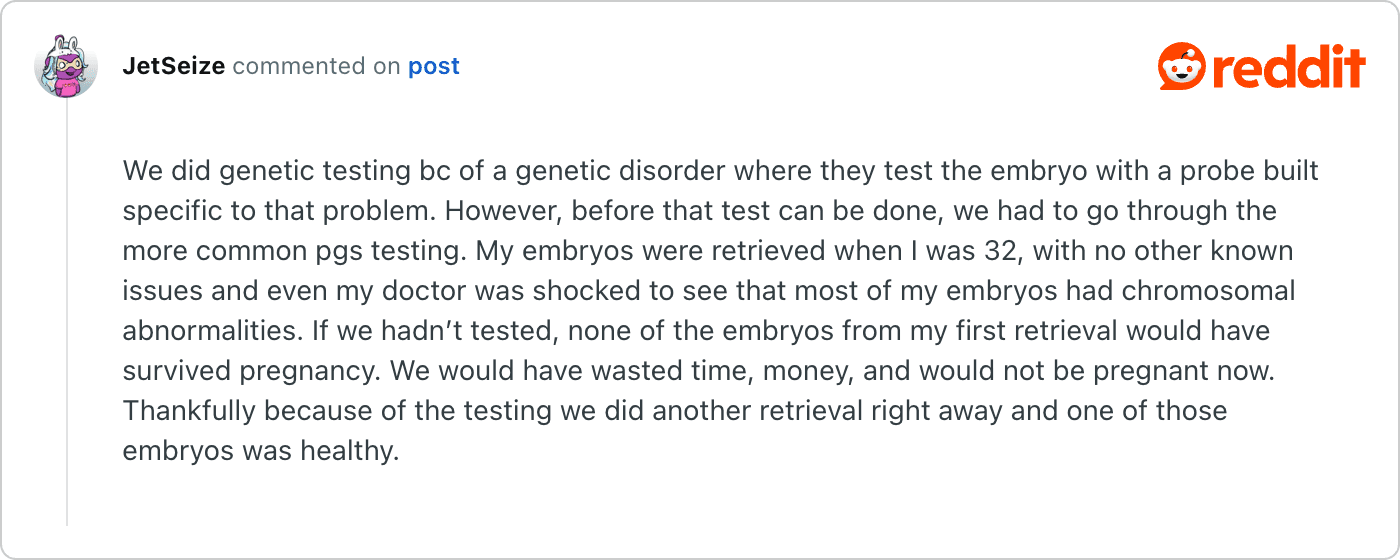
Si usted o su pareja son portadores conocidos de una afección hereditaria, como la fibrosis quística, la enfermedad de Tay-Sachs o la anemia de células falciformes, su médico podría recomendar la PGT-M.
Ser portador no significa necesariamente que su hijo vaya a heredar la afección, pero sí aumenta el riesgo. La PGT-M puede ayudar a identificar qué embriones no están afectados y darle más información para guiar sus decisiones sobre cuáles transferir. Para muchas personas, es una forma de reducir la incertidumbre y sentirse con mayor control durante un proceso de FIV sumamente exigente.
Publicación completa: Reddit
Consejo 💗
Si desea comprobar si usted o su pareja son portadores de ciertas afecciones genéticas, pruebe Nucleus Preview. Es la única prueba de detección de portadores que analiza los riesgos para la salud a lo largo de la vida y los rasgos más allá de las enfermedades raras.
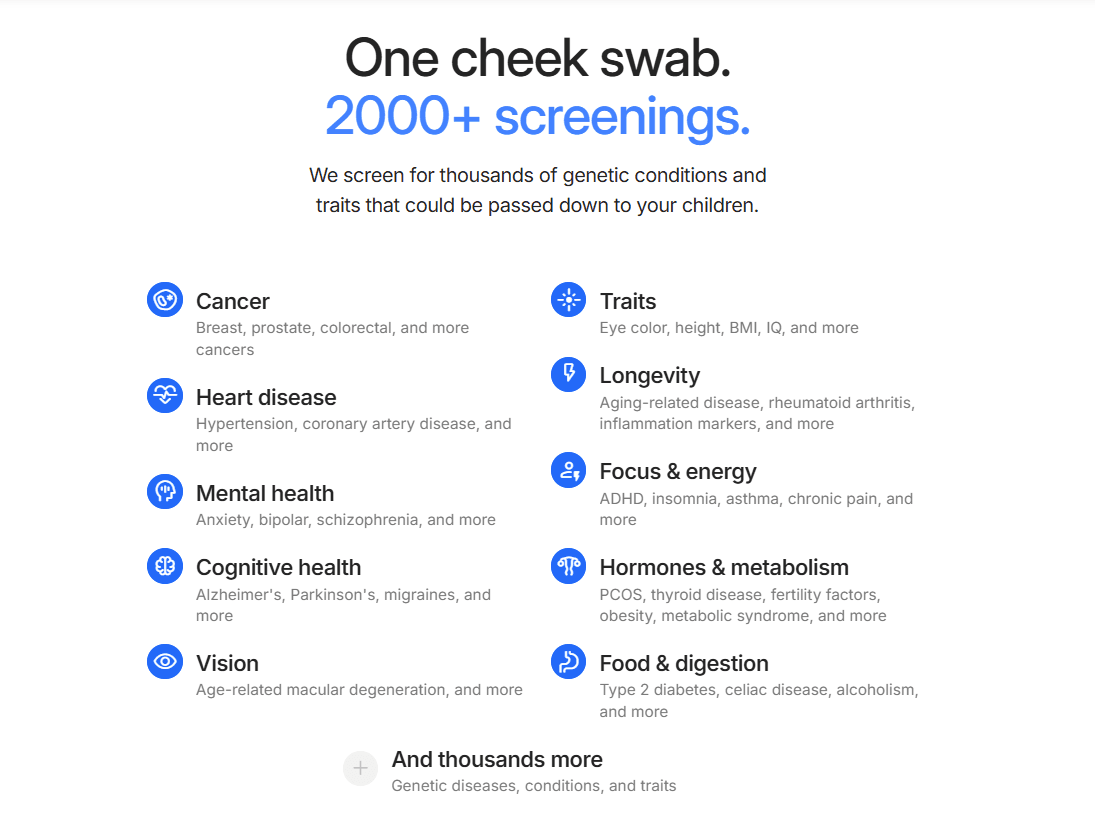
Puede realizarse la prueba en cualquier punto de su proceso de fertilidad; todos los informes son fáciles de interpretar y también tiene la opción de recibir asesoramiento genético para obtener mayor apoyo.
4. Embarazos previos con anomalías cromosómicas
Si ha tenido un embarazo anterior afectado por una afección cromosómica como el síndrome de Down o el síndrome de Turner, o tiene un hijo con un trastorno genético, su médico podría recomendar la PGT para futuros ciclos de FIV.
La PGT puede ayudarle a comprender mejor qué embriones son saludables, para que pueda tomar decisiones informadas sobre cuáles transferir. Para muchas familias, es una manera de sentirse con más seguridad y apoyo.
¿Cuáles son los tipos de pruebas genéticas preimplantacionales en embriones?

Fuente: Zakir Rushanly
Dependiendo de sus antecedentes personales o familiares, su médico puede recomendarle un tipo específico de PGT. Algunos tipos buscan anomalías cromosómicas generales, mientras que otros se centran en afecciones hereditarias o cambios estructurales dentro de los cromosomas.
Existen cuatro tipos principales que encontrará:
Prueba genética preimplantacional para aneuploidías (PGT-A)
Prueba genética preimplantacional para afecciones monogénicas (PGT-M)
Prueba genética preimplantacional para reordenamientos estructurales (PGT-SR)
Prueba genética preimplantacional para trastornos poligénicos (PGT-P)
Cada una de estas pruebas detecta diferentes afecciones. En las siguientes secciones, detallaremos lo que hace cada una.
1. Prueba genética preimplantacional para aneuploidías (PGT-A)
La PGT-A comprueba si sus embriones tienen el número correcto de cromosomas. Los seres humanos suelen tener 46 cromosomas, pero a veces, un óvulo o un espermatozoide no se divide de manera uniforme. Cuando esto ocurre, el embrión puede terminar con demasiados cromosomas o con muy pocos, lo que puede afectar su capacidad para implantarse y desarrollarse adecuadamente.
La PGT-A detecta afecciones causadas por estos desequilibrios cromosómicos, que incluyen:
Síndrome de Down
Síndrome de Turner
Síndrome de Klinefelter
Síndrome de Edwards
Síndrome de Patau
Esta prueba puede ser de gran ayuda para personas mayores de 35 años o para quienes han pasado por múltiples ciclos fallidos de FIV, ya que el riesgo de estas anomalías aumenta con la edad y a menudo provoca fallas de implantación.
2. Prueba genética preimplantacional para afecciones monogénicas (PGT-M)
La PGT-M es una prueba diseñada para personas que tienen un trastorno genético o son portadoras de él. Si usted o su pareja/donante es un portador conocido de una afección monogénica, esta prueba puede ayudar a identificar qué embriones están afectados, de modo que pueda evitar la transferencia de uno con esa afección específica.
La PGT-M busca trastornos hereditarios específicos como:
Fibrosis quística
Anemia de células falciformes
Enfermedad de Tay-Sachs
Enfermedad de Huntington
Mutaciones en BRCA (vinculadas al cáncer de mama y de ovario)

Publicación completa: Reddit
Esta prueba se adapta a sus antecedentes genéticos. Antes de poder analizar el embrión, la clínica normalmente tendría que crear una sonda personalizada para su afección específica.
3. Prueba genética preimplantacional para reordenamientos estructurales (PGT-SR)
La PGT-SR se recomienda en situaciones en las que uno de los progenitores biológicos tiene una anomalía cromosómica estructural conocida, como una translocación o una inversión. Esta prueba detecta afecciones como:
Translocación recíproca
Translocación robertsoniana
Al identificar embriones con estructuras cromosómicas normales, la PGT-SR puede ayudar a reducir el riesgo de aborto espontáneo o de fallos en la implantación.
4. Prueba genética preimplantacional para trastornos poligénicos (PGT-P)
La PGT-P es una de las opciones de detección genética más avanzadas que calcula el riesgo de un embrión de desarrollar enfermedades complejas influenciadas por múltiples genes. Si tiene antecedentes familiares de afecciones complejas o crónicas, su médico puede recomendar la prueba PGT-P para identificar de manera proactiva los embriones que tienen un menor riesgo de enfermedad.
Algunas de las afecciones que la prueba detecta incluyen:
Enfermedades cardíacas
Diabetes tipo 1 y tipo 2
Ciertos tipos de cáncer
Trastornos neurodegenerativos
La mayoría de las pruebas genéticas para embriones se enfocan en identificar trastornos monogénicos raros o anomalías cromosómicas importantes. Pero muchas de las afecciones que afectan la calidad de vida —como las mencionadas anteriormente— no son causadas por una sola mutación, lo que convierte a la PGT-P en una parte esencial de las pruebas genéticas preimplantacionales.
¿Cuándo y cómo se realiza la prueba genética preimplantacional?

Fuente: Gustavo Fring
El proceso de la PGT suele incluir:
Creación de embriones: Su clínica extraerá sus óvulos y los fertilizará con esperma en el laboratorio para formar embriones.
Permitir que los embriones se desarrollen: Estos embriones se cultivan durante 5 a 7 días hasta que alcanzan la etapa de blastocisto, cuando tienen suficientes células para la prueba.
Momento de la biopsia: En la etapa de blastocisto, cada embrión tiene un trofoectodermo (futura placenta) y una masa celular interna (futuro bebé). Se extraen con cuidado unas pocas células del trofoectodermo, dejando intacta la masa celular interna.
Congelación de los embriones: Una vez realizada la biopsia, los embriones se congelan para mantenerlos a salvo mientras espera los resultados.
Análisis en el laboratorio: Las células extraídas se envían a un laboratorio para su análisis, donde los especialistas buscan anomalías genéticas o cromosómicas, según la prueba que vaya a realizarse.
A muchas personas les preocupa que extraer células o congelar el embrión pueda dañarlo. La buena noticia es que estos procedimientos se llevan a cabo con una precisión increíble, y los estudios demuestran que, por lo general, son seguros y bien tolerados por los embriones.
¿Cuánto tiempo se tarda en obtener los resultados de la PGT?
El tiempo que se tarda en recibir sus resultados de PGT puede variar en función de varios factores clave, pero depende principalmente del tipo de prueba PGT que se esté realizando y del laboratorio o proveedor que gestione el análisis. Algunas pruebas son relativamente rápidas y siguen un proceso estándar, mientras que otras son más complejas y requieren tiempo.
Aquí le presentamos un vistazo rápido a los tiempos de espera habituales para los diferentes tipos de PGT:
Prueba | Tiempo de entrega promedio |
|---|---|
PGT-A | 1–2 semanas |
PGT-SR | 3–5 semanas |
PGT-M | 4–6 semanas |
PGT-P | 2–3 semanas |
Por lo general, la PGT-A tiene el tiempo de entrega más rápido porque sigue un proceso bastante estandarizado. Sin embargo, para la PGT-M, que analiza afecciones hereditarias específicas, el laboratorio a menudo necesita crear una sonda personalizada adaptada a sus antecedentes familiares específicos. Ese trabajo adicional puede prolongar el plazo.
Extra: Lea este artículo para conocer el desglose del cronograma de la FIV, incluyendo cómo encajan las pruebas genéticas como la PGT en cada etapa.
¿Qué tan precisa es la prueba genética preimplantacional?
Es fundamental tener en cuenta que ninguna PGT es 100% precisa. Aunque la tecnología detrás de ella es avanzada y de amplia confianza, aún no es completamente infalible.
Existe una pequeña posibilidad de falsos positivos (cuando se clasifica un embrión con una afección que no tiene) o de falsos negativos (cuando un embrión pasa el cribado pero aún podría portar un problema). También hay casos en los que el resultado es no concluyente, y los médicos pueden recomendar repetir la biopsia o realizar pruebas adicionales para obtener un panorama más claro.

Publicación completa: Reddit
Dicho esto, la PGT aún ofrece un alto nivel de precisión en general:
Prueba | Precisión |
|---|---|
PGT-A | 98% |
PGT-M | 95–99% |
PGT-SR | 98% |
Una zona gris que puede surgir al someterse a la PGT-A es el mosaicismo: cuando un embrión contiene tanto células normales como anormales. El mosaicismo puede hacer que los resultados de la PGT sean más difíciles de interpretar, ya que el desenlace de la transferencia normalmente depende del número de células anormales y de su función potencial en el desarrollo del embrión. Algunos embriones con mosaicismo aún pueden dar lugar a embarazos saludables, mientras que otros podrían no implantarse en lo absoluto.
Debido a esto, su clínica de fertilidad podría recomendar pruebas prenatales adicionales más adelante en el embarazo, como la NIPT o la amniocentesis, para verificar y confirmar los resultados antes del nacimiento.

Publicación completa: Reddit
Extra: Descubra qué tan precisa es la PGT-A para determinar el sexo de sus embriones.
¿Cuánto cuesta la prueba genética preimplantacional?
No existe una tarifa fija para la PGT. El costo a menudo varía según:
El laboratorio con el que colabora su clínica
El tipo de prueba que se realice (PGT-A, PGT-M o PGT-SR)
La cantidad de embriones analizados
A continuación, presentamos una estimación aproximada de lo que la gente suele pagar por diferentes pruebas de PGT:
Prueba | Costo |
|---|---|
PGT-A | $250–$4,000 USD |
PGT-M | $2,500–$5,250 USD |
PGT-SR | Desde $2,600 USD |
En general, la PGT-M puede ser más costosa porque el laboratorio debe desarrollar una sonda personalizada específica para la afección genética que se está analizando. Ese paso adicional requiere más tiempo y más dinero. Si desea hacer el proceso más sencillo y centrado en los datos, considere realizarse un análisis de detección de portadores con Nucleus, ya que los resultados ayudan a su médico a identificar las afecciones necesarias para crear la sonda personalizada.
Si bien la PGT representa un costo adicional dentro de un proceso de FIV que ya es costoso, brinda a las personas la tranquilidad y la información necesarias para elegir embriones que puedan tener mayores probabilidades de una implantación exitosa o que estén libres de riesgos genéticos específicos.
¿Cuáles son los siguientes pasos después de recibir los resultados de la PGT?

Fuente: Pavel Danilyuk
Una vez que sus resultados de PGT estén listos, normalmente se envían a su clínica de fertilidad. Su siguiente paso será una consulta con su médico para analizar los hallazgos en detalle. Este puede ser un momento emotivo, especialmente si los resultados indican que solo tiene unos pocos embriones viables o, en algunos casos, ninguno.
Es completamente normal sentirse abrumado. Aquí es donde su red de apoyo, tanto médico como personal, se vuelve tan importante. Su médico le explicará las implicaciones de los resultados, comentará los posibles pasos siguientes (que podrían incluir otro ciclo de FIV) y le ayudará a tomar decisiones informadas.
Si cuenta con embriones viables, el siguiente paso implica decidir cuáles transferir. La mayoría de los embriones se congelan después de la biopsia, por lo que una vez que esté lista o listo, el embrión seleccionado se descongelará y se preparará para la transferencia; sin embargo, elegir entre embriones por su cuenta puede ser difícil.
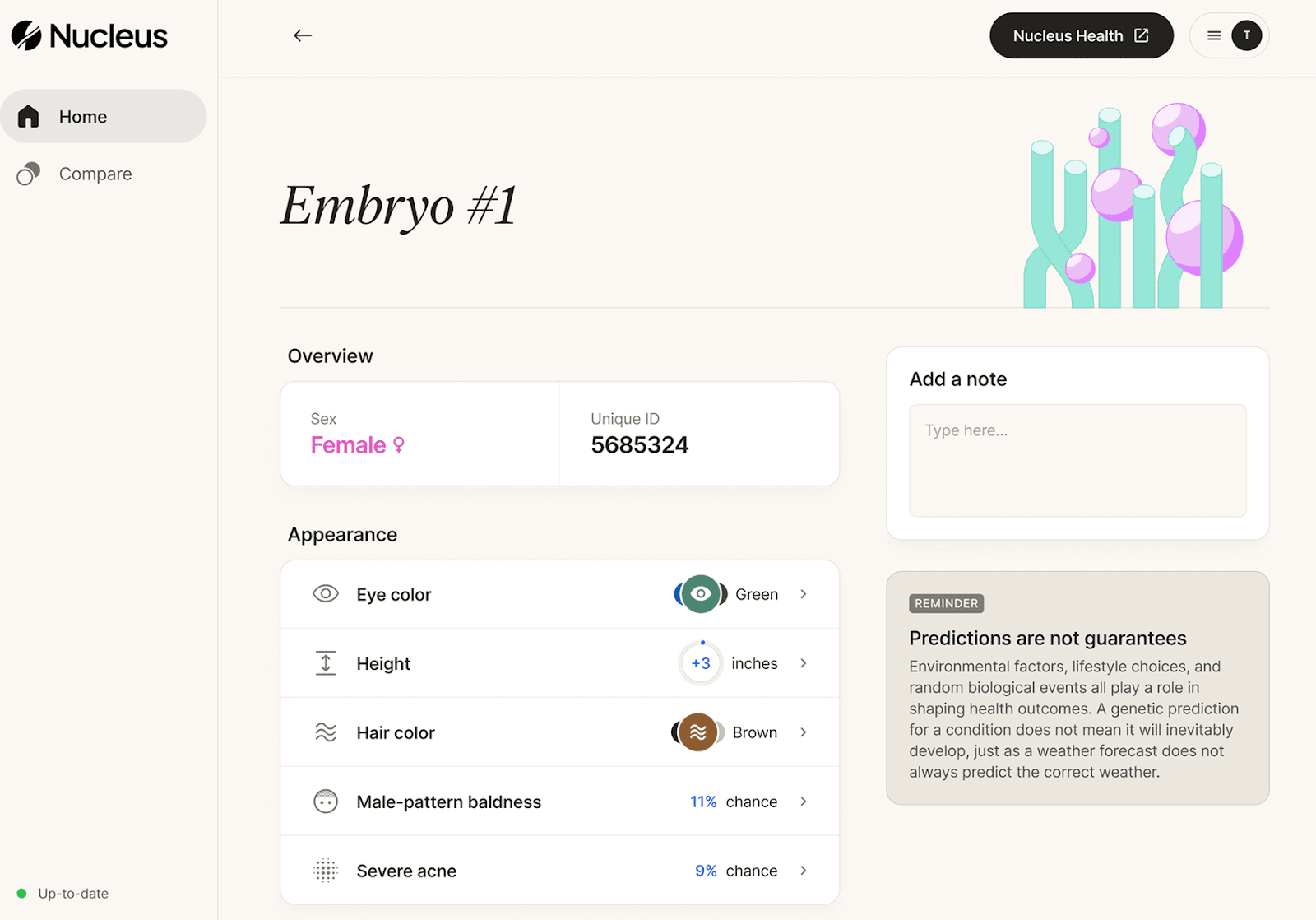
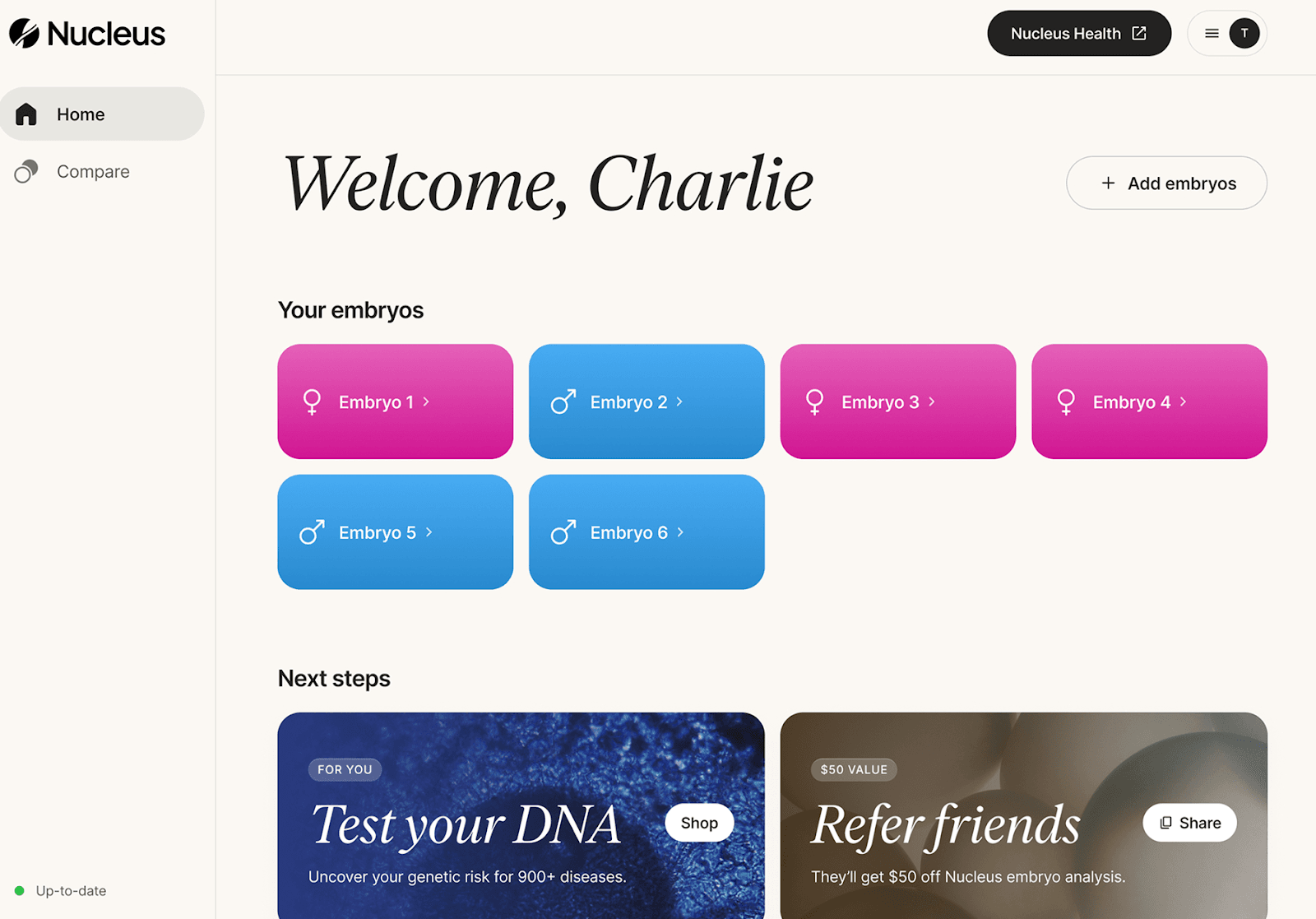
También puede utilizar herramientas de optimización genética como Nucleus Embryo junto con las pruebas PGT para acceder a análisis genéticos profundos y comparar embriones uno al lado del otro. Nucleus Embryo le ofrece una interfaz interactiva para ver los riesgos de enfermedades, los rasgos físicos, el bienestar y la salud mental de cada embrión. El objetivo es ayudarle a elegir lo mejor para su familia con información responsable y respaldada por la ciencia.
Conozca más sobre sus embriones con Nucleus Embryo
Las investigaciones muestran que muchas mujeres todavía consideran que tener hijos es como una apuesta, y con frecuencia señalan una falta de acceso a la información necesaria para tomar decisiones reproductivas informadas.
Nucleus Embryo busca aportar claridad y confianza mientras toma esas decisiones personales tan vitales. No existe un enfoque único para todos en lo que respecta a la fertilidad y la planificación familiar, por lo que Nucleus creó una plataforma que presenta toda la información científicamente respaldada para los futuros padres y les ayuda a tomar sus decisiones con cuidado, transparencia y responsabilidad.
Al momento de elegir qué embrión transferir, Nucleus Embryo puede ayudarle a explorar sus embriones de manera más integral.
Una vez que tenga sus resultados de PGT, regístrese en Nucleus Embryo para obtener información más profunda sobre la composición genética de cada embrión. Puede obtener detalles sobre cómo se posicionan los embriones en términos de su potencial de desarrollo en:
Afecciones de salud: Enfermedades cardíacas, riesgo de cáncer, TDAH, depresión y decenas de otros trastornos hereditarios
Rasgos físicos: Color de ojos, estatura, color de cabello, calvicie de patrón masculino
Bienestar: Marcadores de inteligencia, riesgos de salud mental y más
La mejor parte es que Nucleus está diseñado para ser utilizado por padres de familia, no por científicos o médicos. Podrá ordenar, comparar y seleccionar embriones en una interfaz clara y fácil de navegar, a su propio ritmo.
También podría interesarle…
Fuente de la imagen destacada: Gustavo Fring