With a network of 40+ clinics nationwide, CCRM (Colorado Center of Reproductive Medicine) provides comprehensive fertility care, from early diagnostics to personalized treatments. In addition to expert services and a team of renowned fertility experts, the clinic offers multiple financial programs and educational resources to help patients better understand the process.
In this review, we’ll take a closer look at CCRM Fertility of San Francisco, examining its service offerings, success rates, and patient testimonials.
CCRM Fertility San Francisco: Team and accessibility
CCRM boasts a team of geneticists, embryologists, and reproductive endocrinologists who helped refine industry-changing processes, including preimplantation genetic testing (PGT) for day 5 and day 6 embryos. Fertility specialists at all CCRM facilities are experts in infertility and frequently provide consultations to other IVF practices.
The female-led team of fertility specialists at CCRM Fertility San Francisco includes:
Dr. Sunny Jun, specializing in IVF, female reproductive health issues, and third-party reproduction
Dr. Angela Liu, a reproductive endocrinologist who holds a Cancer Research Training Award (CRTA) and focuses her research on PGT and perinatal outcomes
Dr. Salli Tazuke, the clinic’s co-founder and laparoendoscopic surgeon with two decades of experience in reproductive endocrinology and infertility
At the 2024 ASMR Scientific Congress & Expo, the CCRM team presented 30 studies and earned two ASMR Prize Papers, along with multiple individual honors.
CCRM Fertility of San Francisco is open seven days a week. It offers telehealth consultations to those who wish to learn more about the services before visiting in person.
CCRM Fertility of San Francisco review: 7 key considerations
In this review, we’ll evaluate the clinic across seven crucial areas:
Range of services
Inclusivity
Insurance coverage
Financing options
Digital tools
Patient experience
1. Range of services
CCRM promises an end-to-end experience providing a full spectrum of fertility-related services:
Service | Description | Pricing information |
|---|---|---|
IVF | An IVF cycle includes the following stages:
| The average cost of one IVF cycle ranges from $15,000 to $27,000, and typically includes:
The cost doesn’t include storage, testing, anesthesia, and medication. |
Intrauterine insemination (IUI) | The IUI treatment consists of:
| Average per-cycle costs range from $1,200 to $4,000, covering:
|
Preimplantation genetic testing (PGT) | The three available genetic testing options are:
| Not disclosed |
CCRM offers in-house, fully personalized gestational carrier programs. | Not disclosed | |
Egg donation | All donors undergo extensive genetic, health, and psychological screenings. | The donor egg package is listed at $18,500 and covers:
|
Egg freezing | Elective egg freezing preserves mature eggs through cryopreservation. | $6,000–$12,000 per cycle |
2. Inclusivity

Source: Karola G
CCRM Fertility of San Francisco makes no distinctions based on a patient’s medical history, race, sexual orientation, or personal circumstances. Its services are designed to address diverse families, establishing an inclusive approach to care.
Patients with a cancer diagnosis require a highly tailored approach to fertility planning, and CCRM recognizes the complexity of the situation. Oncofertility treatments offer guidance and multiple family-planning options, including:
Embryo freezing: Patients can create and freeze embryos, maintaining the possibility of a future pregnancy.
Sperm freezing: Male patients can opt to preserve their sperm before undergoing cancer treatments.
Egg freezing: Female patients can freeze eggs for use in future fertility treatments.
Donor eggs or sperm: When their own eggs or sperm aren’t viable, donor options remain available.
CCRM supports LGBTQ+ individuals and couples by offering family-building solutions customized to diverse needs and goals. Many options enable a biological connection to the child when desired. Fertility care options for members of the LGBTQIA+ community include:
Lesbian pregnancy and fertility treatment options: IUI, IVF with donor sperm/donor eggs, reciprocal IVF
Options for gay couples: IVF with donor eggs or gestational surrogacy
Fertility treatment for trans and non-binary: IUI, IVF, gestational surrogacy, and fertility preservation procedures before, during, or after hormone therapies or gender-affirming surgeries
As a part of their inclusive approach, the clinic has also established the Black Fertility Matters initiative. Through this program, CCRM launched a survey that generated significant insights into the fertility challenges faced by Black individuals.

Source: William Fortunato
3. Insurance coverage
The insurance coverage of your fertility care depends not only on the insurance plan but also on the state you live in. A CCRM financial counselor will walk you through all available options, ensuring that out-of-pocket costs, payment timelines, and other key details are fully transparent. While payment plans vary based on individual circumstances and insurance, treatment costs are usually due before the cycle begins.
In the case of employer-sponsored health insurance, CCRM encourages patients to contact the insurance provider directly or speak with an HR representative for more details. For patients in California, it is also worth noting that as of 2026, the SB 729 Mandate expanded IVF insurance coverage for certain large-group employers, now including single parents by choice and LGBTQ+ individuals.
CCRM reserves the right to update its criteria on insurance plans and emphasizes the importance of verifying plan coverage with the clinic when scheduling an appointment. In some cases, such as an HMO plan, a copy of a referral from your OB/GYN or another primary care provider may also be required.
If treatment costs aren’t fully covered by insurance, financial counselors can outline fertility financing options, including multi-cycle packages, discounted self-pay rates, or IVF refund programs.
4. Financing options
The Assure IVF Refund Program is the institution’s response to financial uncertainty some patients may encounter on their path to parenthood. As a shared-risk program, it guarantees an 80–100% refund of the program fees for eligible patients if the treatment does not result in a live birth. The program entails:
Three IVF freeze-all cycles
Unlimited frozen embryo transfers
Cryopreservation
PGT-A for up to three instances (testing capped at 14 embryos per instance)
The eligibility for this program depends on multiple factors, including:
Lifestyle choices: Both patients have to be clear of tobacco or recreational drug use for at least three months before treatment
Age: You must be 39 or younger at the time of your first egg retrieval
BMI: Body mass index cannot exceed 35

Source: George Pak
Active-duty military personnel, eligible veterans, and their spouses can receive a 25% discount on IVF packages, transfer services, and egg vitrification. Services not included in the discounted pricing include anesthesia, CCS testing, and CCS shipping. Unlike the Assure program, CCRM’s IVF military discount has a single eligibility requirement: valid identification confirming U.S. Armed Forces affiliation.
CCRM has also partnered with Future Family, a third-party online financing platform offering tailored fertility loans. Along with customizable financing options and 0% financing for eligible patients, the platform offers financial coaching and a clear monthly fee that covers all included benefits.
Bonus: Step into your fertility journey prepared with helpful information from our guides:
5. Digital tools
If you begin your care at CCRM Fertility of San Francisco, you can monitor your progress via a dedicated app or web portal. The Salve app and web portal serve as online management tools, allowing you to access details of your personalized fertility plan at any time, from your phone, tablet, or computer. The app is available for iOS and Android, while the web portal can be accessed through any web browser.
With a Salve digital account, you can:
Upload medical documents and attach files to messages
Communicate directly with your care team
Receive appointment reminders via push notifications
Manage payments securely
6. Success rates
As a member of the Society for Assisted Reproductive Technology (SART), CCRM claims to provide transparent reporting of success rates. The data on their website displays their own network data rather than the official SART information.
Check out the clinic’s consolidated data for CCRM Fertility of San Francisco:
Women’s age at the moment of retrieval | <35 | 35–37 | 38–40 | 41–42 | >42 |
|---|---|---|---|---|---|
Average number of embryos transferred | 1.0 | 1.0 | 1.0 | 1.0 | 1.0 |
Number of transfers | 93 | 71 | 65 | 28 | 15 |
Percentage of live births per embryo transfer | 65.6% | 69.0% | 70.8% | 64.3% | 3/4 |
Percentage of singleton delivery per live birth from a single embryo | 98.4% | 100.0% | 100.0% | 17/18 | 11/11 |
The clinic stresses that success rates shouldn’t be viewed in isolation since many factors, including patients’ medical history and treatment approaches, affect the data.
7. Patient experience
CCRM Fertility San Francisco holds an 8.3 FertilityIQ rating, with 75% of reviewers strongly recommending the clinic. Positive feedback most often highlights the convenience of on-site screening, modern laboratories, efficient staff, and the care team’s involvement and kindness.
One reviewer on Reddit shared that they felt supported by the team and described the IVF process as very thorough.
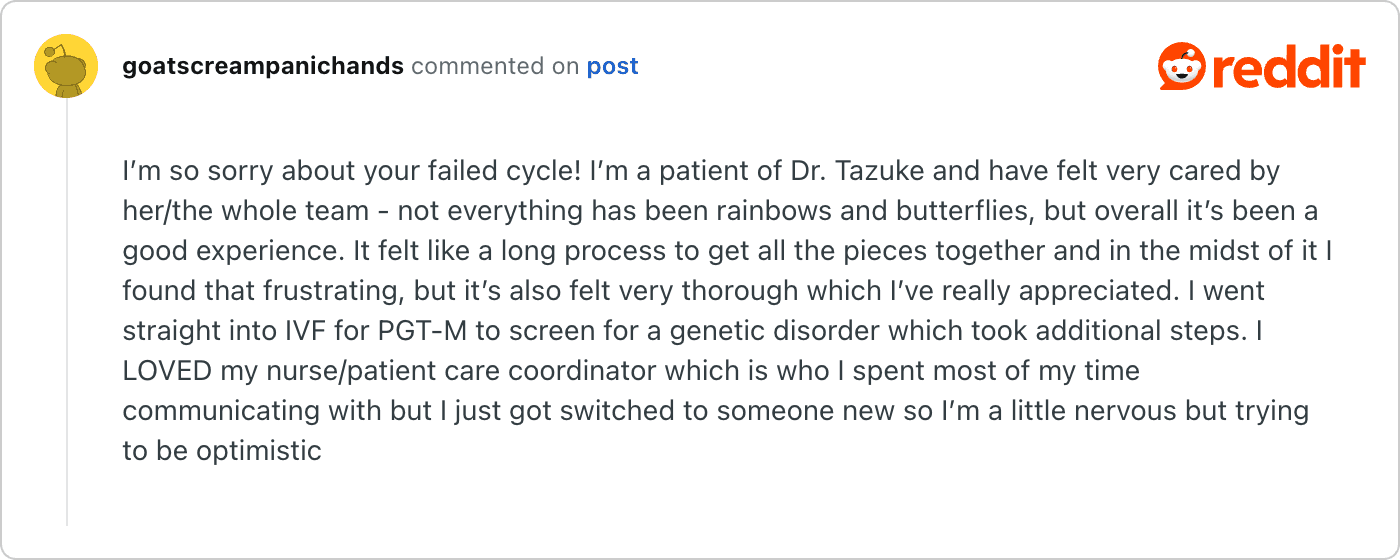
Full post: Reddit
Negative impressions often include the clinic’s web portal and app. Several reviewers mention issues with efficiency and speed, noting that in-app communication is not always as prompt as expected. The Google rating of 3.7 appears to be influenced largely by remarks citing staff unresponsiveness and disharmony between the medical team and nursing staff.
Is CCRM Fertility of San Francisco the optimal choice for you?
CCRM’s reputation, accessibility, and numerous recognitions in fertility and reproductive medicine position it as one of the leading establishments not only in San Francisco but nationwide. Still, it is a huge system that can make some patients feel unseen and confused. Large clinics can feel crowded, and their digital channels often lack the advanced, user-friendly interface.
The lack of understanding during IVF can make this emotionally demanding process even harder. Advanced carrier screening, along with embryo analysis, can bring clarity and help you make optimal choices for your future family.
Nucleus offers deep insights into your and your future child’s genetic makeup, assisting you and your medical team in selecting IVF methods and embryos that are right for you.
Choose embryos beyond basic viability with Nucleus
Historically, embryo selection relied on basic lab reports that focus primarily on chromosomal normality or embryo viability. These were decisions typically made by clinicians without giving parents much say in the process.
Nucleus Embryo helps parents explore this data in greater depth through advanced predictive models and translating complex genetic analysis into clear, actionable insights. You can access genetic predisposition across 2,000+ factors, including:
Heart health: coronary artery disease, hypertension
Neurological and mental health: Alzheimer’s disease, anxiety, bipolar disorder
Women’s health: endometriosis, PMOS (formerly known as PCOS)
Metabolic health: type 1 and 2 diabetes, celiac disease
Certain cancers: breast, ovarian, and prostate cancer
Hereditary disorders*: cystic fibrosis, hemochromatosis
Physical and longevity traits: including height, hair color, IQ, and ADHD
*Some conditions are detected through parental screening and could require further PGT-M before embryo transfer.
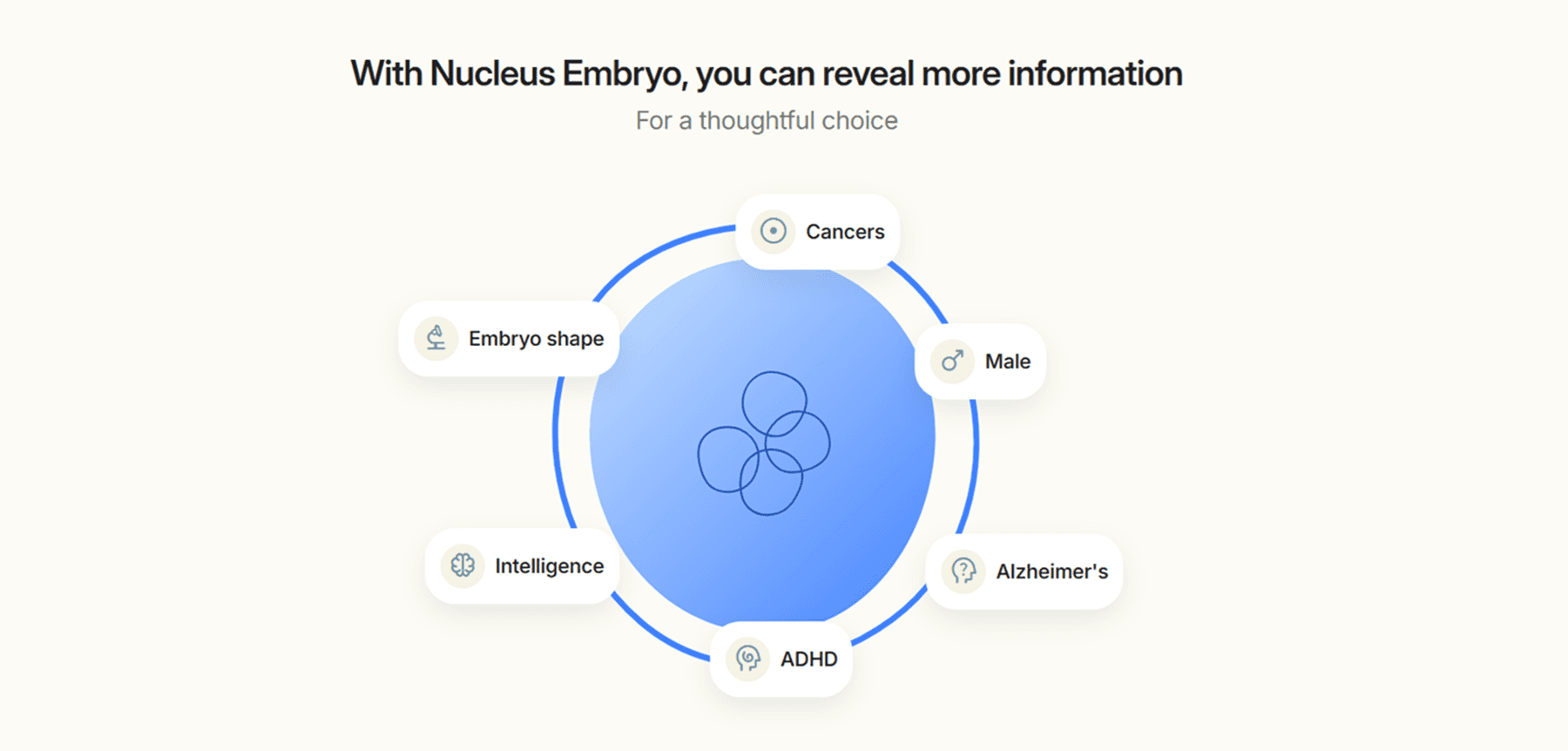
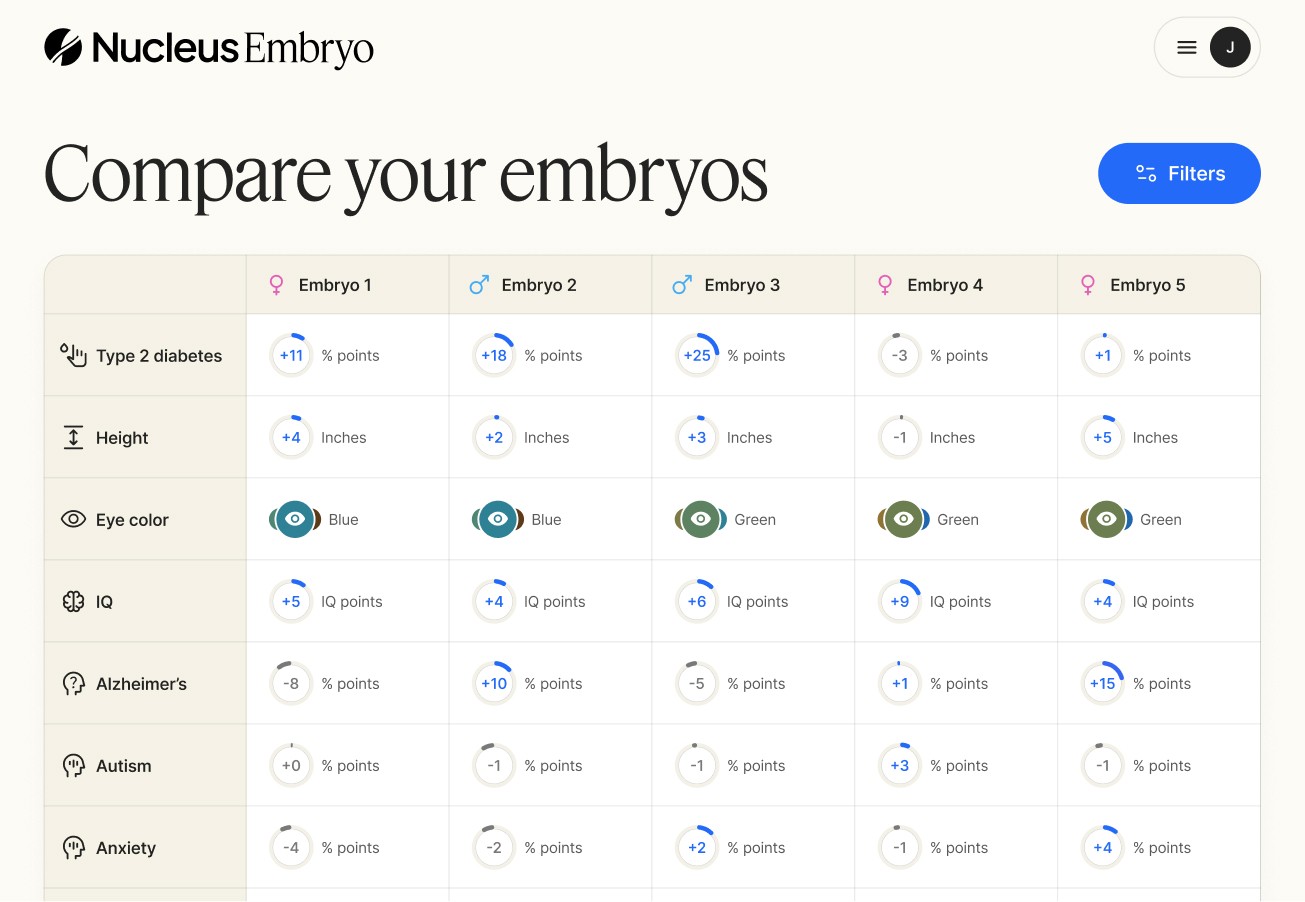
Through an intuitive, interactive interface, you can analyze up to 20 embryos side by side, review predicted health risks and traits, and sort embryos based on the factors that matter most to you. Genetic counseling is available to all patients if you need help navigating and interpreting your results.
How to get started with Nucleus Embryo
If you are already undergoing IVF and preparing for embryo transfer, Nucleus Embryo, which includes Nucleus Preview, can be integrated into your treatment cycle in most cases. You can schedule a call with a Nucleus specialist to get started.
Nucleus Preview is for individuals or couples planning for a baby. The test analyzes the DNA of both partners to identify carrier status for 2,000+ genetic conditions as well as traits like eye color, intelligence, and height. Preview also includes a sibling-level simulation that models genetic risk across 100 potential children.
We work with many partner clinics in the U.S., as well as in countries like Canada, India, the Middle East and Mexico to ensure patients around the world are able to access our advanced genetic optimization services.
For individuals or couples who are thinking of conceiving naturally, Nucleus also offers preconception screening separately, Nucleus Preview, designed to identify hereditary risks and traits.
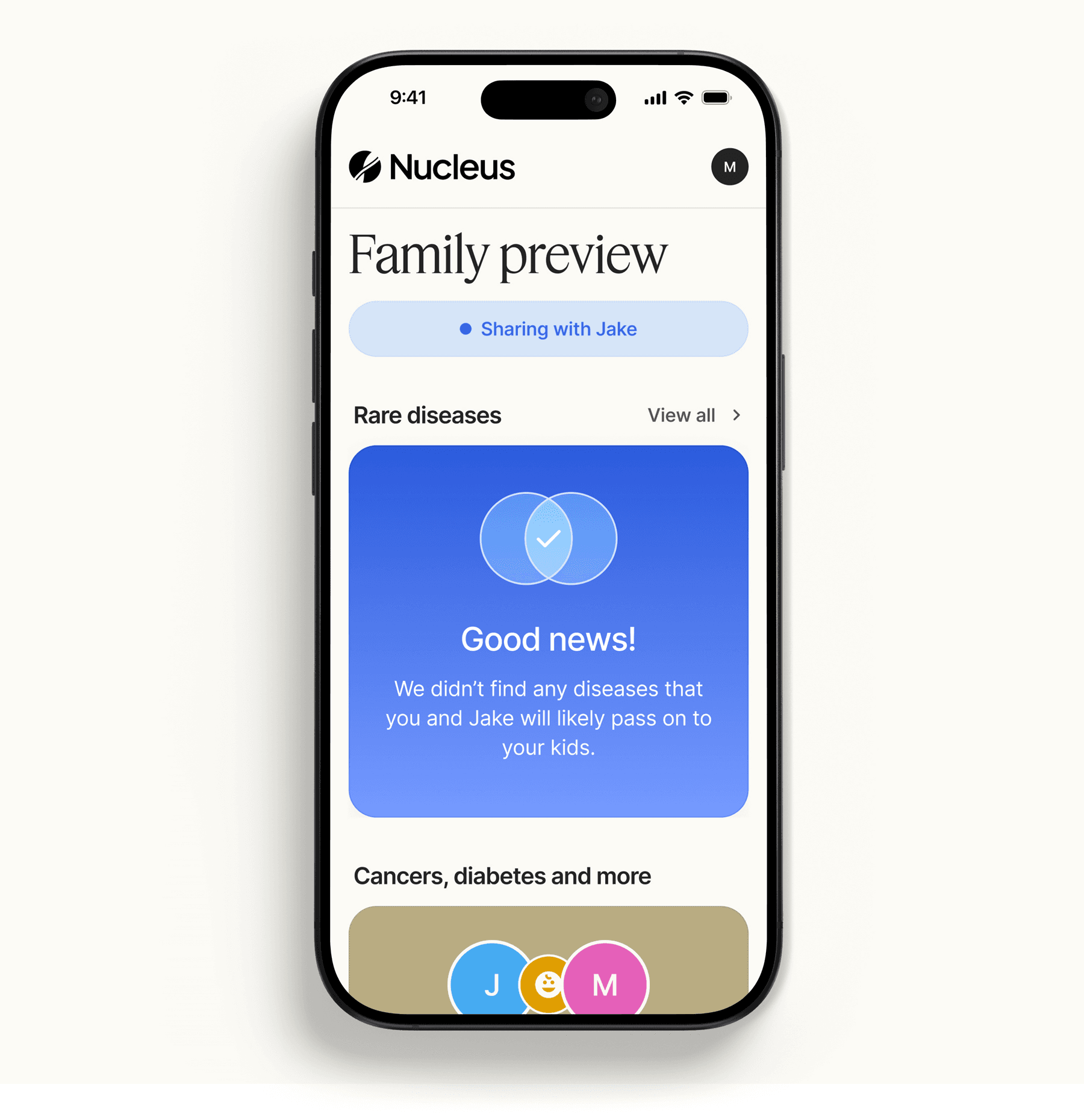
These insights can help:
Identify inherited conditions that may require additional testing
Inform IVF planning and embryo testing strategies via PGT-A, PGT-M, etc.
Give parents clearer information about potential health risks
Nucleus Preview screening can be done at home — order the kit to get started.
Featured image source: Helena Lopes