Kian Sadeghi
Evolution
The case for human flourishing.
To Cza
Malayo pa, pero malayo na.
Table of Contents
- 00IntroTen Years, For Ten Words
- 01Chapter 1Modification Mirage
- 02Chapter 2A Double-Helixed History
- 03Chapter 3The Millennium Mission
- 04Chapter 4The Mistake
- 05Chapter 5The Realization: A Mechanism For Directed Evolution
- 06Chapter 6A Guide to Genetic Optimization
- 07Chapter 7An Abstract Amplifier
- 08Chapter 8Our Non-genetic Heart
- GGlossary
- RReferences
Intro
Ten Years, For Ten Words
The journalist asked me to look off into the distance and keep a stern face.
The year is 2023, and I was a wide-eyed founder building a genomics company. I usually wore sweatpants and a UPenn hoodie to the office, rounded out with a pair of Adidas Ultraboosts.
Not that day. A journalist had reached out looking to write a story on my company, Nucleus. I couldn’t believe it! A journalist wanted to cover our work; he wanted to tell the story of the new era of genomics that was upon us.
When he asked me questions, I did what any twenty-something-year-old obsessed with genetics since he was a teenager would do. I told him everything.
I waxed on and on about polygenic prediction, the central limit theorem, how these models could stratify risk equivalent to Mendelian risk, and how the cost of sequencing a human genome was collapsing. I told him about our launch plans, why we were careful to present absolute versus relative risk, and, of course, my dream of sequencing the world.
It felt like skating on ice freshly smoothed by a Zamboni. Little did I know it would be the first of many times I would end up skating right into the boards.
What did I know? For years, nobody ever asked me about Nucleus. A journalist actually cared enough to ask? Amazing! I remember reading how Athena sprang fully formed from Zeus’s head. I kinda felt that way about Nucleus; it had emerged from my effort and thought into the physical plane, plopping right out of my mind.
The journalist looked at me and asked me to make a stern face. Then asked me to look above his shoulder. Snap! He thanked us for the time and went on his way.
That went amazing! I thought.
The result: “From a Fledgling Genetic Science, A Murky Market for Prediction.”1 Nucleus’ first ever press story. Seven thousand words on discrimination, ethical questions, ill-defined regulatory challenges, Peter Thiel, doubts about the efficacy of polygenic risk scores, and the dangers of IQ genetic prediction.
I read it in disbelief.
Where was the conversation I remembered having? The beauty of genomic science? The collapsing cost of sequencing? The opportunity for preventative medicine? The world I thought I had spent an hour and a half describing?
Instead, there I was, a stranger to my own story, staring sternly into the distance, inside an article that seemed to be about something else entirely. Jesus, I thought. Oh well, it’s just one journalist.
Here’s the picture. I look like I just turned twelve-years-old.
It was not just one journalist.
When we raised our Series A, about a year later, TechCrunch introduced us as a “Controversial genetic testing startup.”2 The familiar cast of characters appeared again: questionable science, intelligence analysis, Founders Fund, Peter Thiel, and increasingly, the word that ceaselessly popped up in almost any public discussion about human genetics: eugenics.
This was before we put glistening baby faces up on subway ads across New York City in our Have Your Best Baby3 campaign, before we went on the staunch pro-lifer podcast Tucker Carlson4, and even before the term genetic optimization (GO)5 was seen as an emerging industry itself.
Before any of what, for many people, made Nucleus, Nucleus, we were controversial.
After we launched GO, the criticisms intensified. Scientific American published the article, titled “The Myth of the Designer Baby — Why ‘Genetic Optimization’ Is More Hype Than Science.”6 After comparing me to another biotech founder who dropped out of college (it wasn’t billionaire biotech dropout Bob Duggan,7 unfortunately) the article turned to the science and ethics of genetic optimization, including this striking claim:
“There are no major genetic markers for many cancers or a truly definitive set for heart disease, let alone for intelligence, acne, body-mass index or longevity.”
Anonymous accounts on X eventually joined the fray, featuring criticisms from one account whose profile is a bowl of noodles as well as the serious, recycled accusation that I use a “Chad” filter.
Something was seriously amiss.
I felt increasingly divorced from the origins of Nucleus and the ten years I had spent enamored with genetics: experimenting with CRISPR as a teenager, studying the history of genetic science, obsessing over statistical genetics, watching the cost of sequencing collapse, and even imagining a new kind of human evolution. There seemed to be a greater and greater chasm between what was in my heart and what was being reported.
The acute feeling of estrangement from my own story eventually drove me to start this book. What compelled me to finish it, though, was the realization that I wasn't just bridging a misunderstanding of Nucleus — I was bridging a much deeper cultural dissonance about the language of life itself. I thought Nucleus was misunderstood. I was wrong. In fact, it was the history, the stakes, and the nature of, well, nature itself.
Genetic science — through which Nucleus is a vehicle — is broadly and deeply misunderstood.
And once one sees this genomics dissonance, they cannot unsee it. Genetics is powerful enough to let parents design their babies, exacerbate inequality, and revive the darkest episodes of twentieth-century eugenics. Yet advanced genetic prediction is simultaneously a “myth,” “hype,” “snake-oil,” something that simply doesn’t work.
Genetics is Armageddon — Gattaca, Orwell, and Nazism. The end of the world as we know it. Also, somehow, a gimmick — what percent Italian you are, if your pee smells after eating asparagus, and if you have the sprinter gene. It’s a good Christmas gift. One of Oprah’s favorite things.8
Which is it? Is genetic prediction so weak that using it is a scam? Or is it so powerful that using it threatens the future of humanity?
Genetics has become everything and nothing at all.
Genetics isn’t some obscure corner of medicine. It’s what evolution acts on. It is what transformed humans, and every other species, into what they are today. How could something be so innate, so consequential, and yet, so deeply misunderstood?
To answer these questions, I did not want to write something short and pithy, designed to be shared in clips or excerpts, or something soulless and slick with the grease of a press story. I did not want something with just one idea that could be bottled up, cleanly packaged, and distributed on the new-media-slop conveyor belt.
I wanted a piece that would come directly from me, from my well of creation, and be as long as it needed to be to say, in full, what I wanted to say. A piece that’s messy, that most readers will not have the energy to finish, and that will make any sensible comms person go, "Have you lost your mind?” Yes, yes I have.
Once you really understand genetics, you realize something magical:
A new kind of human evolution is already upon us.
An evolution directed, in part, by you. Yes, you. You are now a custodian of human evolution. And, as you will see, it’s taken me ten years to write that sentence.
I believe, alongside AI, Genetic Optimization will be one of the central technologies of the 21st century and perhaps beyond. If the computer was once described as a “bicycle for the mind,” GO is something different: an amplifier for the mind and body itself.
Beyond bridging the genomics dissonance, beyond the proposal for a new form of directed human evolution, this book attempts to go one step further.
This book, ultimately, attempts to capture our non-genetic Heart. I believe in what cannot be seen, heard, touched, thought, or reasoned. I believe in the soul. Genetics can impact a man’s body and attributes, but I believe it cannot make a person a person.
Parents can use GO to give their child greater freedom to flourish, greater freedom to cultivate their unique soul. That is what is in our heart. God willing, one day, it will be in yours too.
In light of this, this piece converges on the most important question: in a world where we can increasingly control our genetic destiny, what does it mean to be human?
To begin, I want to start where people think this story begins: gene editing.
Chapter 1
Modification Mirage
On June 4th, 2026, The New York Times broke the news on scientists precisely engineering the DNA of human embryos.9 This is an incredible milestone for humanity.
To understand its significance, it's helpful to understand a little bit about gene editing. The standard or “vanilla” tool to engineer life is called CRISPR-Cas9. Cas9 refers to a protein that works by cutting DNA, producing something called a double-strand break or DSB. A DSB is exactly that: a break on both strands of DNA. Once you break the DNA, you can then insert a desired change, like correcting a disease-causing mutation.
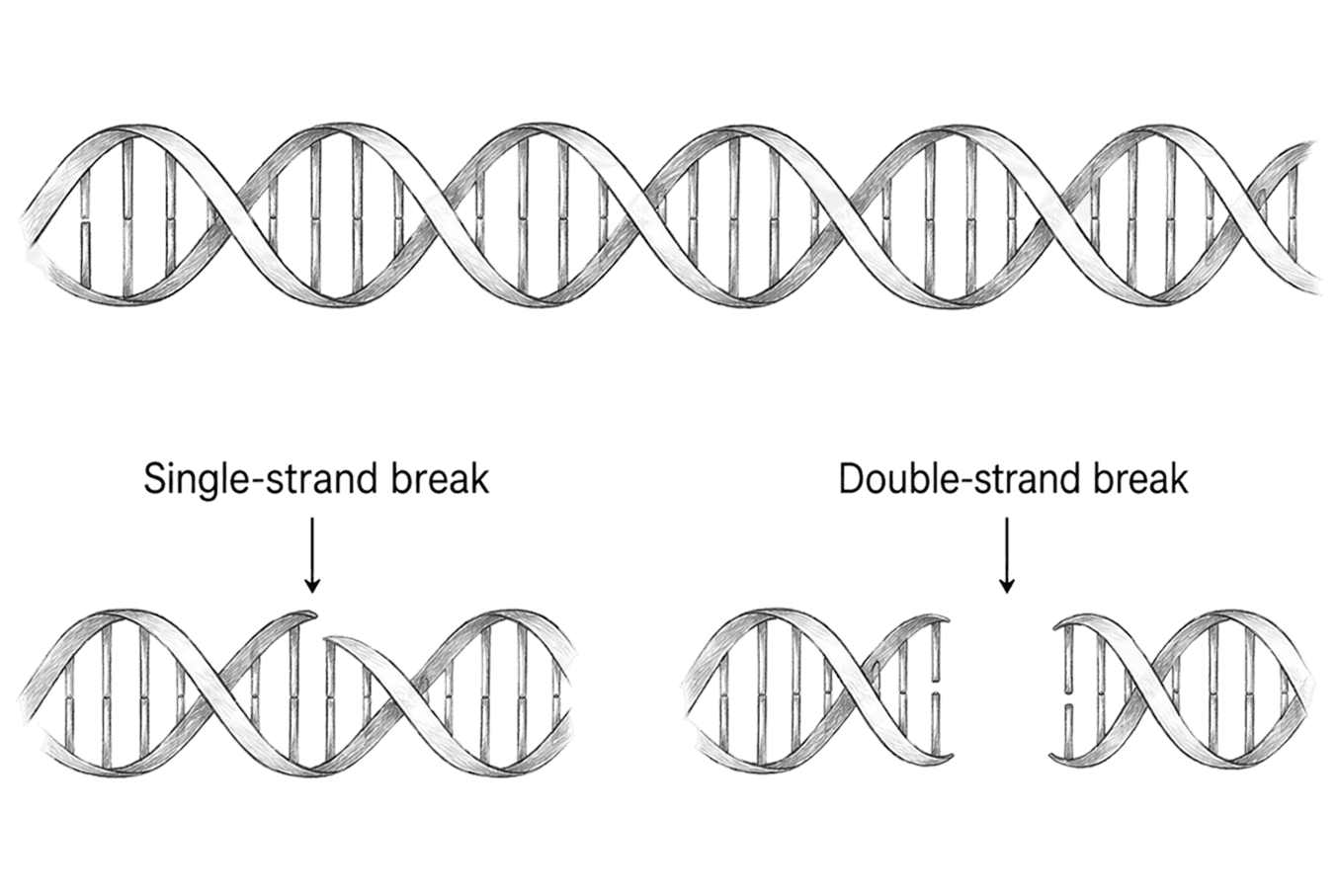
Double- vs single- strand breaks.
In one of humanity’s first forays into gene editing human embryos,10 scientists tried to do exactly that. Use Cas9 to cause a DSB, and then let the molecular tools of an embryo fix the DNA and insert the desired edit. It didn’t work. Worse than not working, though, the embryos were terrible at correcting DSBs, almost always resulting in massive chromosomal loss and genomic abnormalities. Using CRISPR-Cas9 in human embryos was like detonating a tiny DNA bomb. Dr. Dieter Egli described this previous foray into gene editing simply: “catastrophic”.9 To many skeptics, the paper seemed to suggest that a human embryo was simply too delicate for genetic modification.
But, science has a way of proving skeptics wrong.
Now, six years after the previous study, Dr. Egli and team achieved DNA editing efficiencies — essentially, how often the intended genetic edit worked — of up to 100 percent in human embryos, with no sign of chromosomal loss. One senior co-author was Dr. Nathan Treff, Chief Clinical Officer of Nucleus Genomics and an Associate Professor at Rutgers University. Dr. Treff is a pioneer in his own right, having published several papers11 that have shaped genetic testing in reproductive medicine.
This time around, Dr. Egli and Dr. Treff knew they needed to cut embryo DNA with a lot more finesse. Accordingly, rather than using Cas9 as molecular scissors to cut DNA in half, they used what is known as an adenine base editor (ABE). ABE is built from a modified version of Cas9 called Cas9 nickase, which only nicks one DNA strand instead of cutting both. Scientifically, this means the edit is made without generating a DSB. This made all the difference.
The researchers focused on engineering two genes: PCSK9 and HBG1/2. The former is a primary regulator of cholesterol; the latter governs fetal hemoglobin. The desired edit in both cases was a single A → G change. For PCSK9, the change disrupts the gene, causing lower LDL cholesterol levels and a reduced coronary heart disease risk. For HBG1/2, the change is a known variant that protects against diseases such as sickle cell disease and β-thalassemia.
The results were remarkable. Across the two target genes, the scientists achieved roughly 60 percent editing efficiency on average, with 84 percent of analyzed cells carrying at least one of the intended edits. In essence, most of the embryonic cells were successfully modified. This was among the highest success rates ever seen when engineering human embryos. Moreover, there was none of the earlier chromosomal damage that had plagued embryo editing. Switching to the Cas9 nickase and only cutting a single DNA strand enabled the embryo to repair itself with the desired A → G change.
Said differently, humanity’s ability to engineer life had gone from a tiny DNA bomb to a nimble pair of molecular scissors.
These scissors, of course, are still not perfect. The majority of the embryos edited were still mosaic, meaning not all the cells that make up the embryo were successfully edited. Mosaicism does occur in natural conception, though, it may make the outcome of the modification less predictable and potentially limit the effectiveness of the treatment. Ultimately, it remains a key limitation and one that further research will need to address.
Nevertheless, scientists have proven that reliable genetic engineering of human embryos is possible, bypassing what once seemed an insurmountable clinical barrier.
Nature12 reported that Nucleus will fund Dr. Egli’s next phase of gene editing research, with the goal of eventually bringing it into its work. I noted that gene editing is another tool that will help patients make a more informed reproductive choice to have a healthier child.
To many reading these articles, Nucleus’ involvement in gene-editing research may come as a surprise. To me, it was inevitable. I saw, several years ago, long before Nucleus ever launched its first product, all genomic technologies — from sequencing to editing — converging under the umbrella of one company, the Genetic Optimization Company.
To explain what I mean, I need to take you back about ten years.
My Origin
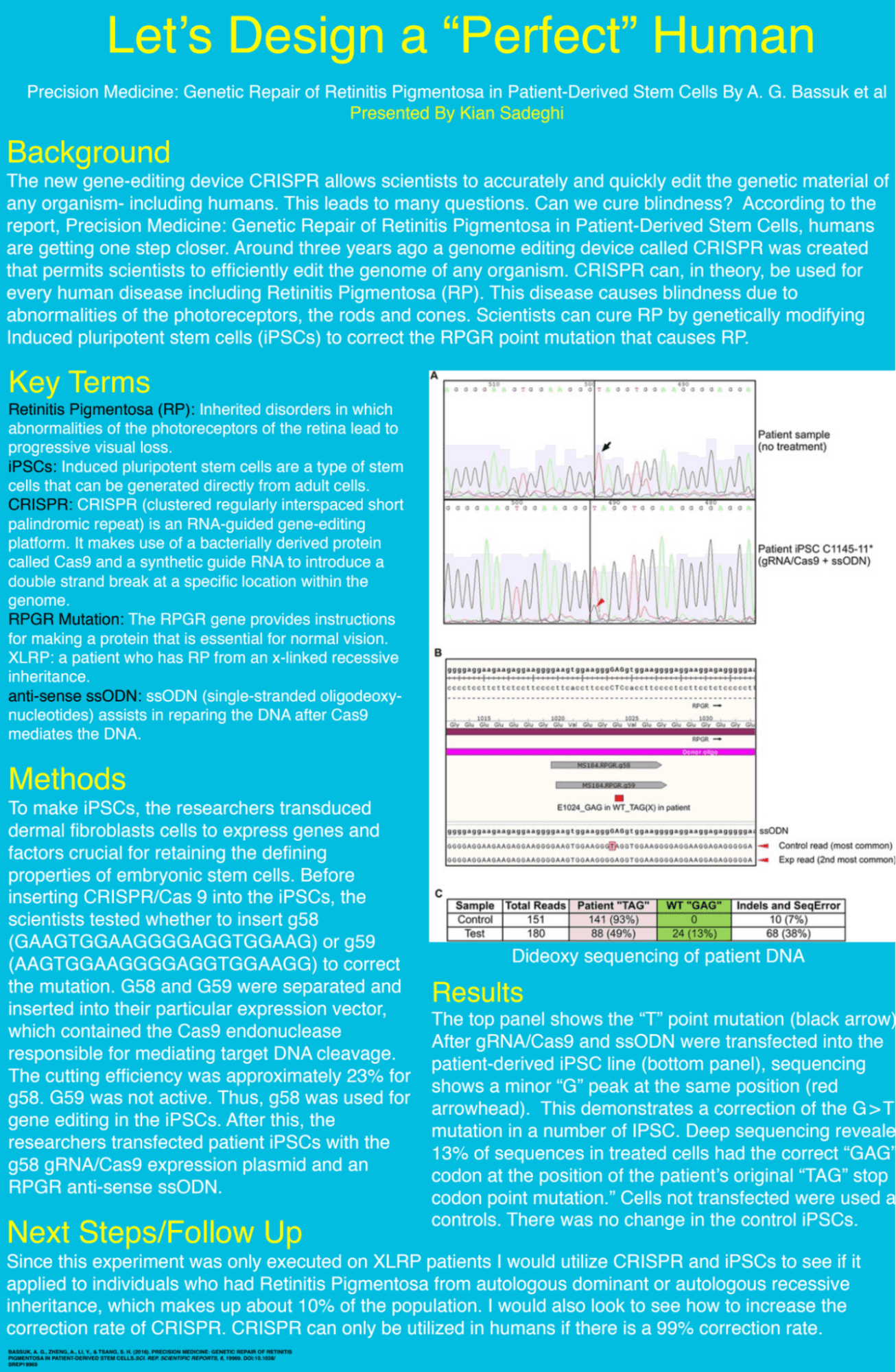
This photo was taken in 2016. I was standing in front of a poster that, believe it or not, said, “Let’s Design a ‘Perfect’ Human.” Even then, I had the instinct to put that in quotes. I was sixteen.
As a sophomore in high school, the topic I chose to focus on for my science fair was gene editing. About a year earlier, a scientist had visited our school and spoken about this extraordinary new technology called CRISPR. He described it as a molecular tool that could cut DNA at precise locations and potentially correct genetic mistakes.
Woah, I remember thinking. You can engineer life?
It felt so endlessly fascinating. I knew, growing up, that people in my family and life had died too soon, too young. My cousin suddenly passed away in her sleep as a teenager. My uncle died of a heart attack in his 40s. Both linked to “bad genetics,” as my dad would tell me. What if this could help prevent that? Moreover, what could you do, what could you discover, if you could reliably engineer life?
I was hooked.
In 2016, one of the landmark papers that came out was “Precision Medicine: Genetic Repair of Retinitis Pigmentosa in Patient-Derived Stem Cells.”13 Scientists had taken cells from a patient, repaired the disease-causing mutation for a form of inherited blindness, and demonstrated that the correction worked. It was a glimpse of something I couldn't stop thinking about: what if DNA wasn't destiny? What if the diseases that had haunted families for generations weren't simply inherited, but repairable? For the first time, biology seemed less like fate and more like a system we were beginning to understand, and perhaps, one day improve.
It is this paper that was my first foray into gene editing research. It is also this paper that I’m presenting at my school's science fair above.
Interestingly, the next paper I studied was from a year earlier: “CRISPR/Cas9-mediated gene editing in human tripronuclear zygotes.”14 Here, researchers used tripronuclear (3PN) zygotes — abnormal, non-viable embryos with three sets of chromosomes — to evaluate the efficacy and safety of CRISPR-Cas9 in human embryos. The results, similar to those of Dr. Egli’s earlier work mentioned above, were pretty abysmal. The study was treated as evidence that CRISPR wasn’t suitable for editing human embryos.
In a literature review I wrote at the time, I challenged the study with a critical question: “should gene editing devices like CRISPR [even] be used on humans/human zygotes?” Prescient question indeed. It got me thinking, though, about a decade prior to writing this book you are now reading, on the feasibility of actually engineering humans at the level of an embryo.
In 2017, about a year later and, as usual, a little ahead of myself, I figured that I was ready to actually try CRISPR. I emailed countless scientists asking if I could join their lab. To the surprise of absolutely no one, almost none of them responded.
Then I came across a DIY gene-editing lab called Genspace in Brooklyn. There was an age limit of sorts (I was seventeen and I think you needed to be eighteen), but I made a deal with the person running the lab: if I brought my teacher — shout out to my high-school bio teacher! — they should let me join the gene-editing experiment. They agreed.
Classes were on Saturdays. A weird thing about my high school experience was that I was obsessed with the soccer team AC Milan. In fact, I probably wore a different AC Milan jersey every day for all four years. I even wrote for a small sports blog on AC Milan15 in high school. Naturally then (and I promise you will see why this detail is relevant in a moment), I put on my AC Milan uniform and headed out the door.
My mom stopped me.
“Where are you going?”
“To the lab.” She looked at me, looked at my hair, and told me to brush it. “In life, you never know who you will meet.”
Ignoring her, I figured whatever. Who the hell was I going to meet?
The experiment at Genspace was focused on utilizing CRISPR-Cas9 to engineer brewer’s yeast, or Saccharomyces cerevisiae. The goal was to disrupt a gene called ADE2 and then try to insert the coding sequence for green fluorescent protein (GFP) in its place. ADE2 plays a role in the production of adenine, one of the four nucleotides that make up DNA. When the gene is disrupted, a precursor builds up inside that cell that causes the normally cream-colored yeast to turn red.
So the experiment gave us a remarkably visible way to see whether the editing had worked. If CRISPR successfully disrupted ADE2, the yeast would turn red. If we both disrupted ADE2 and successfully inserted GFP, the yeast would turn red and glow green under the appropriate light.
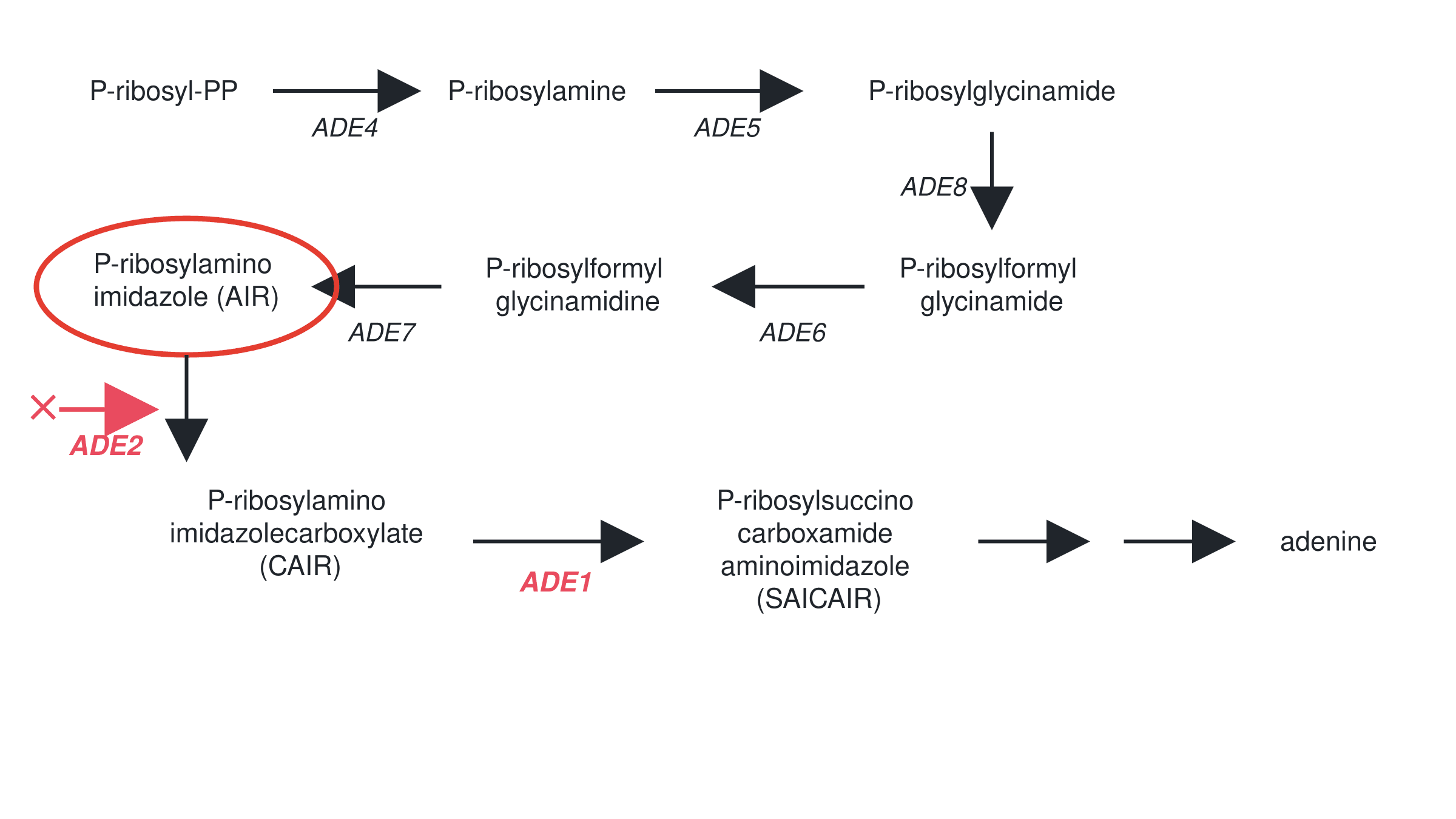
A visual of the metabolic pathway we were disrupting.
When I arrived at the lab, it was really the size of a few closets on the second floor of a random building by the Barclays Center, where the Brooklyn Nets play basketball. Most of the people there were older, with all sorts of bizarre reasons for why they’d shown up. And then, as life would have it, there was Amy Docker Marcus, a Wall Street Journal journalist. She was writing a story on Genspace and the DIY gene-editing enthusiasts working there. I was the youngest person in the room. That piqued her interest. One thing led to another, and before I knew it, I was being interviewed.
In what can only be described as some sort of dance with destiny, Marcus published an article titled “DIY Gene Editing: Fast, Cheap — and Worrisome.”16 It ran on the front cover of the health care section, and the picture accompanying the story was, believe it or not, an even younger Kian — in an AC Milan uniform, no less — slightly smiling at the awkwardness of a giant light flashing in his face as he read notes on gene-editing steps. I should have brushed my hair. Sorry, Mom!
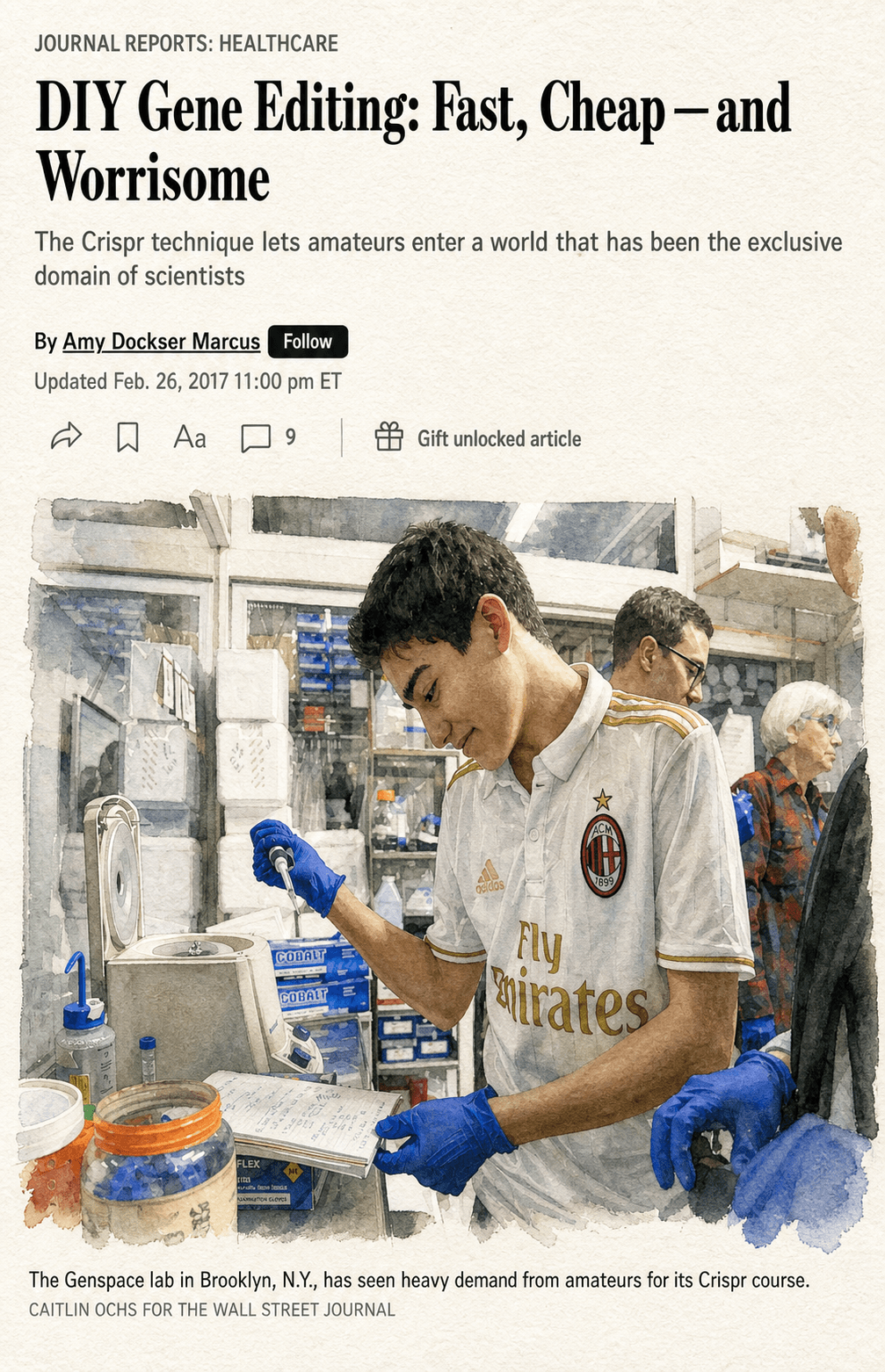
The article talks about “the Crispr technique [that] lets amateurs enter a world that has been the exclusive domain of scientists.” The article starts off by noting:
“Kian Sadeghi has postponed homework assignments, sports practice and all the other demands of being a 17-year-old high-school junior for today. On a Saturday afternoon, he is in a lab learning how to use Crispr-Cas9, a gene-editing technique that has electrified scientists around the world — and sparked a widespread debate about its use.”
It continues to elaborate on the ethics of DIY gene editing and the rise of CRISPR. One interesting tidbit is:
“A scientific advisory committee set up by the National Academy of Sciences and the National Academy of Medicine issued a report this month that supports human genome editing to try to treat and prevent diseases, but says more public discussion is needed for other uses, such as editing genes in eggs, sperm or embryos, which could be passed on to future offspring.”
Ironically, ten years later, that same sentiment would be written again by the National Academy of Sciences. The article continues and eventually ends on my biology teacher trying to assuage my concerns about my pipetting abilities:
“‘It’s like driving,’” [Kian’s teacher] tells him. ‘You learn the right feel.’ Mr. Sadeghi doesn’t have his driver’s license yet. He figures he’ll do Crispr first.”
I still don’t have my driver’s license. But what this experience did teach me was to trust my curiosity. At a very young age, I learned that some instincts are worth following, even when bizarre or seemingly irrational. Without that experience, I’m not sure I would have had the confidence to start Nucleus.
After doing this work at Genspace, I continued to do DIY gene editing, eventually writing a paper titled “CRISPR/Cas9 Editing.”17 It outlined further work, this time on bacteria, where we attempted to make E. coli resistant to an antibiotic called streptomycin using the Odin kit.18
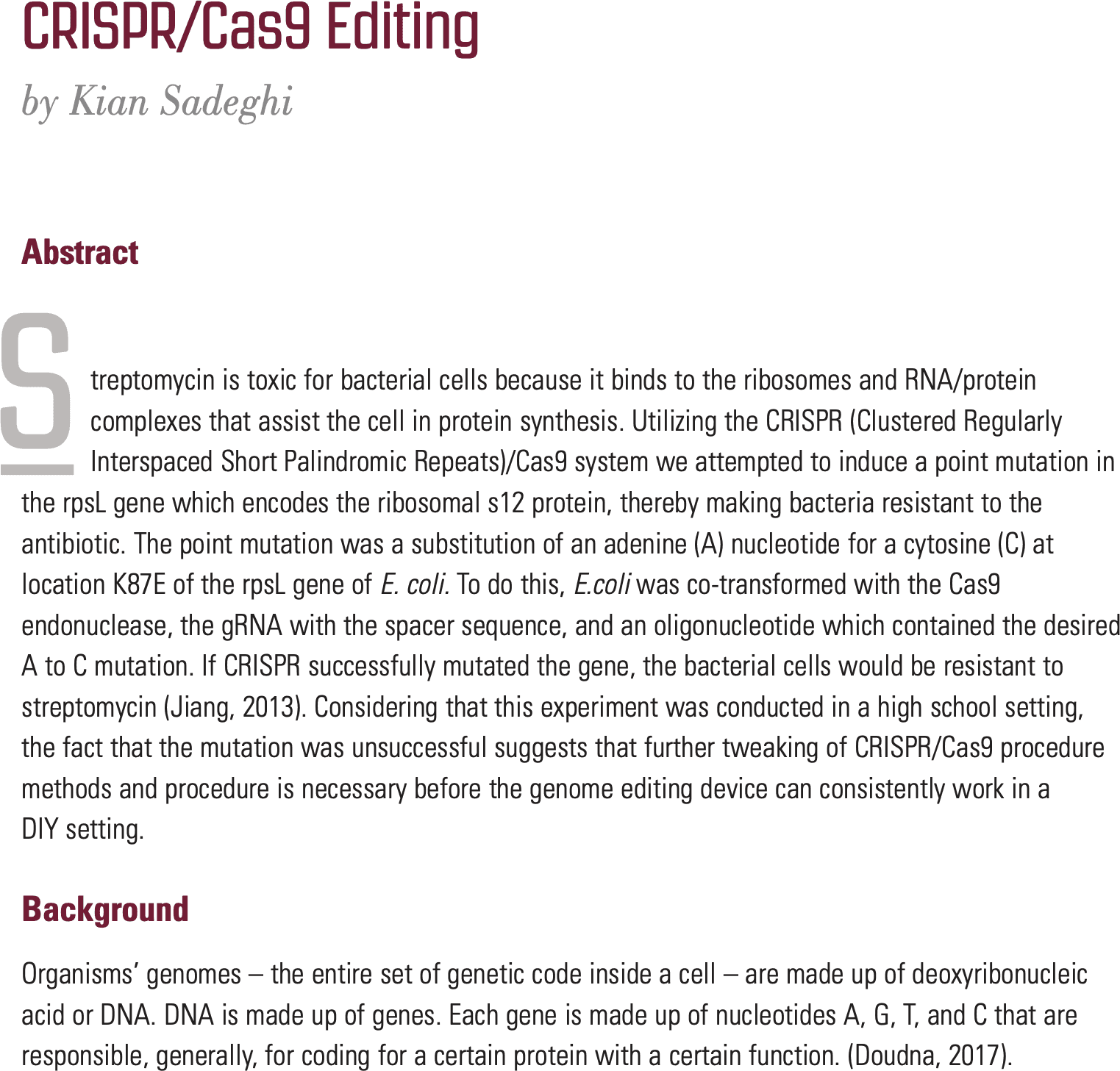
Attempting to engineer the bacteria, unfortunately, didn’t work. Made me realize that “DIY” gene editing is somewhat of an oxymoron.
In the conclusion of this paper, I wrote:
“CRISPR may even be used one day to edit human embryos to rid them of any inherent disorders or make a child be a certain height or have a certain colored hair.”
At this point, having graduated high school, I had pretty much exhausted all the DIY CRISPR experiments you could do and felt I needed to move into the big leagues. Naturally, as I thought about what I wanted to do in college, it was obvious: gene editing. In fact, it was so clear to me that in my common application to Penn, the university I ultimately attended, albeit briefly, I wrote:
“Considering the imminent revolution in genome editing, scientists will be the pioneers of not only medicine, but of evolution and life itself. To fully realize this revolution, it is my wish to dedicate my life to these two disciplines, marrying science and business in pursuit of large-scale therapies and cures.”
I was even more succinct in my main common application essay that went to all the colleges I applied to: “I have plans to found a biotech company” around, of course, CRISPR. When I applied to Penn, I sought admission to the Life Sciences and Management (LSM)19 program as my first choice, which was business and science in one program, and the College of Arts and Sciences as my second choice. I got rejected from LSM but did get into the college.
When I went to Penn, I began to be influenced by this guy named Paul Graham whose essays20 I started reading. Graham is one of the godfathers of contemporary Silicon Valley thought, who espouses precise yet substantive ways on how to found and run a startup. His essays revolve around software and programming. As I read them, I began realizing that the logistics of starting a gene editing company — not exactly a software company — would not be easy at all. I ruminated on how one could go about doing it, or whether it made sense to start a more trivial company that wasn’t rooted in biotech.
I figured the best thing to do would be to learn computer science. Maybe I could combine it with gene editing and biology in some way? This led to two of the best decisions I made in college, for they would both prove to be pivotal in starting Nucleus: 1) taking computer science and bio-stat classes, and 2) reading CS183: Startup.21 The latter are notes I found online from another billionaire guy named Peter Thiel. Remarkably, in classic Thiel fashion, he had a brilliant little essay comparing biotech and AI22 (in 2012!) and evaluating which one to pursue. He actually said, in what may be truly one of the most prescient investment calls of the twenty-first century, AI is “contrarian and under-explored.” If you want a cool thing to read … go read that. He also remarks on genome sequencing, longevity, and computational biology where he writes:
“One big question is the extent to which biological problems can be reduced to computer problems? The cost of DNA sequencing is falling rapidly. It cost $500 million to sequence a genome in 2000. Now that’s down to something like $5,000. Within a year or two, it will probably cost $1,000. The question is whether we can do as much as people have been assuming we can with all the information this will yield.
The Human Genome Project was seen as incredibly revolutionary in the late 1990s. But it hasn’t quite lived up to the hype. Perhaps it was all too early or too costly. But the second cut may be that it’s because the main problem is not a sequencing problem at all. The biggest problem may be that we just don't know what to do with the data. Exactly how much of biology is computational is still an open question.”
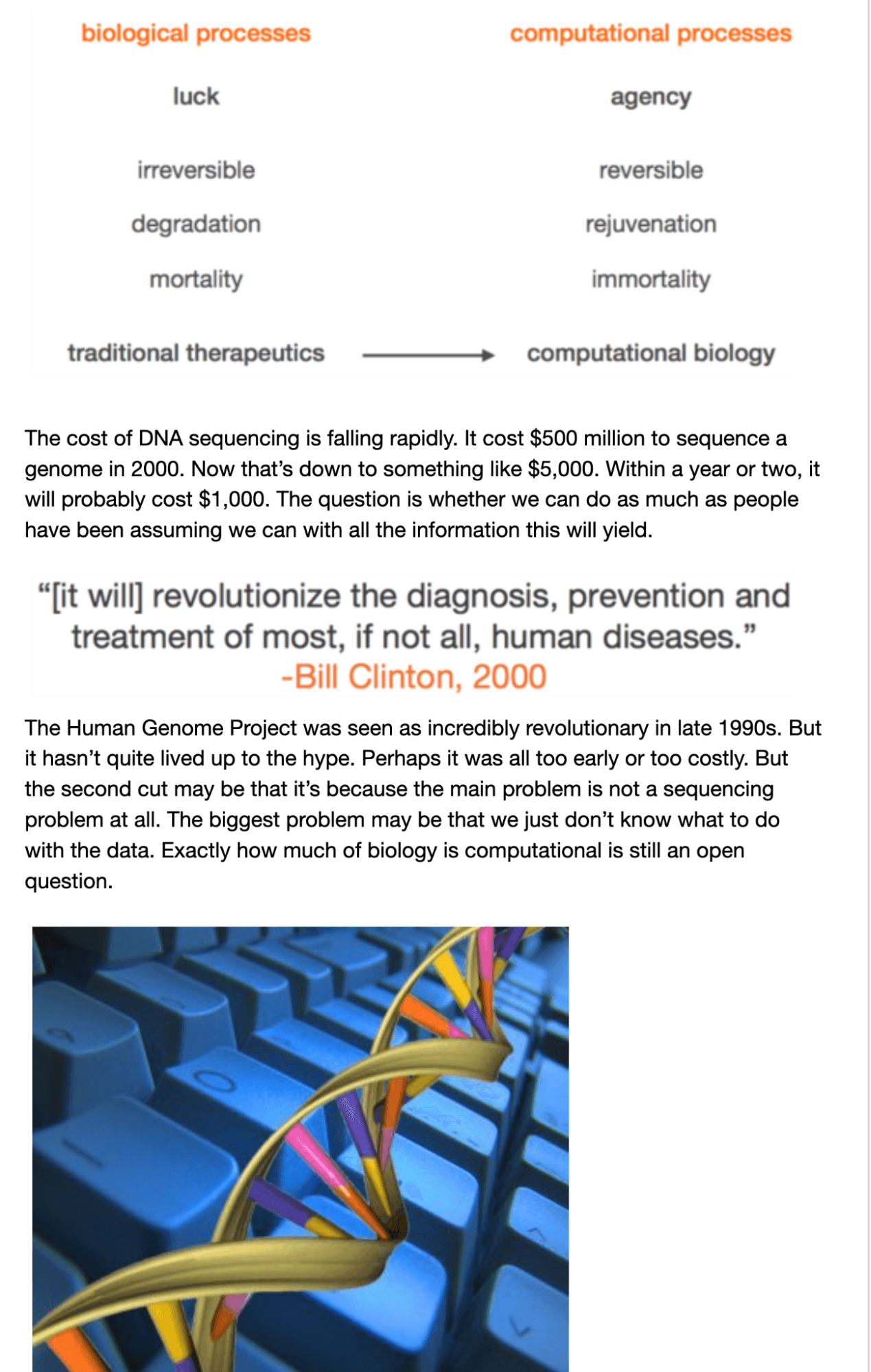
This got me thinking. Is this the way to combine genetics and programming? It also got me thinking about what happened to genome sequencing. How does it make sense that reading the entirety of our source code has led to … nothing? What??! Interestingly, I remember also reading at the time Graham mentioning in his essay “How to get startup ideas”:23
“So if you're a CS major and you want to start a startup, instead of taking a class on entrepreneurship you're better off taking a class on, say, genetics.”
He then continues:
“The most successful startups generally ride some wave bigger than themselves, it could be a good trick to look for waves and ask how one could benefit from them. The prices of gene sequencing and 3D printing are both experiencing Moore's Law-like declines. What new things will we be able to do in the new world we'll have in a few years? What are we unconsciously ruling out as impossible that will soon be possible?”
From my vantage point in 2018–2019, I felt Thiel was being too bearish in his essay about genomics. We could now engineer human life, I couldn’t imagine a technology more consequential than that. Between Graham and Thiel, what I had been grasping at coalesced: apply computation to genomics as a way to get started now. That is, harness the wonders and efficiency of software to get a genomics company off the ground. Then, eventually, incorporate the far more expensive, regulatorily complicated, and technical challenges required for a gene-editing company, which I viewed principally as a human optimization company.
In other words, on Thiel’s computational processes to biological processes axis, start from the right, then move to the left.
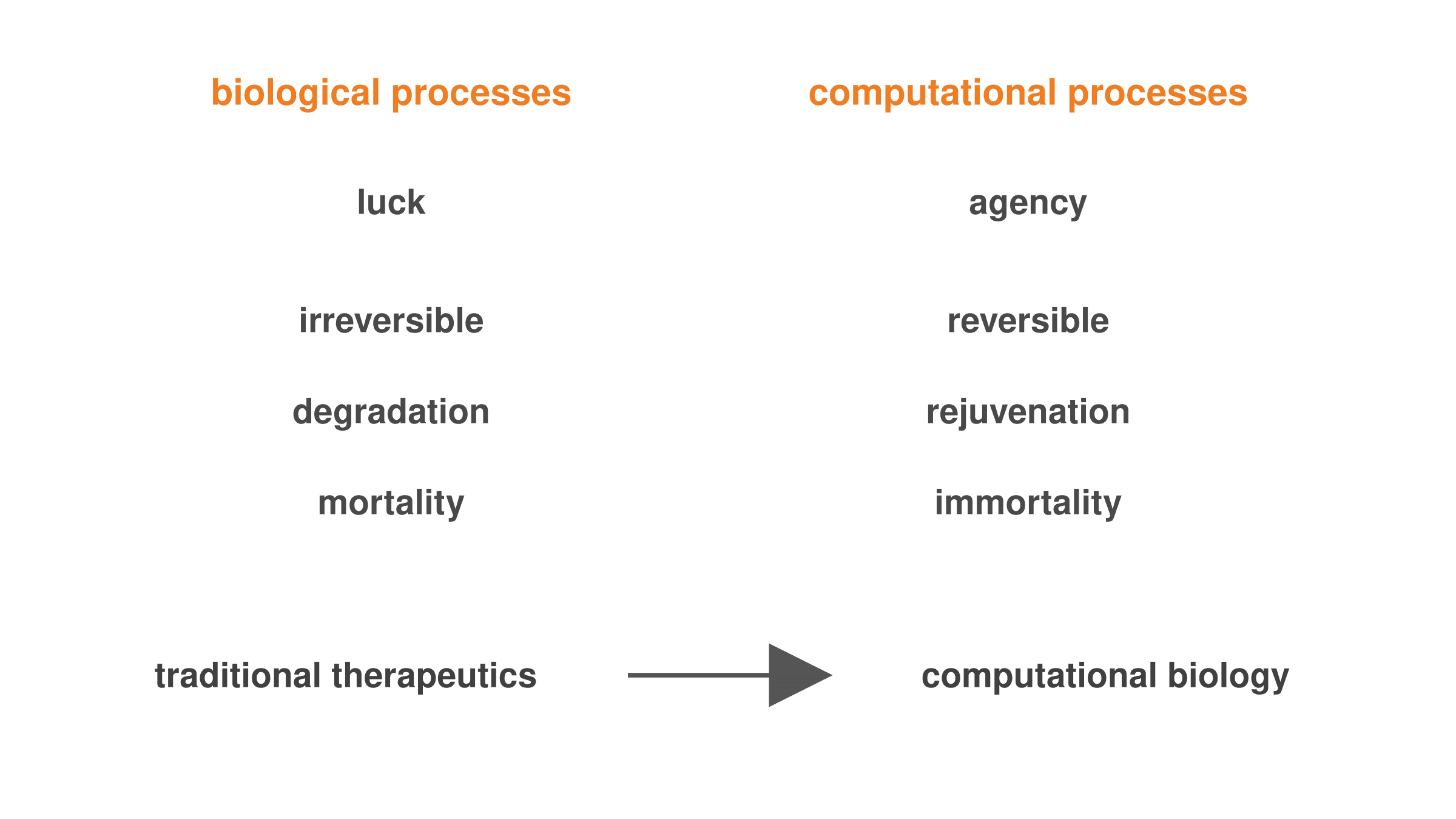
Thiel’s model on how to think about starting a bio company.
It was around this time when I was in Bio 221,24 a genetics class at Penn, that I really started thinking more about the decrease in cost of sequencing a human genome, and, in that class, I learned about this thing called genome-wide association studies or GWAS.
It turns out, there was a massive data repository called the GWAS catalog25 that had all these genetic associations for thousands upon thousands of diseases and traits. If my memory serves me correctly, I learned about it in a guest lecture by a Penn professor named Dr. Iain Mathieson,26 whose group studies population genomics. I was watching this presentation when I turned to my classmate and asked, what can you do with all this data?
The question, in retrospect, was one that Thiel’s essay on genomics had no doubt influenced. My classmate responded by asking if it would be in the midterm. I knew, then, I had to leave college.
And COVID provided the perfect timing. My thesis was simple: the cost of sequencing would continue to plummet, there would be an exponential rise in genomics data, and someone should build the software application that analyzed this data. I called my girlfriend at the time and pitched her the idea. The name “Nucleus” came to me because an atom’s nucleus hangs in the middle of my childhood bedroom as the main light fixture. I looked up at the light and thought perfect.
The year that followed in my bedroom could be a 10,000 word essay on its own. But for the purposes of this book, I filled in about eighteen subject notebooks — which exist in a safe in my bedroom to this day — on computational and statistical genomics, focused on trying to build this software application that could analyze whole-genome DNA. This was the incarnation of Nucleus you are probably most familiar with if you have followed the company for a while. Hold that thought for later.
Now, I want to go back again. This time, much deeper in history. I quickly realized that the work I started doing in my bedroom in 2020 was really on the backs of about 150 years or so of genomics research culminating together. To understand the future of human evolution, you must first understand the history of genetics.
Buckle up.
Chapter 2
A Double-Helixed History
The genetic optimization (GO) industry emerged from the convergence of two seemingly independent scientific revolutions: genetics and in vitro fertilization (IVF).
DNA was first isolated in 1869 by a Swiss chemist named Friedrich Miescher (called "nuclein" at the time). He did not know its biological function or that the molecule had anything to do with heredity. Thus, the study of genetics did not begin with DNA. Instead, it began earlier, in 1856, in a quiet monastery in the Czech Republic. A monk named Gregor Mendel started running sophisticated pea-breeding experiments using meticulous tracking to try to understand heredity.
At the time, nobody knew what DNA or a gene was. The only thing Mendel knew was that traits seemed to follow patterns. Some pea plants were tall, some were short. Some produced yellow peas, others green. By crossing plants and carefully recording the outcomes generation after generation, Mendel, being a mathematician, noticed that the inheritance patterns of peas were not random but followed specific statistical patterns.

Mendel is the second person standing from the right.
He also noticed that phenotypes (basically any attribute or characteristic in an organism, like flower color or height) were passed through “discrete units” — what became known as genes — rather than blending together like paint. For example, a tall parent and a short parent did not inevitably produce a medium-height offspring. Instead, discrete invisible instructions were being transmitted across generations according to mathematical rules.
Mathematical rules. Genetics has a long history as a statistical versus a molecular science. Many people today, when they think of genetics, think of a wet-lab or some sort of diagnostic. When I think of genetics, I think of a pen and paper. I think of math. It is this fundamental shift in perspective that is and has always been the basis of genetic prediction.
As we will see, this fact — genetics as a statistical, not a molecular science — was not just embodied by Mendel. The derivation of advanced genetic prediction itself came more than a century prior to its molecular or empirical validation.

Mendel identified that the phenotypes of pea plants followed specific ratios, in this case, 3:1 for being purple.
One way of thinking about Mendel’s work is that he had discovered the software of life, i.e., the principles of heredity, before understanding whether the hardware existed, where or how these principles were actually physically being transmitted from one generation to the next.
One of the people who helped transform Mendel's abstract observations into a physical science was Thomas Hunt Morgan. Morgan was initially skeptical of Mendel's theories. He wasn't convinced that inheritance could be explained by these invisible hereditary units. To investigate, in around 1910, decades after Mendel had done his work, Morgan turned to his own experimental organism: fruit flies.
Morgan’s lab was located in uptown Manhattan at Columbia University, about 10 miles or so from where Nucleus was started. The tiny lab, appropriately being nicknamed the “Fly Room,” contained hundreds of thousands of flies and almost a dozen graduate students.
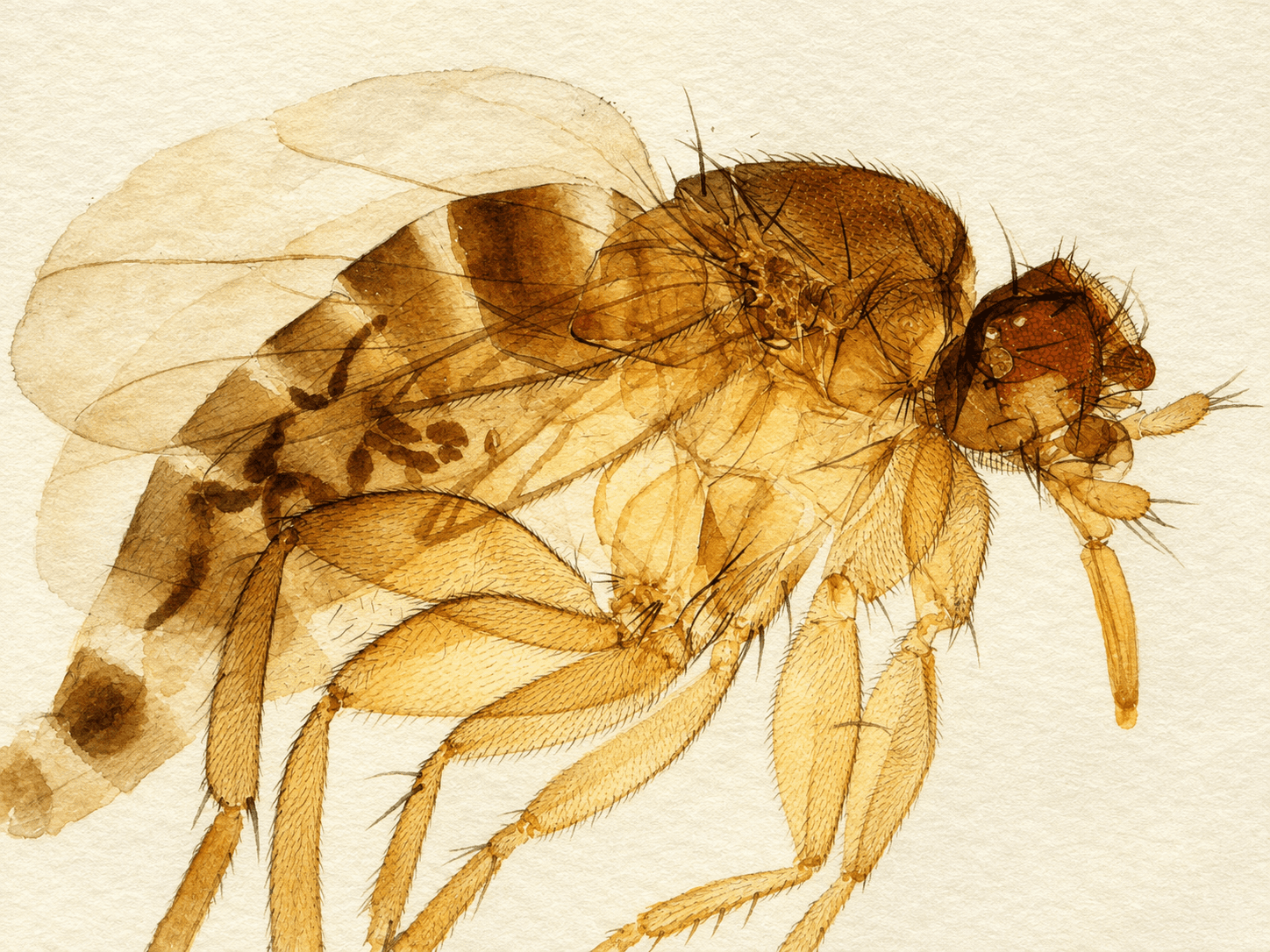
Example of looking at fruit flies called Drosophila melanogaster under a microscope. The fly room is talked about on the Columbia Biology history page.27
In this cramped room, Morgan and his team established many of the principles of modern genetics. Specifically, amongst several observations, Morgan demonstrated that hereditary factors or “genes” were physically located on this thing called chromosomes.
But that raised another question: what, exactly, were genes made of? Protein? Or maybe DNA? This was being fiercely debated.
Meanwhile, several years after Morgan did his work, another critical part of genomics history happened. One that happened in a notebook. And one that’s gotten largely lost by modern-day genetics textbooks and classes.
Mendel’s theory, the Punnett squares you did in high school, intuitively makes more sense for traits that come in categories, like if someone has a rare disease or not. However, what it could not explain, though, were traits we see in everyday life that exist on a spectrum, things like height, IQ, or BMI.
For people in the early twentieth century, the two seemed like a contradiction. How does someone reconcile a fundamentally discrete theory of heredity (what Mendel proposed) with the continuous traits humans see every day in real life?
A brilliant statistician named R. A. Fisher answered this exact question in 1918. He wrote a paper called “The Correlation between Relatives on the Supposition of Mendelian Inheritance”28 in which he showed mathematically that continuous traits could emerge naturally from Mendelian inheritance if they were influenced by, not one or two, but countless hereditary factors (read: genes).
For example, in Fisher's theoretical framework, a trait like height is not determined by a couple of genes with large effects (how most people still think about genetics), but by the cumulative effect of a huge number of genetic markers or “variants” spread across the genome. Each variant (read: DNA difference) nudges the trait slightly higher or lower. When these tiny effects are summed across the genome—and combined with environmental influences—the result is the smooth, bell-shaped distributions we observe in the real world.
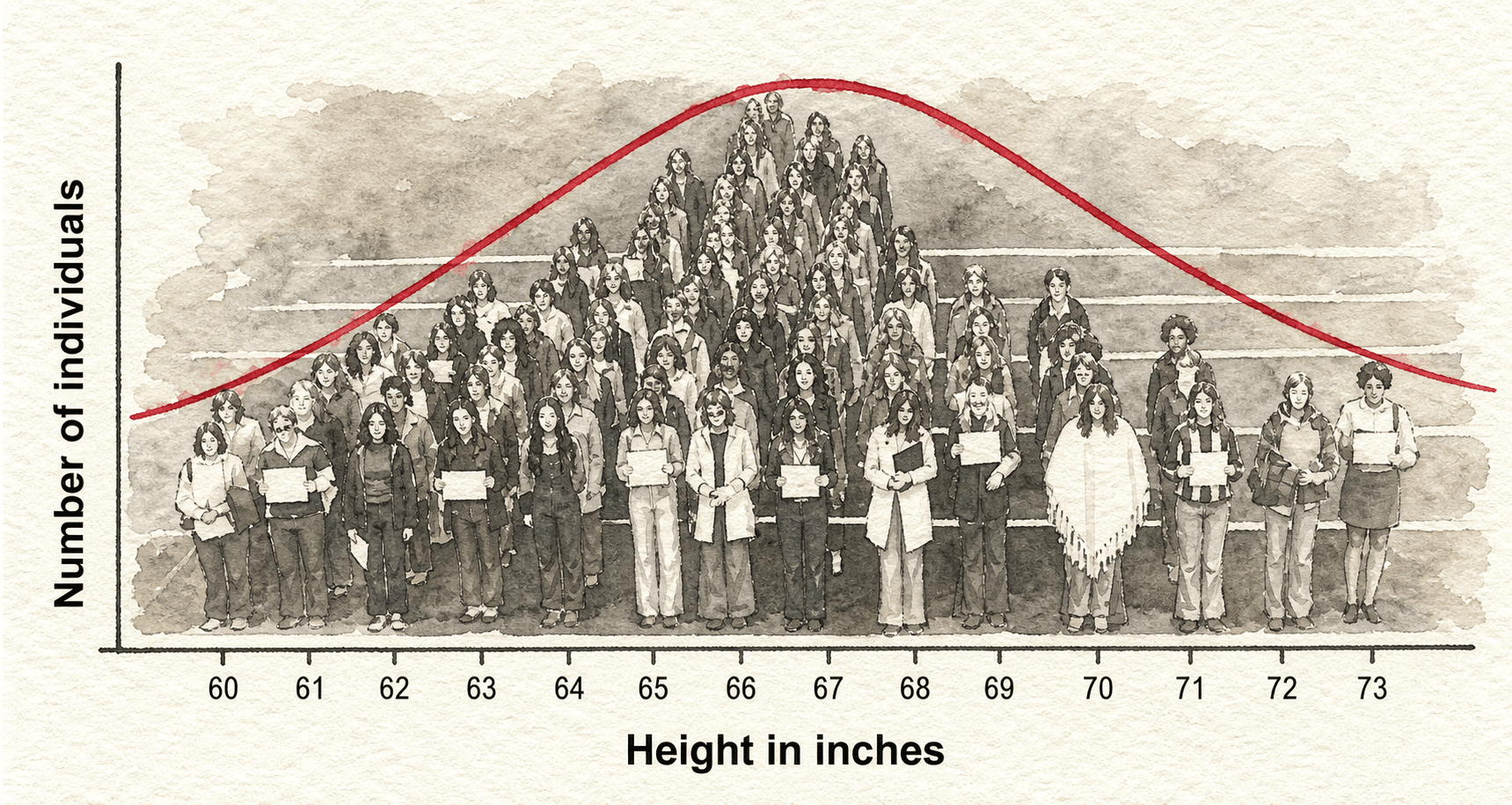
Height is an example of a continuous phenotype.
This insight became known as the infinitesimal model:29 the idea that complex traits (like disease risks, height, IQ) are influenced by an extremely large number of genetic markers, each with effects so small that they are almost imperceptible individually, but highly predictive when considered collectively.
This infinitesimal model is the foundation of what is now known as polygenic prediction. It is also, more than a century after Fisher proposed the theoretical model, what is being used today in advanced genetic models, including by Nucleus, to predict things like disease risk, height, and IQ from human DNA. What is so remarkable about Fisher’s paper is that, following Mendel’s lead, he derived the theory behind polygenic prediction without even knowing what DNA was. One of the biggest misconceptions today is that the science behind polygenic prediction is “new”; it is, in fact, well over a hundred years old.
Remember that Fisher’s work was purely mathematical. This means that humanity understood the principles of heredity prior to knowing where these principles actually physically resided, before knowing the answer to the question: what are genes actually made of?
As I already alluded to, for many scientists in Fisher’s time, the answer seemed obvious. Proteins, of course. Proteins were very complex and life was very complex. DNA, meanwhile, was far too simple to be the language of life. It would take several more decades, now in the 1950s, for scientists Alfred Hershey and Martha Chase to run a beautiful experiment to get to the bottom of this question.
Hershey and Chase were studying bacteriophages, tiny viruses that infect bacteria. They reasoned that whatever molecule a bacteriophage injects into its bacterial host to direct the creation of new viruses must be the molecule that carries hereditary information. To test this idea, they labeled the bacteriophages' DNA with radioactive phosphorus and their protein coats with radioactive sulfur.
If DNA carried heredity, the phosphorus signal would enter the bacteria. If proteins carried heredity, the sulfur signal would enter.
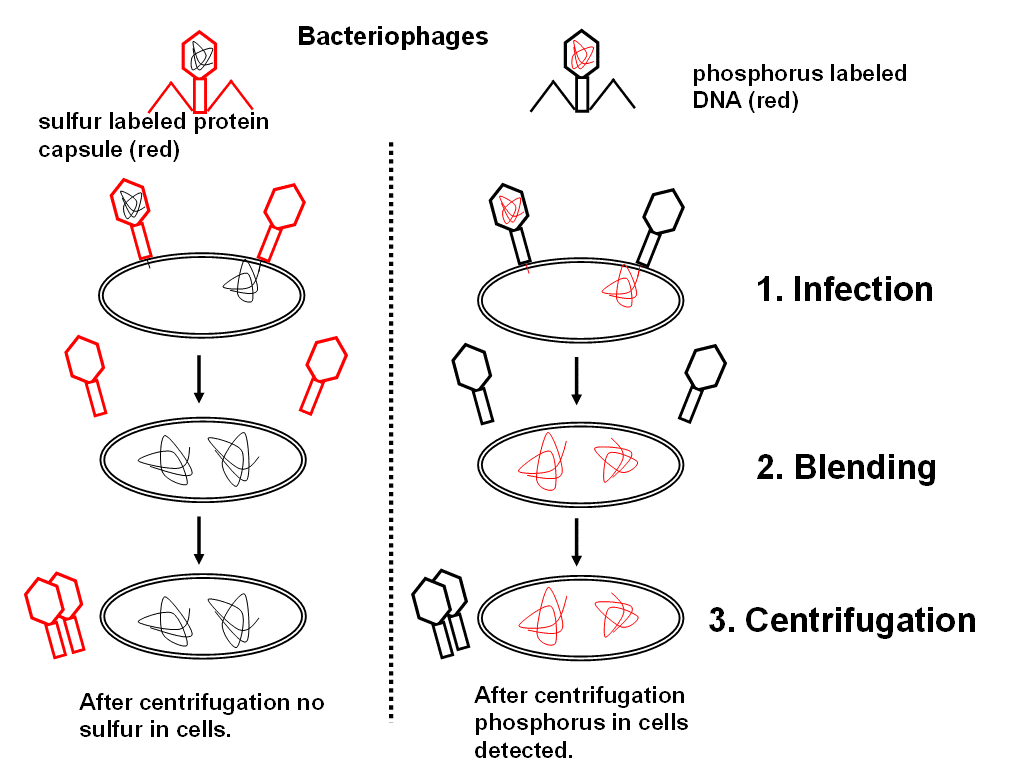
Model of the Hershey-Chase experiment.
When they isolated the material inside the bacterial cell, it was clearly DNA. This rocked the scientific world.
Remarkably, it was the following year, in 1953, that Raymond Gosling, a PhD student working under chemist and X-ray crystallographer Rosalind Franklin, PhD, took photo 51. The image helped molecular biologists James Watson and Francis Crick at Cambridge propose the double-helical structure of DNA, one of the most famous scientific discoveries of all time.
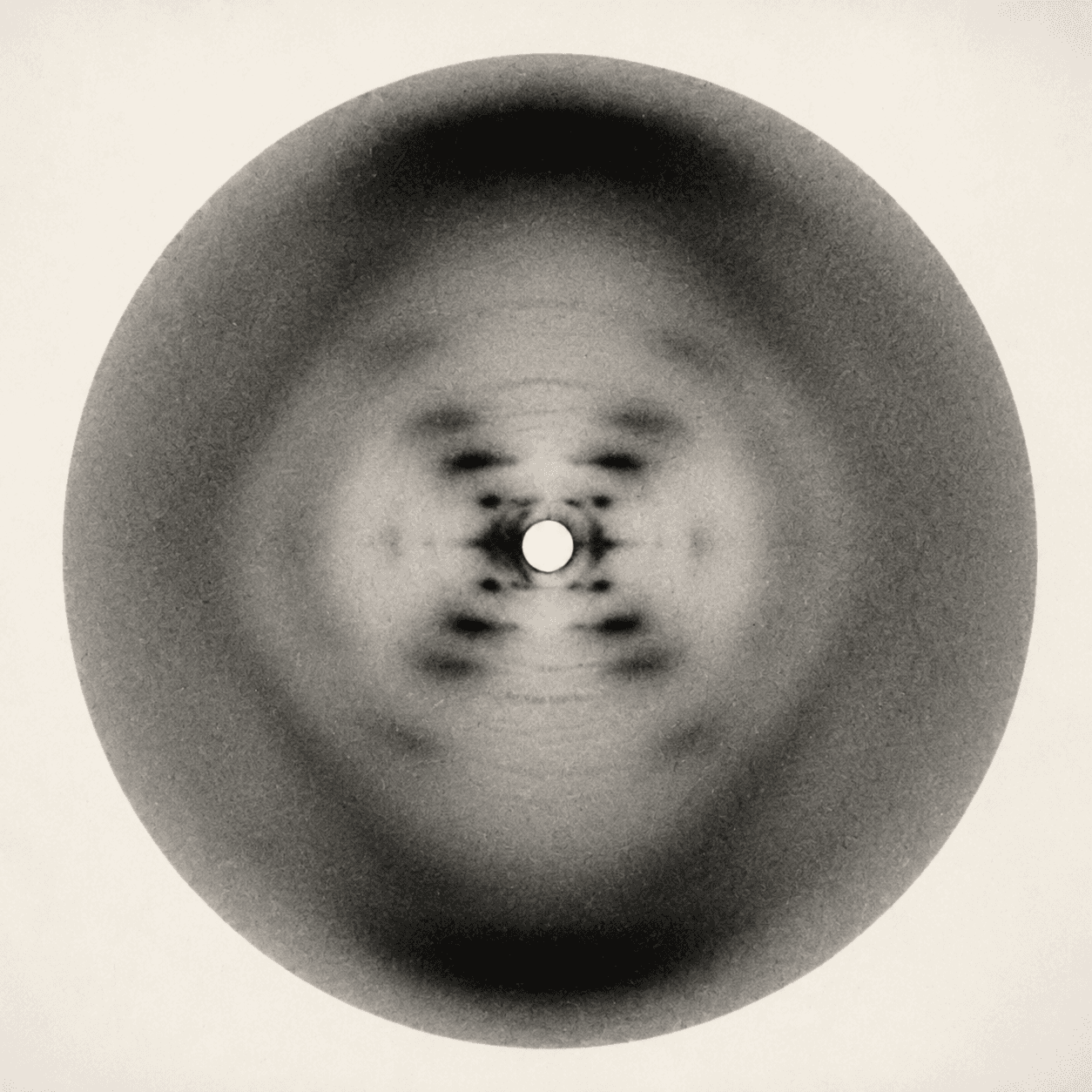
Humanity could, now, about one hundred years after Mendel proposed the first model of heredity, see the architecture of its own source code. DNA’s structure.
The elegance of DNA as the source of all life is difficult to overstate. Four chemical letters — A, T, C, and G — arranged in different combinations are responsible for every being that has ever lived. Every tree, every whale, every bacterium, every human, every eye color, every blood type, every inherited disease, and every evolutionary adaptation. All of it comes from the combination of just four letters.
Software engineers often marvel that the modern world runs on sequences of zeros and ones. Biology perfected simplistic storage of complex information billions of years earlier.
As molecular genetics started taking off, another revolution was quietly being born, this one in America.
The IVF Revolution
Only six years after scientists identified the structure of DNA, a scientist in Massachusetts named Dr. Min Chueh Chang demonstrated31 that rabbit eggs fertilized outside the body could be transferred back into the uterus and could develop into healthy offspring.
By 1959, scientists already knew that a sperm and an egg fuse to create an embryo. They could even watch an embryo developing under a microscope. But conception had, prior to Chang, remained fundamentally tied to the body.
This posed an obvious question. Would that work in a human? If you could fertilize a rabbit egg outside the womb and then get the animal pregnant, could you do that with humans?
Robert Edwards, PhD, a developmental biologist, was, come hell or high water, going to figure it out. On the back of Chang’s paper, he spent a decade seeking to understand how human oocytes matured and under what conditions they could be fertilized in the laboratory. His work culminated in a landmark 1969 paper in Nature titled “Early Stages of Fertilization In Vitro of Human Oocytes Matured In Vitro.”32
In the paper, Edwards and his colleagues reported something unprecedented: you could mature and fertilize human eggs outside the body, and embryonic development would begin. Chang’s results, in other words, had started to replicate in humans.
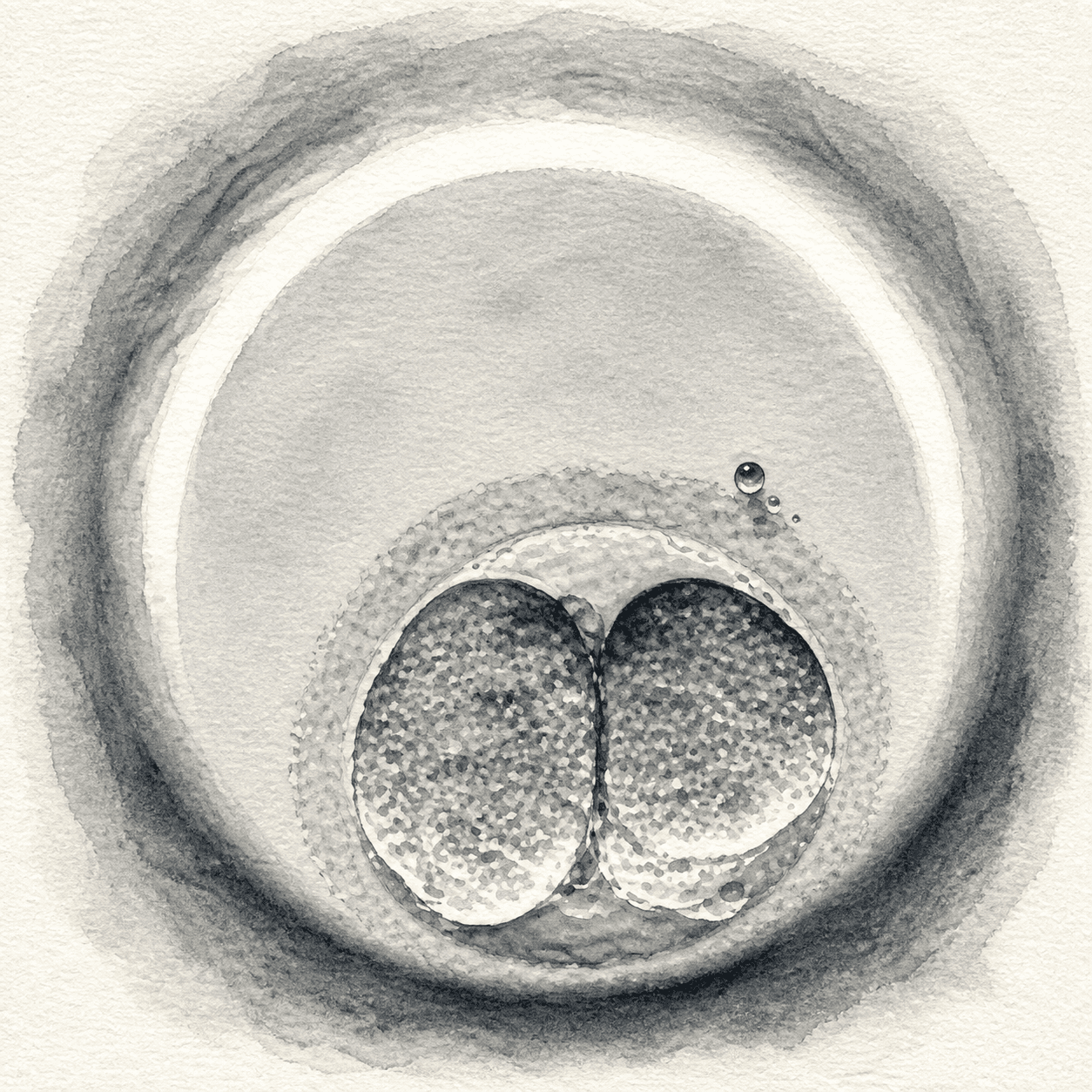
An embryo replicating under a microscope.
The paper established that this thing called in vitro fertilization was biologically possible. In the Nature paper, the team casually wrote:32
“Human oocytes have been matured and fertilized by spermatozoa in vitro. There may be certain clinical and scientific uses for human eggs fertilized by this procedure.”
You can say that again! Of course, this was just step one. Fertilizing and maturing an embryo versus producing a successful pregnancy were very different challenges. After all, making an embryo was only half the battle. It still had to implant and develop into a pregnancy.
To solve the latter problem, Edwards had partnered with Patrick Steptoe, MD, a surgeon who had pioneered laparoscopy, a technique that allowed eggs to be retrieved directly from the ovaries. Throughout the 1970s, the pair worked to transform what was essentially a laboratory demonstration into a viable medical procedure: to use IVF to get a woman pregnant and, ultimately, give birth.
Their failures were relentless. The scientists had more than “100 failed attempts to establish a pregnancy.”33 At the same time, opposition to their work grew as the media labeled their work “making test-tube babies.” Nevertheless, they persisted. In 1977, nearly twenty years after Edwards had begun research on in vitro fertilization, a patient named Lesley Brown arrived at their clinic.
Lesley and her husband John had spent years trying to have a child. It turns out Lesley's fallopian tubes were blocked. Under normal circumstances, at any point in human history right up until that very moment, sperm and egg could never meet.
But these were not normal circumstances. Edwards and Steptoe retrieved one of Lesley's eggs, fertilized it outside the body, and transferred the resulting embryo back into her uterus. Remarkably, it worked: Lesley was pregnant.
For the first time, humans were trying a new way to conceive, and it captivated the world. Both the hospital and Brown’s home became a topic of international obsession.
On July 25, 1978, a baby girl named Louise Joy Brown was delivered by cesarean section in Oldham, England. She became the first human ever conceived through in vitro fertilization.
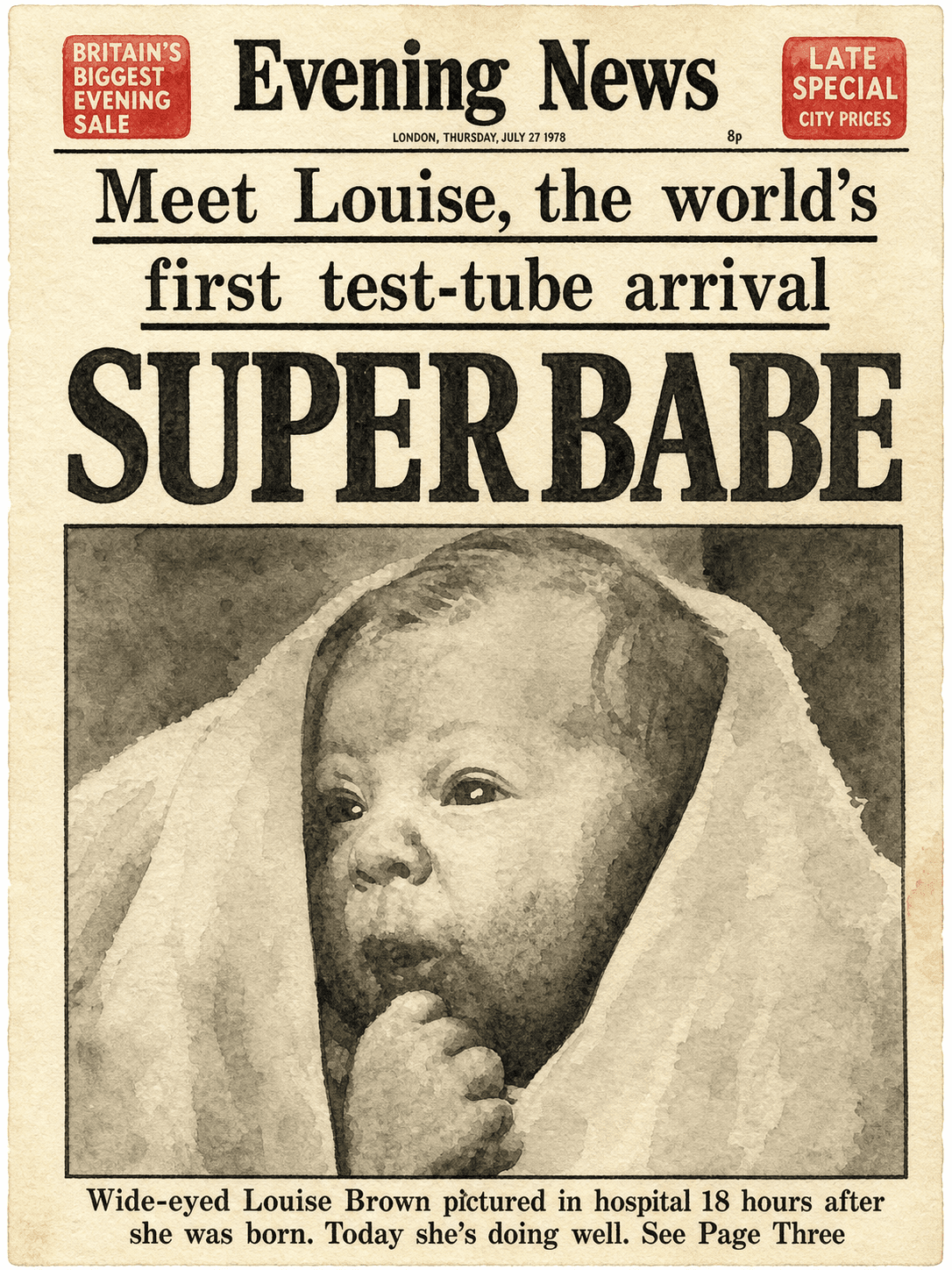
The first-ever “test-tube” baby. Note that … no test tubes are used during this process.
Brown was examined for any and all signs of abnormal development, and there were none. Her most remarkable feature was how unremarkable she was. She was healthy, ordinary. And at just forty-eight years old, Brown is now the oldest person born via IVF.
The fact IVF actually worked — the fact IVF actually worked! — is extraordinary and easy to take for granted. Nature is so remarkably designed, so modular, that fertilization can happen inside a clinic and still produce a healthy, beautiful baby, indistinguishable from one conceived naturally. Extraordinary doesn’t do it justice.
With the birth of Brown it was obvious that an entirely new field of medicine had been born. Less obvious, as “The Test-Tube Baby” was splashed across the cover of TIME magazine, was that an entirely new application of genomics had been born with it.
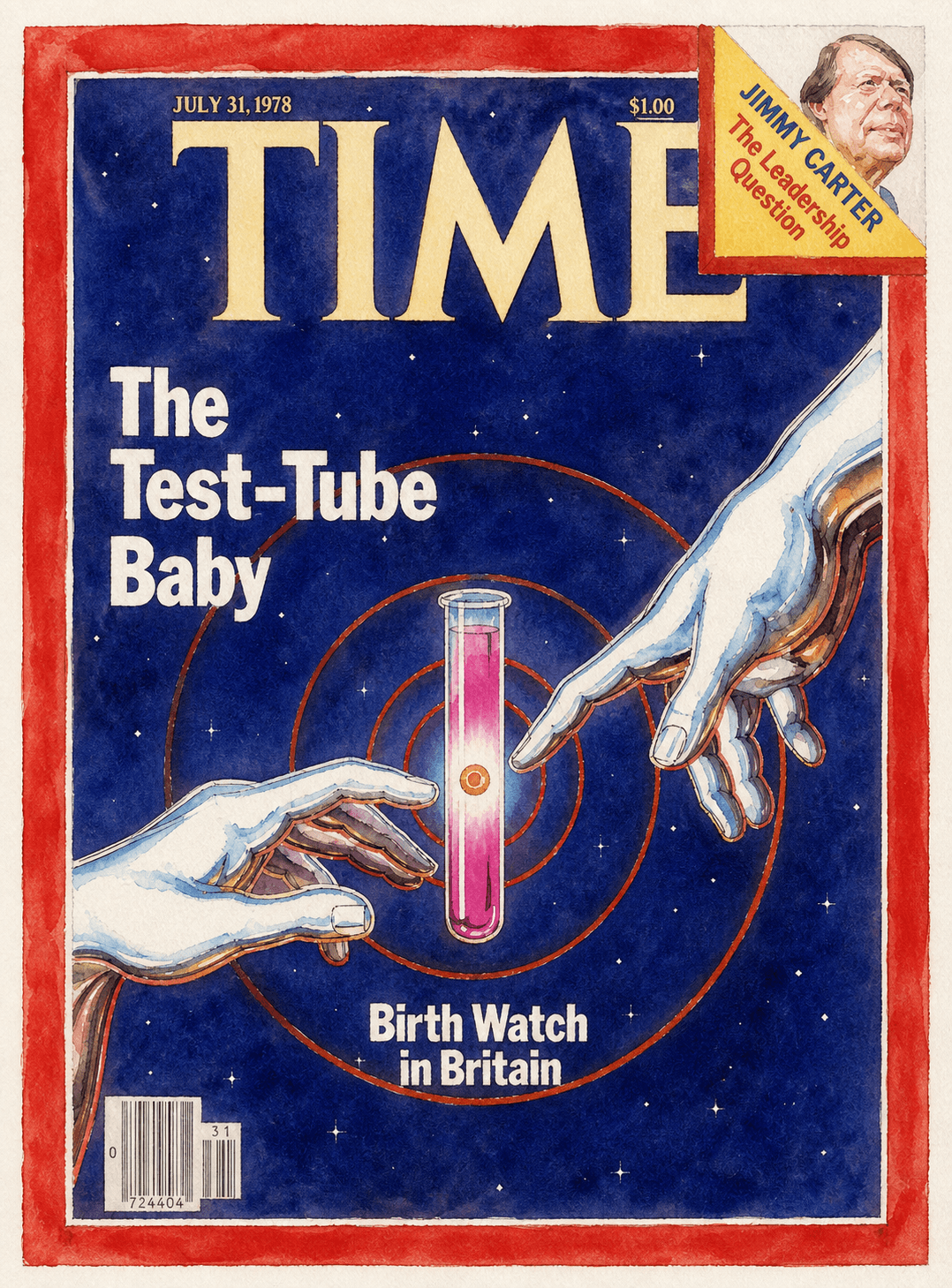
“The Test-Tube Baby” makes the cover of TIME, 1978. A reminder that, not that long ago, IVF was made to look like science fiction.
IVF exploded. In quick succession over the next few years, Australia and America both announced successful IVF births. Meanwhile, scientists and physicians alike began building on the work done by Edwards and Steptoe, tinkering and improving every part of this new baby-making technique.
Then, in the 1990s, something interesting happened. IVF began to intersect with genetics. An embryo, after all, begins as a single cell containing a nucleus. Inside the nucleus is the instruction manual of life, which, thanks to all the scientific work in the 1950s, we knew was DNA. As IVF developed, women could undergo ovarian stimulation so multiple eggs could be retrieved and fertilized in the laboratory, producing several embryos. Critically, each of these embryos (which can be thought of as possible siblings) had a different set of genetics.
This ability to create multiple embryos raised a remarkable possibility. If many embryos could be created outside the body, could they also be genetically examined for diseases or even sex before being transferred into the uterus?
In 1989, Alan Handyside sought to answer this exact question. He was an embryologist working at the forefront of IVF just over a decade after Louise Brown was born. The immediate clinical problem Handyside was trying to solve involved families affected by serious genetic diseases, called X-linked disorders, that moms had a high chance of passing down only to their sons. The X-linked genetic disorder he focused on was Duchenne Muscular Dystrophy (DMD), a progressive, lethal genetic disease that slowly strips the body of its ability to move and function. If a mother has this DMD genetic marker, she will typically not develop DMD, but each son has a 50 percent chance of inheriting the marker and having the disease.
These families faced heartbreaking reproductive choices: conceive naturally and risk passing on the disease, or undergo prenatal testing and potentially terminate an affected pregnancy. Handyside wondered whether IVF offered a different path. Since embryos were already developing in the laboratory before implantation, perhaps they could each be genetically tested first, then the one without the disease could be transferred.
There was an issue, though. A single embryonic cell contains only about 6.6 picograms of DNA — millions of times lighter than the mass of a grain of salt. Despite its vanishingly small size, it still contains all the instructions for life. What happened next, the solution proposed, was the first true convergence of the molecular genetics and IVF timeline.
About seven years earlier, in 1983, a scientist by the name of Kary Mullis34 was tripping out on LSD. Seriously. This is what supposedly35 helped him to develop a remarkable technology called polymerase chain reaction (PCR). PCR solved a deceptively simple problem: how do you study a piece of DNA when you barely have any DNA to begin with?
The technique acts like a molecular photocopier. Given a specific DNA sequence, PCR can make copy after copy after copy, doubling the amount of DNA with each cycle. What begins as a single fragment can become millions, even billions, of copies within a few hours. Suddenly, embryo DNA that had been too scarce to study could be analyzed.
This was exactly the breakthrough Handyside needed. Afterward, he cleverly searched the embryos for evidence of the Y chromosome. If he found it, he then ruled out the embryo for transfer, given that a male embryo would have a 50 percent chance of having DMD (a female embryo would not be at risk).
This was, in 1990, the first-ever case of Genetic Optimization (GO). Specifically, it was the first time IVF was being used not as a means to treat infertility, but as a vehicle for genetic disease prevention. Two scientific revolutions that had developed largely independently, IVF and genetics, had suddenly become intertwined.
This would only accelerate. That year, a healthy baby was born with what became known as the first preimplantation genetic diagnosis. The U.S. National Institutes of Health (NIH) and the Department of Energy also launched the most ambitious genetics project in history: the Human Genome Project. Scientists set out to determine the complete sequence of the human genome; the roughly three billion DNA letters that make up the language of life.
The Thielian Question
Being a geneticist in 1990 was like being a software engineer who had never seen any code. Sure, you know DNA is the hereditary material. You even know some errors in DNA can cause diseases, and you can identify small pieces of the molecule in the Y chromosome. But you’ve never actually seen DNA at its lowest resolution, the sequence of ATGCs that make up life. In other words, you have molecular tools that help you understand what a gene is at a lower level of abstraction than Mendel did, but it’s still an abstraction, an idea.
It’s worth mentioning that by the time the Human Genome Project had kicked off, we had sent astronauts to the moon, split the atom, and invented computers. Yet nobody on Earth knew the DNA sequence held inside every single human cell.
I like to ground myself in this fact: the elucidation of the human genome is really new. Accordingly, on my wall in my office at Nucleus, what I like to call the nucleolus, hangs a framed picture transcript of a conversation about the Human Genome Project.
Watson, who had identified the structure of DNA about forty years earlier, is interviewed about the project. He noted:
“DNA provides the information that makes possible our existence and the existence of every form of life. If you want to understand human beings in this complete sense, you’ve got to understand the nature of DNA … [The Human Genome Project] is the program for the development and functioning of human beings—all the instructions [for life].”
He continues:
“Biologists certainly have worked in rather small groups up to now. This will take the coordination of the work of many hundreds, if not thousands, of people. We think we ought to be able to work with about $3 billion to be spent over 15 to 20 years.”
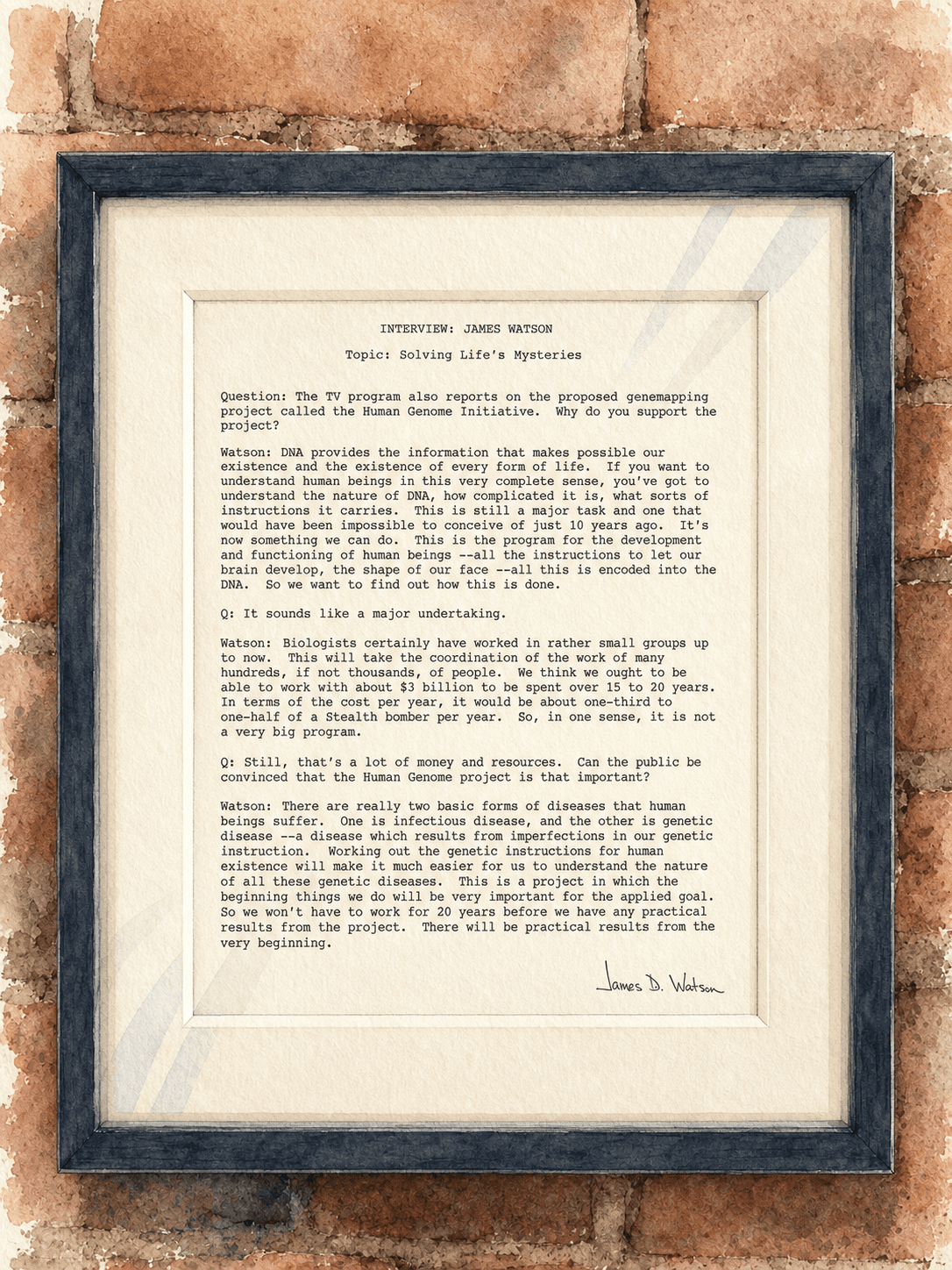
Watson’s interview in the nucleolus.
And so it was, the Human Genome Project, whose goal was nothing less than to solve life's mysteries, had begun.
It is often forgotten as a remarkable, contemporary piece of history showing the extraordinary things we can accomplish: thousands of scientists across multiple continents worked toward the single goal of determining the complete sequence of the human genome. The project transformed sequencing from a slow and expensive process into something fast, cheap, and inherently computational. Entirely new fields of computational biology were created to handle the flood of genetic data being generated.
And as the years passed, progress accelerated. What had initially seemed like a twenty-year moonshot felt achievable.
Then, on June 26, 2000, the world arrived at, what I would say is, one of the defining scientific moments of the modern era. As in so many moments of national ambition before it, the US had arrived at another frontier. This time, it wasn’t westward expansion, or landing on the moon. The frontier wasn’t outside of us, but inside.
Francis Collins, MD, PhD, a geneticist who helped lead the Human Genome Project, captured this sentiment perfectly at the White House when, in awe, he proclaimed:
“We have caught the first glimpse of our own instruction book, previously known only to God.”

J. Craig Venter, President Bill Clinton, and Francis S. Collins, in the White House announcing the Human Genome Project.
Man had identified its source code.
We could see the complete instruction manual underlying every human being. A hereditary factor or gene was no longer merely a concept but a measurable set of ATCGs. The significance of this moment would have astounded Mendel and his contemporaries.
But there was a problem. It soon became clear, as Thiel pointed out in his 2012 notes,21 the Human Genome Project did not answer the most important question of what it all means?
Knowing the sequence of the genome is not the same thing as understanding it. We had finally deciphered the language of life but, in doing so, realized this was just the first step.
To bring back the software analogy, imagine discovering a massive software repository containing billions of lines of code written in a programming language nobody fully understands. You can read every character and maybe even identify a few critical functions, but you don't understand how the entire system works.
How can we figure out how to interpret the source code?
Well, as scientists would soon discover, any two people on Earth share roughly 99.9 percent of their DNA. The remaining 0.1 percent contains millions of small differences scattered throughout the genome. These differences are known as genetic variants.
One of the most common forms of genetic variation is called a single-nucleotide polymorphism (SNP). A SNP is simply a location in the genome where people commonly differ by a single DNA letter. One person may have an A at a particular position while another has a T. When I say “common variant," you can think of a SNP.
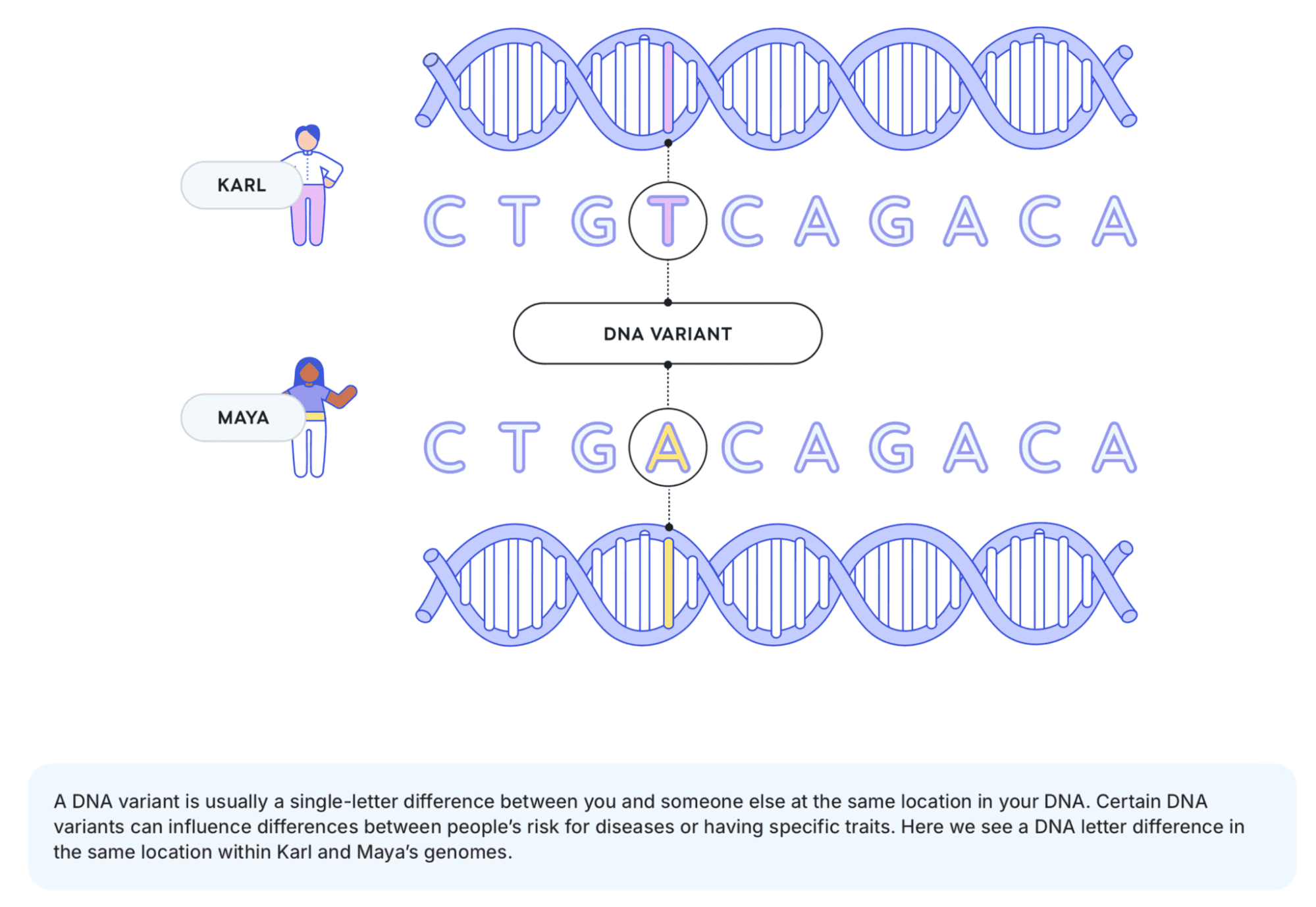
Visualization of a single nucleotide polymorphism (SNP). DNA is made up of four nucleotides: A, G, C, and T. A SNP is a difference in a single nucleotide at the same position in two people’s DNA. Here, Karl has a T in the fourth position, while Maya has an A.
Scientists reasoned an intuitive idea: common differences in DNA must lead to common differences in humans. If someone could make a map of all common genetic variation, of all the places where humans commonly genetically differ, they could then begin to study the genetic basis of, well, anything genetic.
This insight became the foundation of the International HapMap Project.36 Launched in 2002, the HapMap Project sought to create a map of common human genetic variation. A coalition of researchers cataloged millions of locations where people commonly differ in their DNA.
The task of analyzing these millions of SNPs in many people was simplified immensely because of a simple genetic fact, DNA tends to be passed down in large chunks. If a scientist identifies a common SNP between two people, that SNP “tagged” many other nearby SNPs as well. If they analyze the DNA and find one SNP, they also find many other nearby SNPs as well. These ~3 million or so common variants could be represented by roughly a few hundred thousand “tag” SNPs.
This meant that instead of spending hundreds of millions of dollars sequencing just a couple of genomes, researchers could now measure a relatively small set of tag SNPs and capture much of the common variation across the genome. Scientists now had a practical way to study the genetic basis of diseases and traits at scale, not in a few people, but thousands.
Sequencing cost
The cost of reading a human genome
99.999%decline since 2001
At the time of the HapMap project, in 2002, the cost of reading a human genome was about $100 million.
Meanwhile, since Handyside's first PGD in 1990, embryologists had become increasingly capable of testing embryos before transfer. New molecular techniques allowed embryologists to test for a growing number of monogenic (single-gene) diseases like cystic fibrosis, Huntington's, and Tay-Sachs disease.
As you now know, the process of IVF involves making several embryos. These embryos are genetic siblings: they have similar, albeit nonidentical, genetic profiles. Their genetics can be tested, and patients and physicians can transfer the embryo that does not carry the disease-causing genetic marker(s). That is, GO, practicing preventative medicine before life has begun, was expanding to a greater number of diseases.
But it didn’t stop at just a few rare diseases. Researchers noticed that human embryos frequently contained too many or too few chromosomes, a condition known as aneuploidy. Most aneuploid embryos failed to lead to a pregnancy or resulted in developmental disorders like Edwards syndrome. Humanity needed a way to look not just at individual genes but at whole chromosomes before transfer. This led to the development of new methods, like fluorescence in situ hybridization (FISH), that allowed scientists to determine the number and type of chromosomes each embryo had which opened the door to sex determination and selection.
By the time the HapMap project was going on, IVF clinics in the United States were screening embryo DNA for hereditary diseases, sex, and aneuploidy. It is interesting to think about this, as GO had now expanded to include not just more hereditary diseases and chromosomal abnormalities but also a completely non-medical optimization as well, the sex of a baby.
Yes, in 2002, you could walk into an IVF clinic in the United States and select the sex of your baby for “family balancing” reasons or what was also referred to as “non-medical sex selection.” That is, IVF has, for decades, enabled parents to select a child’s sex to achieve a desired mix (or lack thereof) of boys and girls in their family.
Back to the genetics timeline. The HapMap Project did not tell scientists why some people were taller, smarter, or more prone to disease than others. What it did provide, though, was the infrastructure to ask those questions at scale.
To study the genetic basis of cancers, height, IQ, and any other common disease or trait you can think of, scientists used the HapMap project to design a genetic test that measured common markers. They called it a “SNP chip,” “microarray,” or “genotyping.” Why read the entirety of someone’s genome when you can just focus on the common differences that make people unique?
Almost immediately, a new type of study exploded across genetics: the genome-wide association study, or GWAS. This was the same study that, about 15 years later, a younger Kian at Penn in Bio 221 would ask himself — what can we do with all that data?
The logic behind GWASs was simple:
1) DNA influences human traits.
2) Common traits are caused by common markers.
3) Researchers can now measure these common markers directly.
4) Why not compare the common markers of people with a trait to those without it and see which variants appear more frequently in one group versus the other?
In 2005, Robert Klein, a geneticist then at the Laboratory of Statistical Genetics, Rockefeller University, ran with this study design and published “Complement Factor H Polymorphism in Age-Related Macular Degeneration”37 in one of the earliest GWASs ever published.
What Klein and his colleagues did was pretty simple: they recruited individuals with and without age-related macular degeneration (AMD) and split them into two groups. AMD can cause vision loss at an old age. Then, one by one, across hundreds of thousands of variants, they asked, “Does this variant appear more frequently in people with the disease than in people without it?”
The GWAS worked. Scientists identified a common variant in the complement factor H gene that was strongly associated with AMD.
Wait a second. If a GWAS could identify a genetic factor for AMD, why not type 2 diabetes? Why not coronary artery disease? Why not schizophrenia? Why not height? Why not IQ?
What’s so interesting here is that, whether Klein and his team realized it or not, GWASs were direct ideological descendants of Mendel's peas. Geneticists have always observed differences between organisms and worked backward to uncover the hereditary factors responsible.
Mendel began it all with pea plants. Fisher followed with pure mathematics. Mary-Claire King, PhD, another geneticist who identified BRCA1 (breast cancer gene), did it with pedigrees. Now, Klein was doing it with GWASs. The main difference between all these geneticists was not the fundamental intellectual workflow, but the level of resolution they were dealing with.
Whereas Mendel and Fisher dealt with mathematical abstractions or hereditary factors, Klein, thanks to the Human Genome Project, could measure the genetic factors directly. Klein understood genomics at a resolution that was one-to-one with its true underlying biological reality. In this way, the evolution of genomics — and really, all of biology — could be understood as a progression toward a lower level of abstraction, bringing us closer to connecting our eyes to the true underlying biological reality.
Klein’s study opened the floodgates. Over the next several years, GWASs were run on virtually every disease or trait (phenotype) researchers could measure. Trait after trait began yielding genetic associations: height, BMI, cholesterol, blood pressure, educational attainment, intelligence, schizophrenia, and depression. Thousands of studies were published, and the catalog of known genetic associations grew from dozens, to hundreds to tens of thousands.
There was something that didn’t make much sense though.
Where was the height gene? Or the IQ gene? Or the depression gene? GWASs only identified common variants with vanishingly small effects. For example, a variant associated with height might increase stature by a fraction of a centimeter. A variant associated with risk of disease might change the probability of illness by a single percentage point. No single variant or gene could explain the genetic basis of really anything — i.e., no one gene had a large effect on IQ or height.
To many scientists, this seemed disappointing. In reality, it was one of the greatest confirmations in the history of genetics.
Recall that nearly a century earlier, R.A. Fisher had proposed the infinitesimal model29 — that common traits and diseases emerged from a huge number of tiny effects in the genome. He posited that there was no height or IQ gene, or Alzheimer’s gene, but instead the genetic basis of these phenotypes were the result of millions of genetic markers spread throughout someone’s DNA.
A century later, as the data rolled in, GWAS after GWAS kept reaching the same conclusion: Fisher was right.
The genome was a vast network of tiny genetic influences, each contributing a small causal nudge. In aggregate they exert substantial influence — and, thus, can be used to make robust predictions.
To be clear, it’s not that Mendel was wrong. Mendel’s theory of heredity applies in rare disease cases very well (what you learned in high school, Punnett squares). Fisher’s theory, however, scaled Mendel’s theory to explain the variation that we see in everyday life.
That is, millions of individual genetic variants, each inherited from our parents according to the basic rules Mendel discovered, combined to shape the genetic component of someone’s disease risk, height, or IQ.
Given the initial GWAS results and Fisher’s theory, it made sense to see if you could actually predict complex diseases and traits from human DNA. In 2009, the International Schizophrenia Consortium did just that, publishing “Common polygenic variation contributes to risk of schizophrenia and bipolar disorder.”38 They combined thousands of SNPs together into something we briefly touched on earlier: a polygenic score (PGS). A PGS measures the combined impact of common genetic markers into a number or “score.” The higher the score, the higher your genetic risk.
The researchers found early signals that the score could begin to distinguish between if someone did or didn’t have schizophrenia. Nearly a century after Fisher had described polygenic inheritance, researchers could now observe this directly in human DNA.
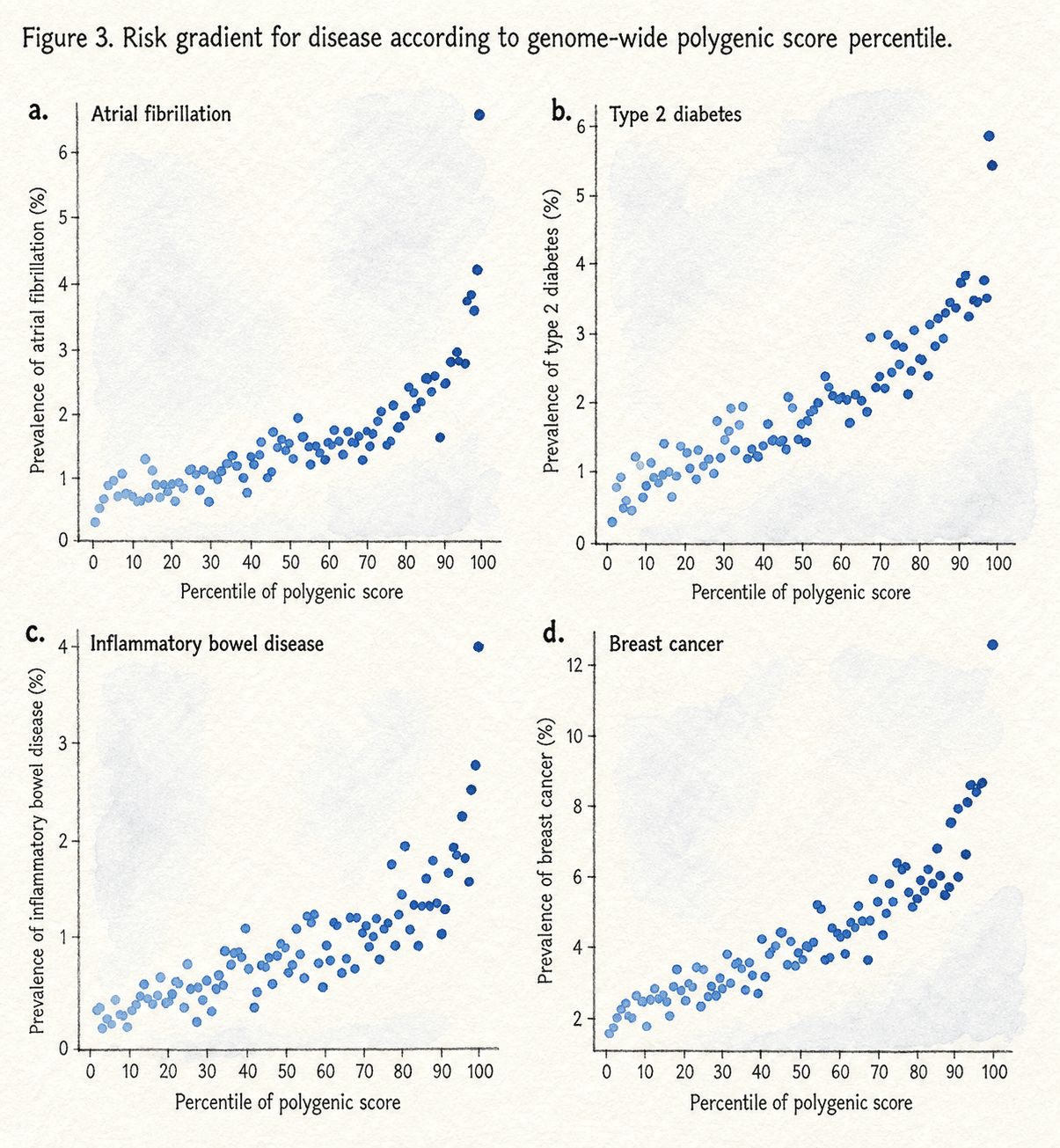
An example from a 2018 study39 of how disease risk increases with a higher PGS score. These graphs show the proportion of people with a condition on the y-axis and PGS scores on the x-axis. More people with a higher PGS have the condition compared to people with a lower PGS.
Meanwhile, in the IVF genetic testing world, around the same time as polygenic scores were beginning to enter the literature, a scientist named Dr. Nathan Treff (who is now Nucleus’ Chief Clinical Officer) published two papers that would change the way that genetic testing was done in every IVF clinic in the world.
The first came in 2010 when he published “SNP microarray-based 24 chromosome aneuploidy screening is significantly more consistent than FISH.”40 FISH, if you remember from earlier, was a genetic test designed to assess aneuploidy. The issue with FISH was that it focused on a small set of chromosomes. Dr. Treff took the newer genotyping method which had been developed on the backs of the human genome project, this genome-wide SNP chip, and compared its ability to flag aneuploid versus FISH’s.
What Dr. Treff found was that the microarray produced far more consistent chromosome diagnoses than FISH. This paper began the acceleration away from FISH-based embryo screening toward genome-wide methods.
That is, the IVF industry began to screen embryos by looking at markers on nearly every chromosome in the human genome. The kind of testing in embryos began to mirror the kind used in GWASs.
Dr. Treff didn’t stop there. In 2013, he published “Cleavage-stage biopsy significantly impairs human embryonic implantation potential while blastocyst biopsy does not: a randomized and paired clinical trial.”41 This paper revealed that one of the core assumptions of IVF genetics was wrong. For nearly two decades, since Alan Handyside did the first genetic test in embryos, clinics had taken one of the eight cells from an embryo on what is known as the “cleavage stage” or the third day of embryonic development. Prior to this paper, the belief was that the procedure was largely benign for the embryo.
Dr. Treff showed that this was actually not the case. It turns out doing an embryo biopsy, meaning, taking a single cell from the embryo on day-three actually hurts an embryo, reducing the chances that it leads to a successful pregnancy. He and his co-authors demonstrated an approach with far greater efficacy: biopsying 5 - 10 cells from the trophectoderm (the tissue that later forms the placenta) on day five. In doing so, he showed implantation rates on parity with having not done any biopsy on the embryo.
This paper would turn out to be critical for GO. Clinics could now collect more DNA, safely from human embryos. By biopsying numerous cells versus one, embryologists could substantially improve the quality and quantity of DNA available for analysis.
By the mid-2010s, thanks in part to Dr. Treff and his colleagues, modern IVF’s clinical workflow had become capable of generating something that had never existed before, a genome-wide genetic profile of an embryo before pregnancy had even begun.
All the while, geneticists realized something that will sound familiar to all the AI folks reading this book. The accuracy of a polygenic predictor — that is, how reliable you can predict diseases and traits from DNA — was a function of how large the GWAS was. Around the same time as Dr. Treff did his work, a scientist named Dr. Hans Daetwyler published “Accuracy of Predicting the Genetic Risk of Disease Using a Genome-Wide Approach”42 where he wrote, in the characteristically dry fashion of a scientist:
“We have derived simple deterministic formulae to predict the accuracy of predicted genetic risk from population or case control studies using a genome-wide approach…The common link among the expressions for accuracy is that they are best summarized as the product of the ratio of number of phenotypic records per number of risk loci and the observed heritability.”
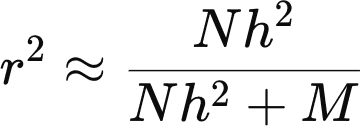
r2 refers to the variance explained, or how accurate the genetic predictor is. N refers to the sample size of the GWAS. M refers to the number of effect loci for the given phenotype. h2 refers to the heritability of the phenotype, which is the proportion of phenotype differences explained by genetic factors (what can be thought of as a measure of how genetically driven a phenotype is).
The predictive accuracy of a polygenic model is a function of how large the GWAS is and how big a role genetics plays in the phenotype. Sound familiar?
The more data you have, the more accurate the prediction. Genetics, as a statistical science, mirrored another statistical science — modern machine learning. In both cases, prediction quality improves as more training data becomes available.
Genomics has its own scaling laws.
Thus, throughout the 2010s, genomics received the extraordinary gift of population-scale biobanks.
A biobank is the genomics industry’s training data. It is exactly what it sounds like: a large database of genetic and non-genetic data. Participants consent to share their DNA samples alongside medical records, laboratory measurements, imaging data, lifestyle information, disease outcomes, and countless other phenotypes for the public good.
The most influential of these was the UK Biobank. Beginning in the mid-2000s, researchers enrolled roughly half a million participants across the United Kingdom and collected one of the richest human datasets ever assembled. Soon after came programs such as All of Us in the United States, along with numerous national biobanks around the world. Now there were rich genetic databases tracking decades’ worth of health and life outcomes spanning more than a million people across ancestries.
From Mendel, to Fisher, to Chase, to Watson, to Chang, to Edwards, to Handyside, to Mullis, to Collins, to Treff…the time had finally come. Train much larger GWASs on this treasure trove of genetic information in biobanks to get polygenic prediction at a level of accuracy43 that has never before been seen.
Then, run these advanced models on the embryo-wide genetic tests already being run in many IVF centers around the world. With the advent of biobanks, GO could expand beyond rare diseases, sex, and aneuploidy to encompass nearly all measurable phenotypes, all diseases and traits that have a genetic basis.
So it is. 150 years of scientific and medical progress culminating together into one of the most marvelous technological moments in human history.
Chapter 3
The Millennium Mission
Now, back to my Brooklyn bedroom. In 2020, during what I think of as my year in the genomics abyss, I would periodically look out my bedroom window. Every once in a while, a blue bird would land on the windowsill and sit perfectly still. Sometimes the smallest things contain the largest meaning.
On one of these quiet days, in the midst of all the statistical and genomics work I was uncovering, I sat down and wrote The Millennium Mission: Nucleus’ 1,000 Year Vision. As noted earlier, I viewed Nucleus as a vehicle to bridge the gap between what I could build in a bedroom, namely a genomics application layer, and what was my ultimate ambition, the Genetic Optimization Company.
The Millennium Mission begins by outlining what I saw as the central problem:
“I find problems with both evolutionary processes. The first is natural selection. Natural selection, by definition, weeds out deleterious mutations completely or partially that inhibit an organism's ability to produce offspring. Curiously, of the approximately 58 million people that die globally each year, a whopping 71 percent are caused by non-communicable diseases (NCDs) or “lifestyle” diseases. NCDs — like cardiovascular disease, cancer and respiratory disease — are a product of genetic, physiological, environmental, and behavioral factors. Due to their late onset, these individuals are all generally able to survive and reproduce. In other words, it is precisely the kind of problem that natural selection is unable to, by definition, weed out.”
Looking back, I think this observation pointed toward something deeper than I had appreciated at the time. Later-onset diseases persist not because evolution has failed, but because natural selection optimizes for reproductive success rather than longevity. That distinction would become increasingly important to how I thought about genetics as a new kind of general-purpose medical intervention.
I continued:
“Natural selection (NS) also selects for advantageous traits. Obviously, though, NS can only select for the polymorphism that actually exists. Not only are positive mutations few and far between (the vast majority are neutral or deleterious), there are also millions of positive mutations that have — independent of how advantageous they would have been — simply not occurred. So although a population’s success depends partially on the number and magnitude of its positive mutations, natural selection cannot induce these mutations. Instead, NS is ‘stuck’ with acting on variants that, relative to the theoretical positive polymorphism, are extremely limited.
Lastly, we have to wonder what environment we are exactly adapting to. Natural selection will never work if we want human beings to adapt to space, for example. We also have to wonder whether the formerly advantageous mutations — those of strength, agility, and speed — are the same ones for which we, today, seek to be genetically predisposed. Put another way, it seems that the ability to understand quantum physics isn’t linked to being better in bed. Thus, perhaps, the traits that we use to define ‘fitness’ are not those for which natural selection actually selects.”
In other words, not only does evolution exert comparatively weaker selective pressure against many of the diseases that ultimately kill us, it also may not optimize for the traits humans may ultimately value.
The thing I missed when I wrote this essay was that what is "better" or "fitter" is not universal. The “fitness” of a biological characteristic is always contingent on the objective. A weightlifter's strength is extraordinarily "fit" in the context of a weightlifting competition, but considerably less so on the SAT. Likewise, the cognitive abilities that make for a brilliant physicist may not be the same ones that produce an Olympic gymnast or a gifted musician. Even within the same task — say, running — greater muscle mass could be an asset for a sprinter and a hindrance for a marathon runner.
Nature does not converge on a single ideal organism because there is no single ideal to converge upon. Its beauty lies precisely in its diversity, allowing different combinations of traits to excel under different objectives.
As I discussed on Tucker Carlson,4 biological or physical attributes do not have any intrinsic value. They only have instrumental value, meaning, they are only useful insofar as they can accomplish a physical objective someone values. As the expression goes:
“To the worldly man, the gold of heaven is dust. To the heavenly man, the gold of earth is dust.”
The value of a physical thing is in the eye of the beholder, its value changing depending on the subjective judge of value.
When evolution is discussed, people often get this wrong. In fact, this incorrect implicit notion that there is a better or best human can get quite tense and uncomfortable. Cue the eugenics argument.
People tend to imagine optimization as a process of convergence, where enough pressure toward the same objective produces the same answer. That would suggest, then, that some people are better and others are worse inherently. This incorrect notion plagues contemporary ethical thought around genetics and is rooted in a profound misunderstanding of evolution.
In reality, evolution is a process of divergence. Life has been shaped by the same objective — reproductive success — for billions of years and the result is an extraordinary amount of diversity on earth. Not just among humans, but among the millions of species that had a different answer to the same question: how do I survive? The same objective can be satisfied through an almost incomprehensible number of biological solutions.
This is why Nucleus says “have your best baby.” There is no “best” baby. “Best” is contingent on the parents’ goals. What’s interesting is that the preferences aren’t just different between different couples, but are actually different between the same parent’s children.
Many parents, for example, may want a girl after having a boy or vice versa. The moment you change the goal, what’s “best” also changes. This idea that nature is plurality has become increasingly important to how I think about the ultimate goal of Genetic Optimization (GO), and I'll return to it later.
In The Millennium Mission, I then begin to conclude:
“We have been editing and shaping plants and animals for thousands of years. The only difference today is the precision of our tools. Thus, given the suboptimal reality of evolution, the long term vision is evolution directed, in part, by us humans.”
Looking back, I understood the what and how of GO. The Millennium Mission was my first attempt to answer why.
Human beings cannot transcend evolution any more than we can transcend gravity. But neither are we passive observers. Just as airplanes do not abolish gravity but instead harness an understanding of its laws, genomic technology may allow us to exercise greater agency over the evolutionary forces that shape us. These tools allow us to pursue objectives beyond the one evolution has always optimized for: reproductive success. By this I mean, traits are not principally favored because they make us healthier, happier, smarter, or longer-lived, but because they help our genes persist from one generation to the next.
This optimization for reproductive success leaves gaps, both in terms of making us vulnerable to later-onset disease, as well as leaving both existing and potential traits parents care about on the table. Now that humanity is increasingly acquiring the ability to influence its own biology, toward what ends should we use that power?
I believed then — and still believe today — Nucleus’ mission is to give every human the opportunity to harness the wonder of evolution toward a new central goal. This means we can use genomic technologies to reduce disease burden, extend healthy lifespan, and, yes, pursue the personal traits that we care about.
Whereas evolution by NS has reproductive success as the goal, evolution by GO has human flourishing.
I looked up from my desk. The blue bird was still there, perfectly still on the windowsill. The room felt impossibly quiet. There I was — a twenty-year-old college dropout sitting in my childhood bedroom.
Okay, I thought.
Where do I begin?
A question that belonged to us all.
Chapter 4
The Mistake
Because the cost of sequencing the entire human genome was collapsing, the answer seemed clear to me: build a whole-genome application. As I began to look into the commercial side of genomics, I grew more confident in this hypothesis.
Nucleus Genomics Inc. circa 2021. I have to find that CRISPR shirt.
I quickly realized that every genomics company that had existed had contorted itself around the technological limitations that existed when they were founded. Since whole-genome sequencing was so expensive for so long, companies didn’t begin with the genome itself. They began with an application and worked back to test the relevant portion of the genome.
For example, if you wanted to build an ancestry company, you measured the parts of DNA relevant to ancestry. Heard of Ancestry?44 If you wanted to build a cancer-risk genetics company, you measured another subset. Hello, Myriad.45 If you wanted to build a carrier screening company, you measured another part. It’s called Natera.46 If you wanted to measure chromosomal abnormalities in embryos, you measured yet another segment of DNA. Hello Igenomix.47 How about rare diseases? Maybe you would call it GeneDx?48 The list goes on.
To put it simply, I realized that every genomics company had organized itself around reading only the small fraction of the genome required for its particular use case. This created what I can only describe as a kind of genomics dissonance. People thought of these companies as not just fundamentally different businesses, but entirely different industries.
From a computational perspective, however, they were all doing the same thing: reading DNA (reading a string) and interpreting it (analyzing a string). The only meaningful technical difference was which slice of the genome they had decided to analyze and which set of algorithms they needed to write to interpret it.
I felt I had seen the genomics matrix.
As the cost of sequencing an entire genome fell, there would eventually be no reason to choose which slice of DNA to test. You would simply read all of it because, eventually, it would cost virtually nothing to do so.
And if you could read all of it, why build a different company for every slice?
Similar to how the iPhone collapsed several seemingly different industries — maps, telephone books, the internet, alarm clocks, music players, etc. — into a single product, I foresaw genomics unifying adult disease analysis, carrier screening, trait embryo analyses, all within a single, integrated genomics company. This would be the roadmap for Nucleus given I couldn’t create a Genetic Optimization Company.
Since college, I understood this Grahamian-software application model of Nucleus as fundamentally orthogonal to our ultimate ambition. To accomplish The Millennium Mission, I believed, we would at some point need to go from a computational process to a biological process under Thiel’s model for starting a bio company. The genomics software roadmap I described was all about prediction. It could read DNA, interpret it, and tell people what it meant.
It could not, in my mind, actually optimize DNA. Optimization only belonged to an actual biological intervention, like gene editing. Within the model Nucleus was created under, then, embryo analysis was still just a way of understanding DNA, not changing it.
The real breakthrough, I assumed, would come when gene editing was good enough. It was an assumption I had unconsciously absorbed from culture and scientific literature since high school.
This distinction was so embedded in me that I didn't even recognize it as an assumption.
But it was this error — coupling software with prediction and modification with optimization — that turned out to be the foundational misunderstanding in my approach to Nucleus, which mirrored the same misguided approach to the way all of medicine and science approaches genomics. I saw genomics, then, as the world still sees genomics today: a mere risk assessment tool instead of a new form of directed human evolution.
Given my incorrect model, I couldn’t yet build toward my Millennium Mission. Hence, it made sense to begin with whichever risk-assessment application was most practical to build in a bedroom.
The answer was pretty clearly adult DNA analysis. I didn’t even know how I would get raw embryo DNA data, and figured that, at their simplest levels, embryo and adult DNA analysis are both just text files that need to be analyzed. We can just ship the embryo application later.
As I looked into analyzing adult whole-genome data, I quickly ran into a problem. There was no whole-genome data to analyze. It’s not like everybody had their whole-genome file ready to upload. Indeed, I soon realized, to actually get the whole-genome data would require investing millions of dollars to build out the physical genetic testing infrastructure which, of course, I didn’t have the money, connections, nor experience to do.
I needed genetic data that I could analyze today. What genetic data exists, in mass, that I could analyze? Fortunately for me, in an attic in Denmark, a scientist by the name of Dr. Lasse Folkersen was also thinking about this problem. Dr. Folkersen was building a website called Impute.me49 which was a platform that provided free polygenic analysis on 23andMe and Ancestry data. Essentially, it was an earlier iteration on this integrated risk-assessment platform I envisioned, except it focused on providing advanced genetic analysis on microarray data instead of whole-genome data. If you remember, microarray data is a small fraction of your DNA.
As I dug into how the platform worked, I, eventually, adopted a pseudonym Bob (creative, I know), created a fake email, and started emailing Dr. Folkersen.
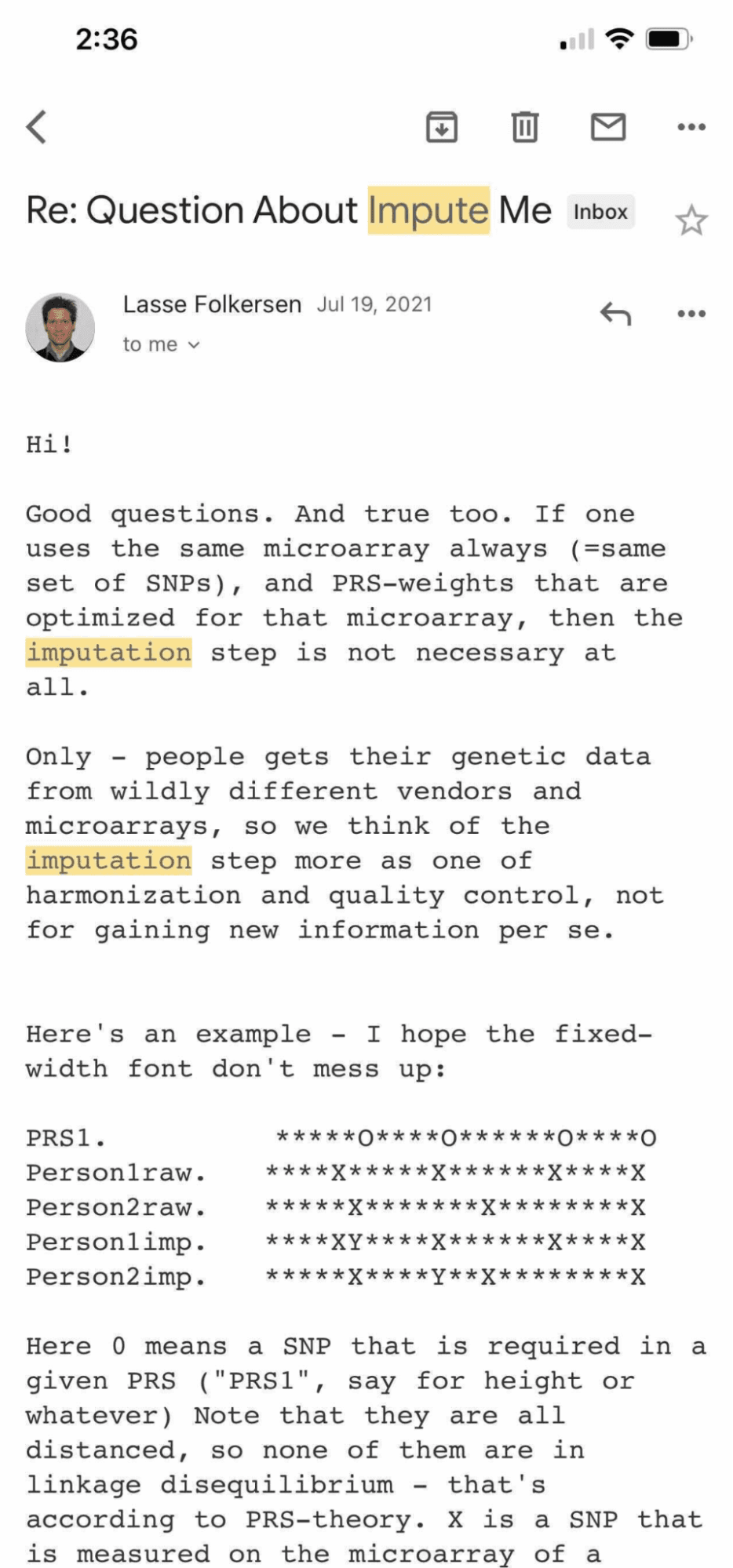
To my sheer astonishment, the scientist in Denmark actually responded!
Encouraged, I unleashed a torrent of questions.
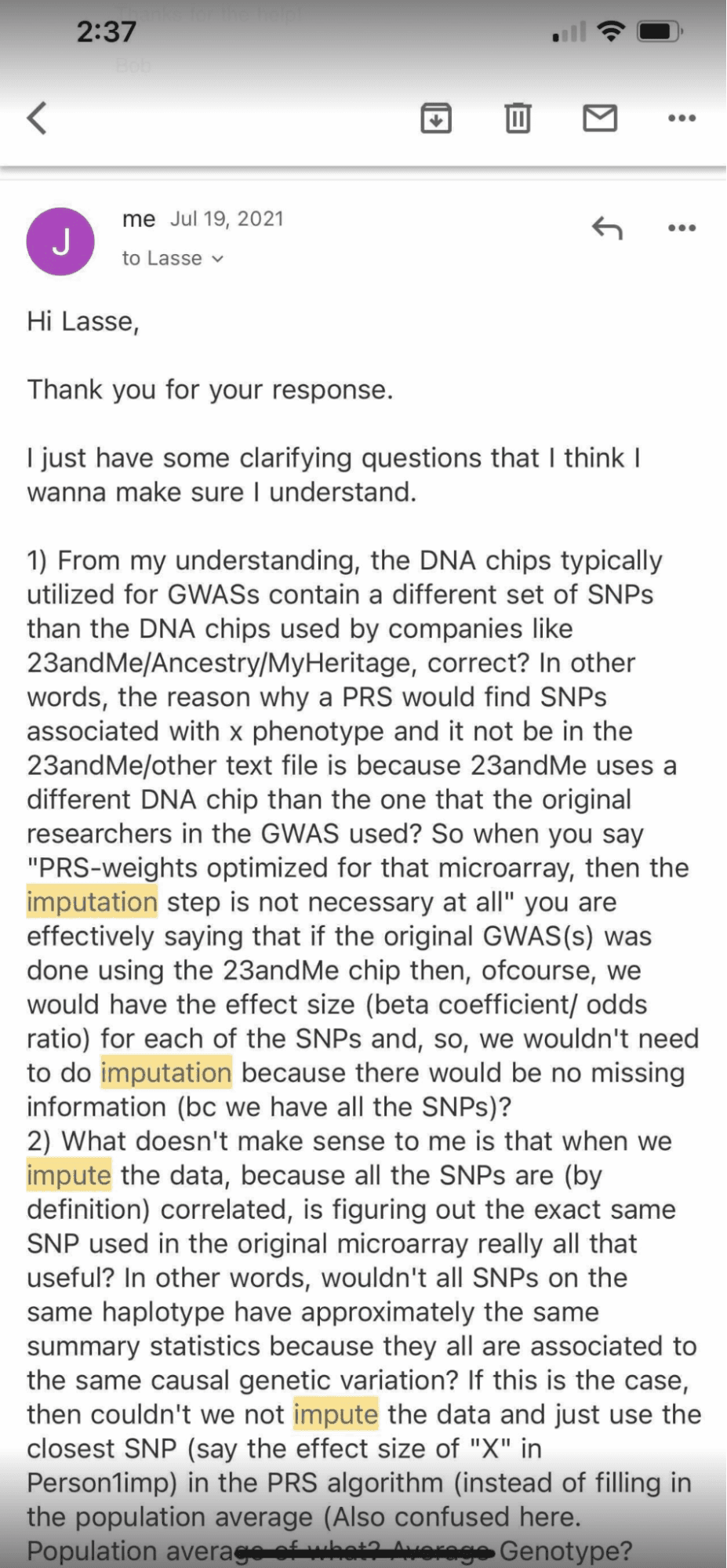
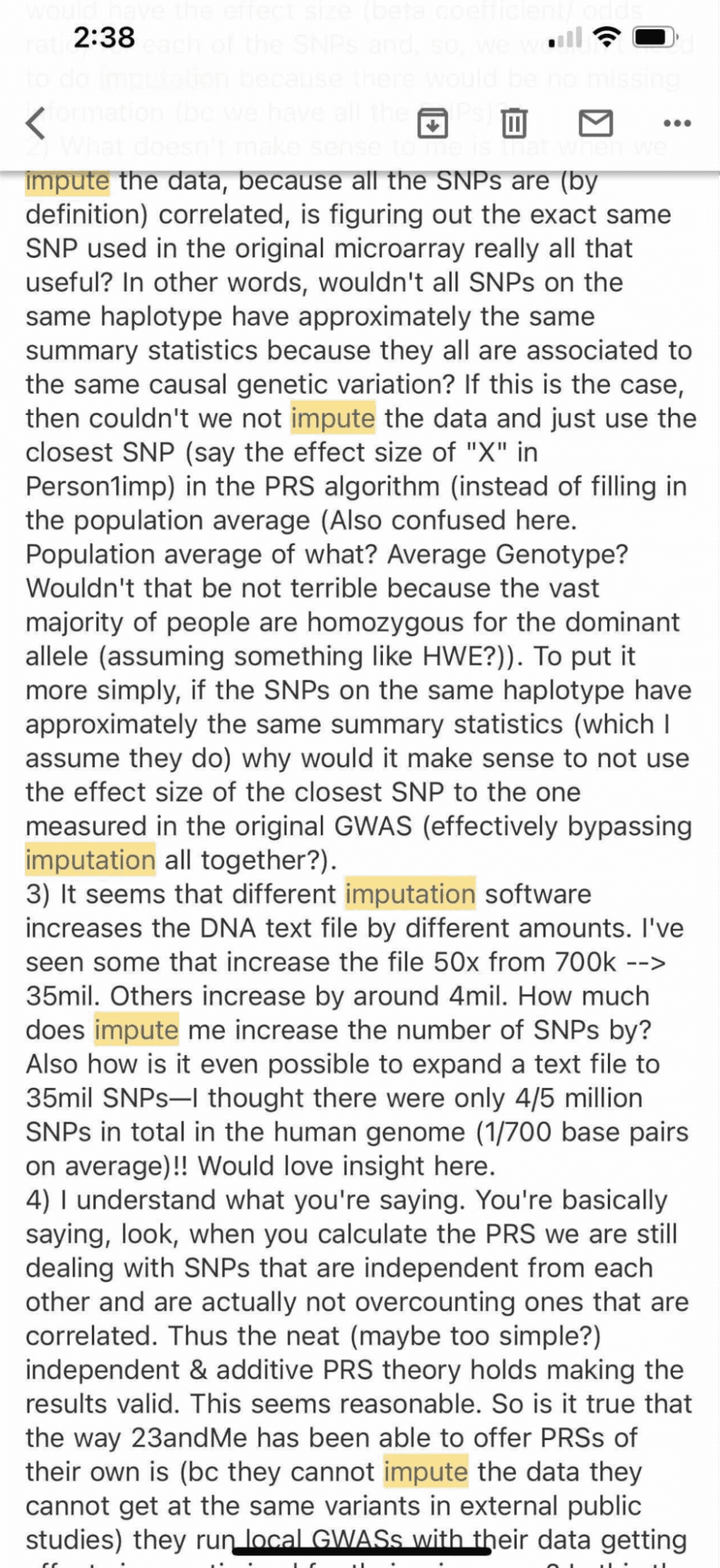
A further tirade of questions from “Bob”. The thread went on for well over 50 emails. Dr. Folkersen answered each question!
There was no ChatGPT at the time, so after a year of intensive study, I finally found someone who could help answer some of my questions.
23andMe and Ancestry enabled there to be genetic data en masse, already in the form of a text file. Someone could simply download the data and upload to impute.me49 and get more insights beyond what 23andMe or Ancestry provided. Because it was microarray data, you couldn’t provide analysis for rare genetic markers, like, for example, what serious genetic markers parents could pass down to their children. Nevertheless, it was a great place to start.
Nearly nine months later, Nucleus acquired impute.me50 and brought on Dr. Folkersen as its Chief Scientist. Right before this happened, I got connected to Keith Rabois, who was a general partner at Founders Fund at the time, where on the call he said, amongst several things: 1) that the cost of sequencing was going to drop further thanks to his investments in the space (i.e. Ultima Genomics51 though, at the time, in stealth), 2) I reminded him of this guy named “Delian”, and 3) Nucleus should not just focus on being a software company, but build out whole-genome testing infrastructure, as it will give it a massive, compounding advantage in the years to come.
I then got introduced to that guy Delian (well, sort of, see below) and Founders Fund led Nucleus’ seed round. Looking back, the first text I sent to Delian foreshadows a large portion of this book I’m writing now.
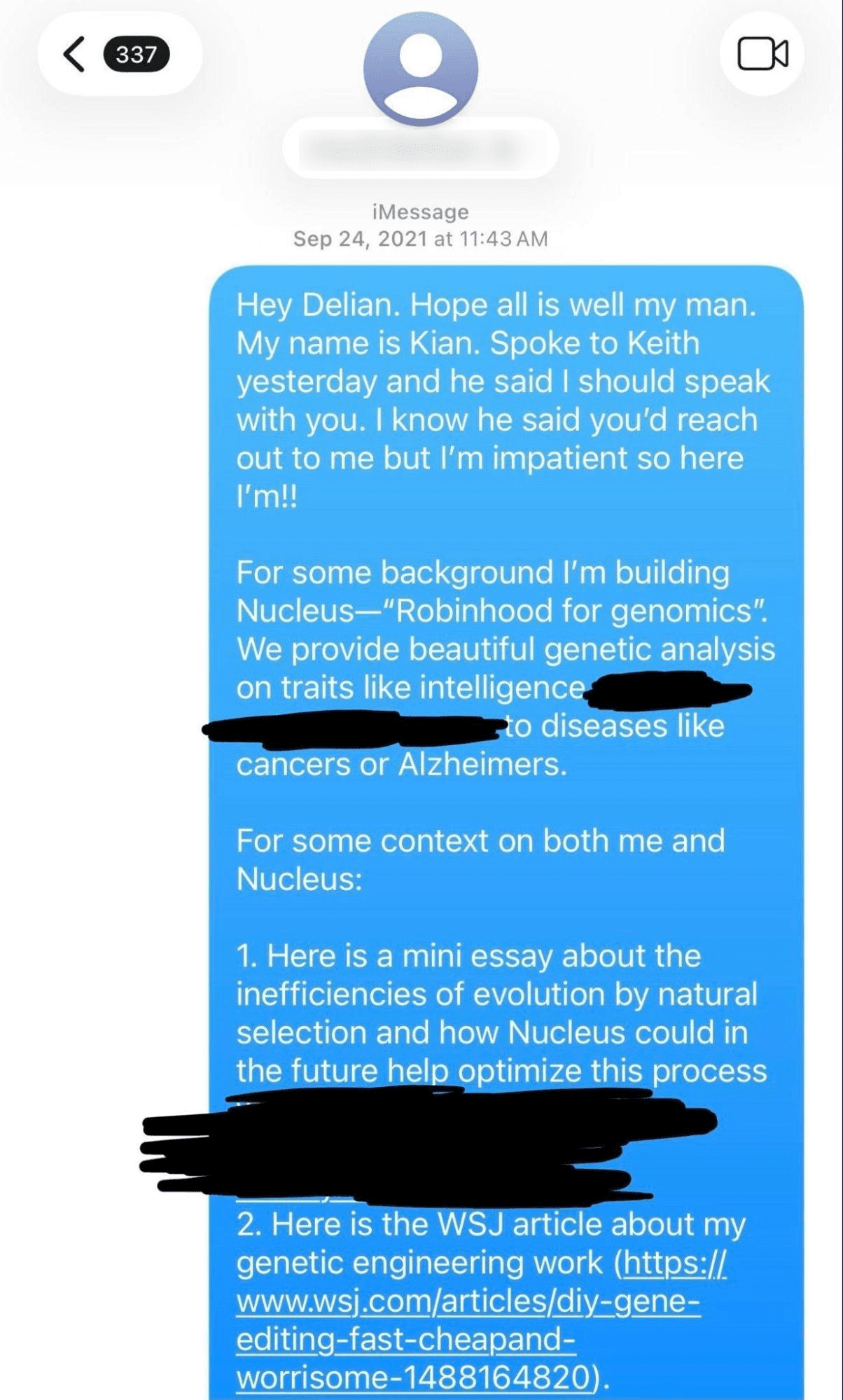

Pretty cool to see leading with the “why” over the “what” in the earliest of pitches. The “mini essay”, by the way, was The Millennium Mission. Also “Robinhood for genomics”? Jeesh!!! Whatever that means…
Now, I’m going to speed run a bit. Building under the framework I outlined, first was to build a platform that could analyze 23andMe/Ancestry data. Effectively, a better impute.me.49 In parallel, we would use the new capital we had raised — and what helped enormously was that Alexis Ohanian also saw this genomics future and invested $10 million more into the organization52 — to build out the physical infrastructure for whole-genome sequencing. This was a great decision we made and are still earning dividends off of it. People forget that a DNA sequencer Illumina X+ machine costs $1.25 million dollars.53 You need a substantial sample volume for a laboratory to be able to pay that amount back, which we have now done several times over.
Once this testing infrastructure was built out, you would then go through all the regulatory clinical-approvals required to provide consumer-initiated, physician-ordered tests to patients. Once that was done — the testing infrastructure, the regulatory approvals, and the initial algorithms — you would rapidly iterate and improve upon the underlying algorithms to provide increasingly sophisticated insights to patients and, eventually, embryos.
This means you could (finally!) bridge this genomics dissonance, following the roadmap to centralize and unify all genetic prediction applications under one company — from adult health screening, to carrier screening, to embryo analysis.
And that is exactly what we did. But it was when we reached the final application of embryo analysis that I realized my most upstream assumption about Nucleus was wrong. I had incorrectly assumed genetic optimization (GO) hinged on genetic engineering.
Embryo analysis completely broke that model. Here was software with no biological intervention, no genetic engineering and yet the ability to substantially change genetic outcomes.
After a decade of thinking about optimizing people, after well over 10,000 hours thinking about genomics: how could I have missed this? How could a computational process be enabling what I had always assumed required biological intervention? This went against everything I thought I understood about genetics.
Worse, this wasn't merely a conceptual misunderstanding. It was the most upstream assumption I had made in creating Nucleus. Nearly everything downstream — from my time in the bedroom, to impute.me, to the first version of our product, to how we allocated millions of dollars in capital, even to the story I told about what Nucleus is — was an intellectual descendant of the same error. Software could predict genetic outcomes, but couldn’t enable its optimization.
I had built my life’s work on a principle assumption that was wrong.
I went back to the drawing board. I was forced to reconsider not just Nucleus’ approach, but, even more painfully, my understanding of genetics and evolution itself.
Chapter 5
The Realization: A Mechanism For Directed Evolution
An astute reader may have noticed something strange about my history of statistical genetics. Not once did I use the word mutation.
And yet, in The Millennium Mission, I used it throughout. Somehow, in my mind, mutation had become linked to evolution. It turns out, the history of how mutation became synonymous with evolution is precisely the history that shaped an entire generation to also misunderstand genetics — and, inextricably, human evolution.
In 1859, Charles Darwin wrote On the Origin of Species, which laid out evolution by natural selection. Darwin wrote:
“Natural selection can do nothing until favourable individual differences…occur.”
Darwin posited that natural selection, this idea that organisms better suited to their environment survive and reproduce more successfully, acts upon individual differences. But as we know from earlier, in the mid 1850s, there was no concept of DNA or even the term “genetics.” More than that, Mendel’s work happened after Darwin, so Darwin had no model of heredity either.
All Darwin knew was what he could see: “individual differences” exist among organisms and natural selection acts on this phenotypic variation.
This, of course, raised the question in the early 20th century: what actually drives these “individual differences”?
Mendel provided the first part of that answer. If you remember, he showed that traits are passed down through discrete hereditary units, what we now know as genes. In other words, in a given population, there must be different versions of genes.
This then begged another question: where did these differences in genes arise from? At the turn of the twentieth century, the Dutch botanist Hugo de Vries offered an answer: mutation.
De Vries had observed striking new forms of a kind of plant he was studying called an evening primrose. He called these discontinuous hereditary changes “mutations”, and in 1901 began publishing Die Mutationstheorie, or The Mutation Theory.
De Vries summarized the theory in a 1919 Nature paper titled “The Present Position of the Mutation Theory”:54
“The production of species and varieties proceeds by small but distinct steps, each step corresponding to one or more unit-characters. It is only after their appearance that the environment can decide about their utility.”
In other words, Vries posited:
1) Mutations drive differences in these “units of heredity.”
2) These differences then drive phenotypic differences in organisms.
3) Natural selection then selects for or against these phenotypic differences.

Oenothera lamarckiana, the evening primrose de Vries studied, depicted in a color plate from Die Mutationstheorie.
Therefore, the raw material for evolution by natural selection is mutations.
Remarkably, you see this concept repeated again and again in contemporary scientific teaching. One example comes from an educational article published in the prestigious journal Nature, titled “Mutations Are the Raw Materials of Evolution.”55
And, in one important sense, this is exactly right. Mutations do produce new genetic variants.
There is a subtle and enormously consequential ambiguity hidden inside the phrase “raw material,” though.
New mutations are not the primary source of “individual differences” in a population.
The mutationists were applying a Mendelian model of genetics. That is, as we have already established, nearly all observable phenotypes in a population are not changed by one new allele or mutation. They actually follow Fisher’s infinitesimal model that was published in 1918. There are many inherited variants, each contributing a very small portion to the phenotypic difference.
This has a profound consequence. You do not need new mutations to generate new phenotypic variation.
If a phenotype depends upon the combined effects of many variants, which is most observable characteristics in a population, two individuals will differ substantially phenotypically because they inherit different combinations of genetic variants that already exist.
The primary source of observable “individual differences,” then, is not new mutations, but new combinations of existing genetic variation.
So the mutationists were right about mutations being the source of genetic variation, but wrong to treat new mutations as the source of "individual differences.”
What we needed, then, was a new model of evolution, one that actually reconciled natural selection with the polygenicity of phenotypes.
Theodosius Dobzhansky, a Russian-American geneticist, did exactly that, culminating in what became known as the Modern Synthesis of evolution. In the 1960s, a Harvard professor in evolutionary biology named Ernst Mayr synthesized this Modern Synthesis in a textbook titled Animal Species and Evolution. In it he wrote:
“‘Mutation as an evolutionary force.’ In the early days of genetics, it was believed that evolutionary trends are directed by mutation, or, as Dobzhansky (1959) recently phrased this view, 'that evolution is due to occasional lucky mutants which happen to be useful rather than harmful.' In contrast, it is held by contemporary geneticists that mutation pressure as such is of small immediate evolutionary consequence in sexual organisms, in view of the relatively far greater contribution of recombination and gene flow to the production of new genotypes." (p. 101 of Mayr, 1963)
Given that new mutations are of “small immediate evolutionary consequence” and, instead, existing combinations of genetic variation is actually what drives phenotypes, that would mean “recombination and gene flow” — i.e., sexual reproduction itself is a principle driver of evolution.
Wait a second.
Sexual reproduction — the process of creating human embryos — is a combinatorial engine. Each parent’s DNA is shuffled into a unique combination, and those two combinations come together to create an embryo. This shuffling and combining, the process of meiosis, segregation, recombination, and fertilization, generates an enormous number of genetically possible offspring and, therefore, phenotypic variation that natural selection can then act on.
To understand this point more intuitively, it is helpful to answer a simple question: how many genetically unique embryos can a couple make? If every couple has the ability to make a huge range of genetically unique children, then every couple could be able to produce a huge range of phenotypic outcomes, too.
Most humans have 46 chromosomes (23 pairs). For the calculation below we will simplify things and say that mom or dad passes down one of their chromosomes as is to their child. As you’ll see, even with this simplification, the possible number of genetic combinations is enormous.
As you know, half of an embryo’s DNA is from the biological mom and half is from the biological dad. Accordingly, each parent can only pass down one copy from each of their 23 chromosome pairs. This means, prior to fertilization, each biological parent can create 2²³ or 8,388,608 genetically unique gametes (sperm for the father, eggs for the mother).
Of course, an embryo is a sperm and an egg. This makes the total number of possible embryos 8,388,608 * 8,388,608 = 70,368,744,177,664 combinations. A couple can produce more than 70 trillion possible genetically unique children.
To put 70 trillion unique combinations into perspective, you could populate nearly 9,000 Earths at our current population level, and every single person would not have the same DNA.

Another stat to put 70 trillion into perspective — there are only about 3 trillion trees on Earth. A single couple can produce more than 20 times as many genetically unique children.
This stat may sound at odds with what you often hear people say about siblings, that they share “50 percent of their DNA.” What’s fascinating is that this oft-cited stat obscures something important: siblings don’t share the same 50 percent of DNA. That is, the same two parents can have trillions of possible siblings who share a different 50 percent of DNA. What that means is that even just two embryos will differ by an average of millions of genetic markers. Each new embryo created will also then differ with each other via different sets of millions of markers, resulting in an extraordinary potential range of possible phenotypes.
Remarkably, the 70 trillion calculation assumes chromosomes are passed down whole. In reality, each pair of chromosomes swap pieces of DNA during meiosis through a process called “recombination.” This process creates even more possibilities — by some estimates more possible children than atoms in the universe.
Nature uses sexual reproduction to generate an enormous number of genetic combinations, because new genetic combinations, not new mutations, are the principal source of new phenotypic differences.
My association of genetic engineering with optimization was rooted in a mutationist understanding of evolution. I had assumed evolution conferred better-adapted organisms through new mutation. Accordingly, I thought gene-editing could confer a new kind of evolution by introducing new mutations in human embryos. I had unconsciously inherited and shaped Nucleus around a falsehood that evolutionary biology had discarded a century earlier.
The computational layer I had dismissed as merely predictive suddenly became something else entirely. Nature had already generated the extraordinary amount of genetic variation needed for optimization. Computation could make the resulting large range of possible phenotypic outcomes legible and, therefore, selectable.
Genetic optimization's chief mechanism is in selection, not engineering. Optimization never hinged on modification, it hinged only on generating enormous genetic variation.
This means that The Millennium Mission did not take 1,000 years. It’s already here.
Man’s manifestation is now programmable — just not in the way I (or you) imagined.
I was and am still astounded.
Chapter 6
A Guide to Genetic Optimization
Given the above insight on recombination, IVF isn’t merely a convenient platform for genetic optimization (GO), as we wait for something like gene editing to come of age.
Embryonic selection is the optimal arena for genetic optimization and, by the very nature of evolution itself, will always be its central platform.
What people imagine genetic engineering could one day do,56 is already possible today at any IVF clinic near you. The age of genetic optimization has begun.
“The Genetic Optimization Industry” will be used to refer to the class of companies that build tools or provide services that enable parents to influence the genetic characteristics of their future children. Of course, we’ve already arrived at the conclusion that the goal of this new kind of evolution is not reproductive success, but human flourishing. There is no “best” or converging definition of “human flourishing.” Nature is pluralism; evolution is a process of divergence.
But before I go deeper into my moral and ethical framework for the technology, I want to talk more tangibly about what GO actually is, and how it actually works.57
The GO industry consists of a “stack”. By “stack,” I mean the technologies that exist or are being developed that help parents in optimizing offspring DNA. These technologies include, but are not limited to: adult carrier screening, advanced embryonic selection, gene editing, in-vitro gametogenesis (IVG), artificial wombs, egg and sperm donor agencies, and anything that makes IVF cheaper, more accessible, automated or easier. Ultimately, the IVF industry will end up being a subset of the GO industry.
Whether you're a founder, an investor, journalist, scientist, doctor, parent or layperson, you may look at those technologies and see a complicated, disjointed monster. You may see massively different industries spanning many companies and a huge range of different scientists and experts working through them.
In reality, all these technologies are actually the same. They each occupy a different layer of the GO stack, all helping optimize DNA just in different ways. In other words, what appears to be a collection of disconnected industries is actually unfolding into a single technological platform. For example, gene editing is a useful tool for optimizing DNA when selection is not possible. The reason why engineering is a secondary tool is straightforward: it’s much easier for nature to develop a new embryo without a disease-causing variant than to correct an existing one with an error. Similarly, as mentioned, nature already can generate enough variation to accomplish whatever your desired attribute is. There are some other applications of gene-editing, for embryos and adults, beyond as a secondary tool to selection, but I will not go into them in this book.
Another critical part of this “stack”: in vitro gametogenesis (IVG). One thing to know about IVF is that the process of creating embryos is very invasive. Sperm is quite easy to collect, whereas eggs require both medication and a procedure to retrieve. IVG promises a new way, creating eggs from a blood draw. This technology will let any couple generate any number of embryos non-invasively. As the process of generating embryos gets commoditized — so too is the process of generating any amount of phenotypic variation. IVG means IVF naturally converges into a question of what genetics the parents want to optimize for.
One important thing to remember about GO is that every embryo’s DNA is made up of you and your partner’s DNA. Know that when I say “partner,” I really mean “biological partner” as couples, particularly same-sex couples and single-parents, often use egg or sperm donors.
Accordingly, one of the most important decisions that determines the genetics of your baby is actually the selection of your partner. The reason for this is simple. You and your partner set what is possible, the outcome space, for your children.
You may be thinking: so what if my partner sets the outcome space if the outcome space is so large? It’s a good question. Theoretically, you are right, because if you could take a huge sample from such an outcome space it would be possible to make a gigantic optimization for or against any phenotype.
Even if you don’t take a huge sample, just two embryos will differ by a large number of genetic markers — many millions — providing substantial average phenotypic spread for the parents to select across. The number of embryos a couple has does not change whether a characteristic can be optimized for, but rather, the degree to which they can do so.
Today, for example, if two short people want a tall-er baby than their average height, they can do so with GO and a small number of embryos. That said, a much taller baby is a rarer combination of the parents' own genetic variants. So getting this combination takes more embryos on average, since reaching further into the tail of the outcome space means sampling more to find it.
The farther the desired biological characteristic is from the parents’ expected genetic outcome, the more embryos, on average, are needed to select for it.
So, again, because the outcome space is so great any couple can in fact optimize for any phenotype — even with a small number of embryos. But, the degree of optimization (i.e., number of embryos) required to get a specific genetic outcome may be greater or smaller depending on the average genomic inputs from the parents.
Thus, the two key inputs for GO are parental genomes and the number of embryos. The GO/IVF industry will focus on helping parents change either the outcome space (i.e., donor selection), or getting more draws from that space (making it easier to make embryos).
What I’m describing will likely become a new sort of counseling, helping parents understand and navigate their genetic possibilities.
This has already started to happen in the first step of GO, a process we call “procreation simulation.”58 In this step, you and your partner each do a whole-genome test to see the likely and possible range of outcomes for your baby. You can see things like disease risks, height, IQ, eye color, and more of your future child. It answers questions like: is my baby at higher risk for any cancers? Heart disease? Rare diseases? How tall will they likely be? What eye colors could they have? And any other questions that you may be curious about. By seeing the answer to these questions, the intended parent(s) can then make the short list of diseases and traits they will choose to optimize for when it comes to choosing an embryo. This includes an understanding on to what degree they would need to optimize to accomplish a desired genetic outcome.
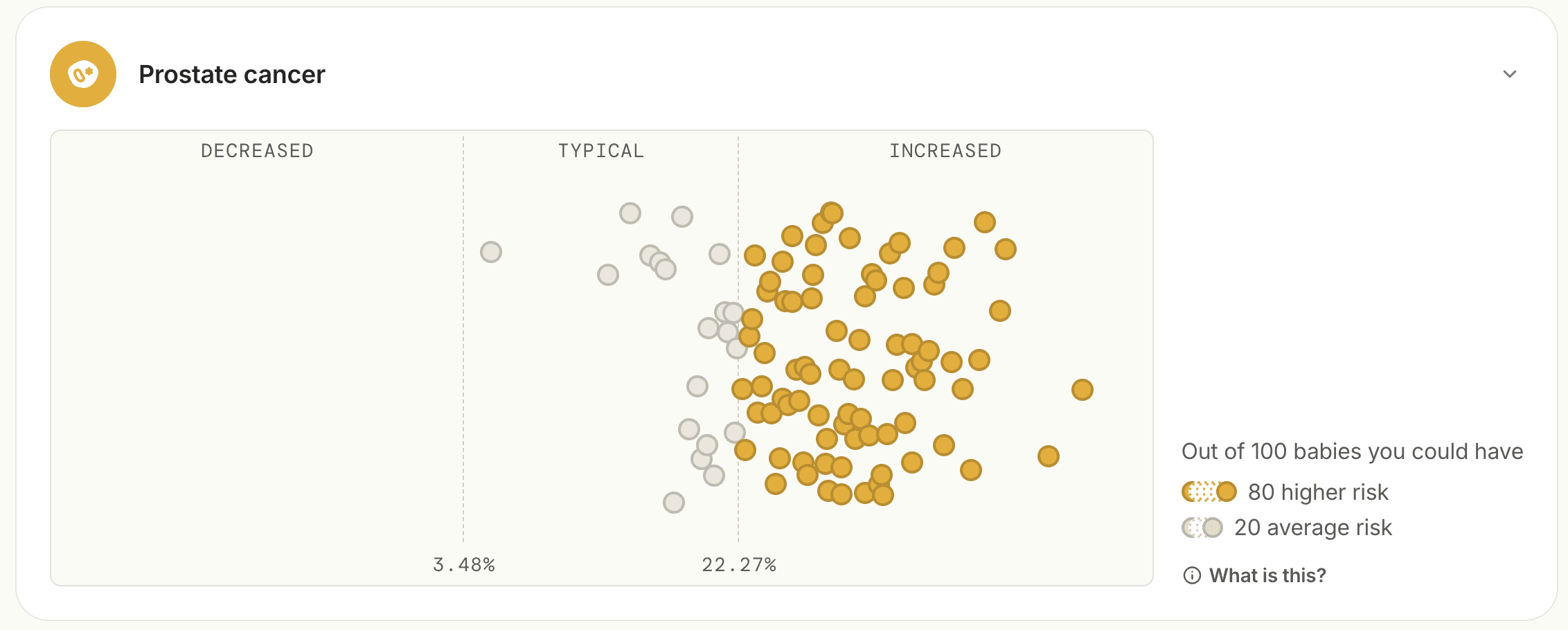
Example where most of a couple’s children will be at higher genetic risk for prostate cancer. They can now choose to decrease that risk with GO.
To put this more clearly, procreation simulation tells you if your baby is at higher risk for any of the following: 1) early-onset diseases, 2) “high penetrant” disease variants, or 3) common diseases, like cancers or heart disease. Then, lastly, it tells you 4) your baby’s likely and possible traits. These are the four things, in order, parents can now choose to optimize across.
The Steps of Genetic Optimization
1. Selecting against early-onset diseases
When it comes to GO, rare diseases are probably the single most important, and most often ignored, benefit of the technology. Before optimizing for any trait or later-onset disease, the focus is on not passing down rare diseases. After all, if you remember from the history section, the first instantiation of GO was actually in 1990 for this exact use case: screening out embryos at risk for the rare X-linked disorder known as Duchenne Muscular Dystrophy (DMD).
GO builds on this decades-long historical precedent by expanding the number of rare, early-onset hereditary diseases that parents can screen for. There are thousands of these devastating genetic disorders, from cystic fibrosis to Alkuraya–Kučinskas syndrome to Tay-Sachs disease, that are inherited recessively, meaning parents could pass down the disease while being perfectly healthy themselves.
One quick note is that Down syndrome and other chromosomal abnormalities are not considered hereditary diseases, though they are a kind of genetic disorder. In the context of GO, I’m assuming embryos have already undergone standard chromosomal screening. So, when I talk about parents screening for more rare diseases, I’m implicitly starting with embryos established to be euploid, meaning they have the typical 46 chromosomes.
Rare genetic diseases are a much larger problem than most people realize. Almost everyone is a “carrier” for at least one rare genetic condition. Being a carrier means you have one disease-causing copy of a gene (“bad” copy), but it doesn’t affect your own health. So these variants can quietly pass from one generation to the next, often without anyone knowing they’re there.
I am, for example, a carrier for cystic fibrosis. I had no idea until I took a whole-genome test. If my partner were also a carrier, each of our children would have a one-in-four chance of having cystic fibrosis, a serious disease that can dramatically shorten lifespan. For me, this is one case where GO becomes deeply personal. If my child was at risk, I would choose to screen for cystic fibrosis through GO and give my future child the foundation for a longer life.
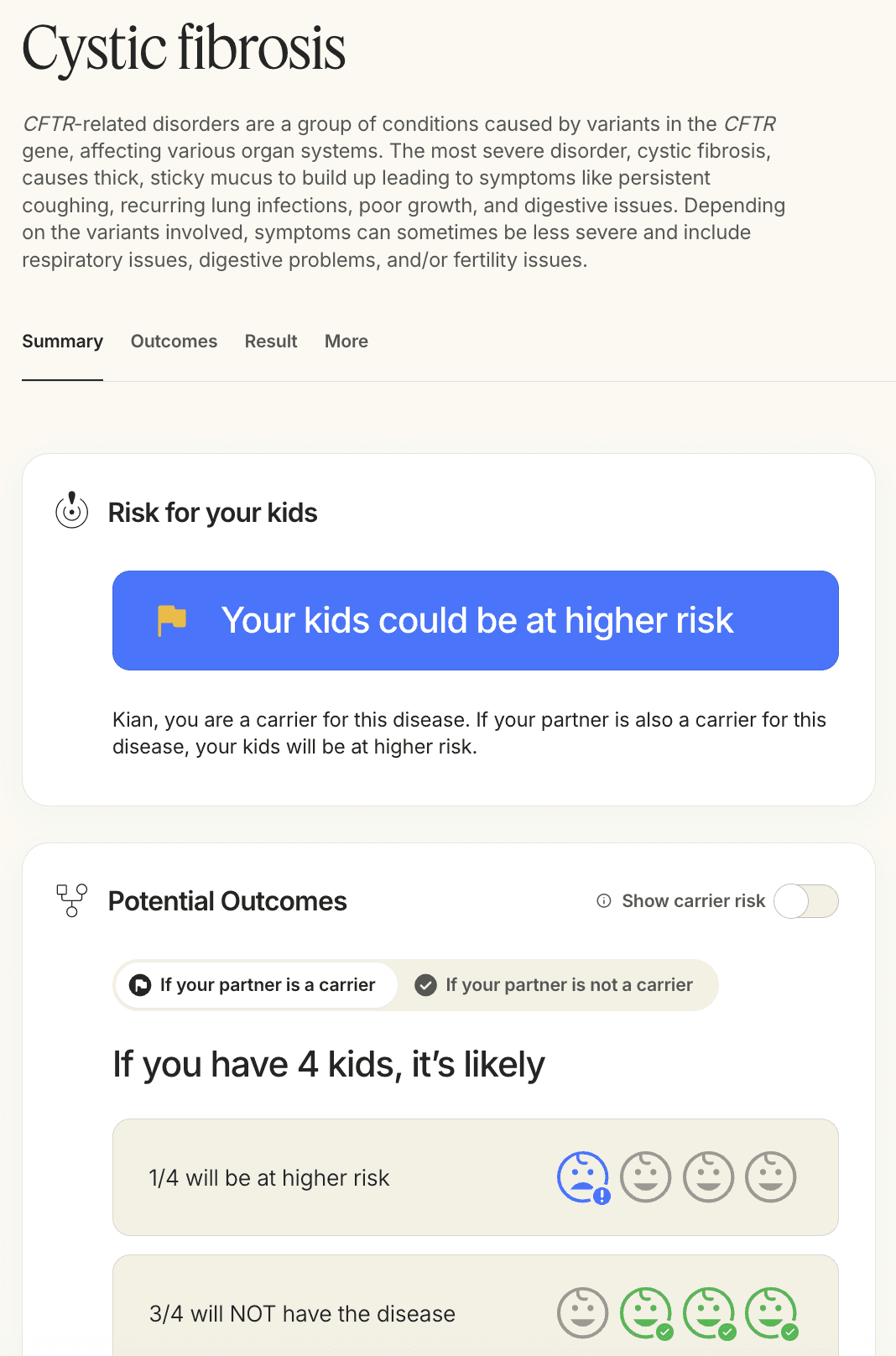
My cystic fibrosis result.
Now, many patients planning to have a baby, whether they are conceiving naturally or undergoing IVF, mistakenly assume that they have already been screened for these potentially debilitating or even lethal conditions for their baby. This is unfortunately often not the case, and one of the biggest, and most potentially consequential, errors made by both patients and physicians.
The standard genetic screenings done today for expecting parents, including those run in IVF centers across America and around the world, choose a small subset of hereditary diseases to screen for in you and your partner. The basic testing doesn’t screen for thousands of diseases that your baby could be at risk for.
There’s a simple reason for this, one that you now know. When many of today’s carrier screening tests were first developed, reading someone’s entire genome was simply too expensive. So they didn’t. Instead, they looked at a small set of genes for a small set of diseases.
At the time, that made perfect sense. But sequencing kept getting cheaper. What once cost millions of dollars eventually cost thousands, and today costs hundreds. We went from having to decide which parts of the genome were worth reading to being able to read essentially all of it. And yet much of genetic screening still reflects the world that came before.
The implication of this lackluster technology meeting a widespread parental misunderstanding is profound. Above all, there is tremendous human suffering. An estimated 300 million people worldwide59 live with a rare disease, and approximately 72 percent of rare diseases are genetic. Many of these diseases are hereditary. That means on the order of 150–200 million people worldwide live with a genetic disease that could have been entirely prevented.
To put that number in perspective, that’s about the entire population of Brazil.
Using the same math in the context of the United States, about 30 million Americans live60 with a preventable genetic disease. That is nearly the entire population of Texas. Rare diseases, in other words, aren’t all that rare. Because of an unlucky genetic draw, our fellow Americans and their families have to spend a lifetime physically suffering at the no-longer invisible hands of heredity.
Of course, preventing an inherited disease through GO means choosing an embryo that does not carry that disease, not removing the disease from the person who would otherwise have been born. But, looking prospectively, it's a distinction without a difference. Every future case of a devastating hereditary disease simply need not occur.
From an economic perspective, the total burden of rare diseases in the United States is estimated to approach $1 trillion a year.61 That includes not only the cost of medical care, but lost productivity, caregiving, and other costs borne by families and society. For some sense of scale, the annual economic burden of rare disease in America is roughly the size of the GDP of Switzerland.
The solution to this problem is already well established amongst medical groups in the country. The American College of Obstetricians and Gynecologists (ACOG) recommends at least some carrier genetic screening — and appropriate downstream care — for all couples62 looking to conceive, regardless of if they are doing IVF or not.
The process is straightforward. You screen the parents to see if they are a “carrier” for the same early-onset hereditary disease. If they are, parents choose an embryo without the disease. If not, there is no additional risk for that condition to screen for.
In this generation, genomic medicine will be thought of as a modern day vaccine where parents at risk can use GO to permanently eradicate rare, hereditary genetic disease from humanity. Just as smallpox was completely eradicated thanks to modern medicine, so too can rare diseases, all 7,000+ of them.
What a strange dissonance that we have the solution to all rare genetic diseases and yet nothing happens. How could this be possible?
The answer, curiously, lies in the same incorrect understanding of evolution on which I had built Nucleus. The vast majority of medicine, science, and culture treats genetics and, by extension heredity, as immutable. Genetics is understood as something that happens to us, that we are subject to and have no control over.
I’m deeply empathetic to this misunderstanding. After all, I spent a decade trying to pick a lock before realizing I had the key in my pocket. As we will see, the approach to a problem is its solution. If you start with the wrong assumption about a problem, you can spend years pursuing the wrong solution. This book has already spent thousands of words exploring how that happened with Nucleus. Now, we see the misunderstanding play out across medical institutions also committed to helping cure rare diseases.
Recently Dr. Robert C. Green, Professor of Genetics at Harvard Medical School, was talking about his central project BRIDGES-NBS.63 This is a project that focuses on sequencing babies once they are born. The goal of the project, according to its website, is simple:
“Earlier diagnosis of these [genetic] conditions [caught by sequencing a baby when they are born] could in turn lead to specific screening, surveillance, and treatment options, allowing for more personalized and preventative healthcare.”
The goal of the project is preventative medicine. When commenting on The New York Times64 article about the project, Dr. Green noted that the project distilled:
“12 years of NIH-supported work and over 40 publications…and that [the project] is a consortium of 10 sites and that the new NIH Collaboratory is co-led by investigators from Mass General Brigham and Ariadne Labs, Boston Children’s Hospital, Albert Einstein College of Medicine, the Association of Public Health Laboratories (APHL), Case Western Reserve University, [and] Baylor College of Medicine.”
It appears this project isn’t something that was just started, it is the culmination of over a decade of work, spanning genetic scientists across universities. It’s a simple idea that when a baby is born, sequence their DNA. If a baby is found to have a genetic disease, the parents and the medical system could start trying to treat them. It’s "preventative healthcare,” right? The New York Times article, written by Dr. Daniela J. Lamas, a physician at Brigham and Women’s Hospital in Boston explained the implication of the project to the reader:
“To understand what is at stake, consider two diseases. In Dr. Green’s 2013 trial, a newborn found to carry a mutation in the gene for elastin — a protein found in skin, lungs and blood vessels — underwent imaging that revealed aortic abnormalities that required monitoring. That finding meant more testing and more stress for the family. It may save his life.
This is the kind of information that is easy to say yes to, the kind of information that most studies would think parents should receive. But then there is Tay-Sachs, a fatal childhood condition. This condition isn’t being reported in the new N.I.H.-funded study, because it is not what the study would describe as actionable. But isn’t it? I would want to know about that finding, too, as awful as it is to consider, because it would change how I spent time with my child.”
I have tremendous respect for Dr. Green and his work. Bringing genomics into the world is a truly commendable goal, and I would be hard pressed to find someone who has dedicated themselves to that goal more than him.
However, I cannot overstate how deeply misguided this project is, rooted in the same faulty assumption that Nucleus was founded on. Once again, the scientists and physicians are assuming that DNA and heredity is immutable.
Medicine has become so accustomed to treating genetic disease after the fact that we scarcely question the premise itself. Instead of addressing the source of the problem, the scientists running this project would rather treat a baby, a child, with a lifetime of surgery, drugs, and therapies after they are born with a disease. And that’s if the parents are “lucky.”
More often than not, there is no treatment for rare genetic disease. This either means that billions of dollars in funding and a lifetime of someone’s work will need to be committed to delivering a therapy for the baby and one rare disease, or, tragically, the baby won’t live long enough to be treated. The baby, family, scientists, and physicians will feel the consequences of the hereditary disease for their life or, even worse, until the end of a precious life.
There is a different way. And it requires going all the way back to questioning our first assumption. DNA and heredity is now, in fact, mutable. A baby does not need to be born with a genetic disease in the first place. Once we see the problem in this way, we see a completely different path forward.
A baby's DNA is based on mom and dad. As a society, we should first look at mom and dad and see if their baby can be born with a serious disease. Again, with my personal example of cystic fibrosis, if my partner was not a carrier for it too, we would have almost no chance of passing down the disease to our baby. In that case, where there is little risk of passing down a rare disease, then, great, the couple can go and choose to have a baby in the bedroom.
If there is a risk, the couple can choose to do GO and select the embryo without the disease. In that way, they are permanently preventing their baby from being born with a life-threatening condition.
What I personally found quite disturbing about the NIH and Harvard’s thinking was when the physician-author notes that Tay-Sachs is actually "actionable" because it would change how she “spent time with her child.” I was so deeply taken aback by this sentence because Tay-Sachs is “actionable,” but I realized what the doctor meant and what I meant were completely different.
Indeed, the doctor's unwritten implication is obvious: we, as parents, as a society are at the mercy of genetics. The best we could hope for is the darkest of tragedies, sitting with our newborn baby as a disease takes their life. This thought makes me want to cry for the author and the imaginary family. It doesn’t need to be this way.
Today, parents can choose to have a baby born without Tay-Sachs disease. Dr. Lamas, the author of the piece, omits the fact that carrier screening was first invented in the 1970s for Tay-Sachs disease. Nevermind GO during IVF, carrier screening for Tay-Sachs has existed for fifty years. In fact, since the 1980s, Dor Yeshorim65 has screened hundreds of thousands of people in Orthodox Jewish communities for Tay-Sachs and other recessive genetic diseases, helping prospective couples take preventative action if both partners carry the same disease-causing variant. This goes completely unmentioned.
The way Dr. Lamas understands genetics — that is it is immutable and endowed upon us — has not been true since Alan Handyside picked a female embryo who would not go on to develop muscular dystrophy more than 30 years ago. To Dr. Lamas, the "actionability" of genetics has nothing to do with prevention but learning to sit with the tragic idea that an unlucky draw of our genes can strike our baby and cause a lifetime of pain. I cannot say it more adamantly, more loudly: Dr. Lamas, and the broader Brigham and Women's Hospital community, genomics is now actionable. No couple today has to have a child with a severe genetic disease.
There is another prescient example. Around a year ago, the Children’s Hospital of Philadelphia announced the World's First Patient Treated with Personalized CRISPR Gene Editing.66
The article notes:
“In a historic medical breakthrough, a child diagnosed with a rare genetic disorder has been successfully treated with a customized CRISPR gene editing therapy by a team at Children’s Hospital of Philadelphia (CHOP) and Penn Medicine. The infant, KJ, was born with a rare metabolic disease known as severe carbamoyl phosphate synthetase 1 (CPS1) deficiency…
Years and years of progress in gene editing and collaboration between researchers and clinicians made this moment possible…said Rebecca Ahrens-Nicklas, MD, PhD…
While KJ will need to be monitored carefully for the rest of his life, our initial findings are quite promising…Ahrens-Nicklas said.”
This is an extraordinary medical achievement, and the scientists should be appropriately praised for their work. When you save one life you are saving the world’s life, so this is beautiful work. Thank God baby KJ is ok.
It is important to note that baby KJ inherited two copies of the CPS1 gene from mom and dad. As I hope to have established by this point, that was both predictable and preventable. Not screening mom and dad required a “historic medical breakthrough,” including “years and years of progress in gene editing and collaboration between researchers and clinicians.” STAT News also reported67 that the project "likely ran into the millions, if not tens of millions, of dollars."
To cure one baby of a rare disease required several years of work and tens of millions of dollars. While this can be an extraordinary moment for science and medicine, and it is, it should have also been a profound wake up call for the entire community. GO could have prevented the condition for a fraction of the cost, at an IVF clinic near you. And this medical intervention lasts a lifetime.
2. Optimizing chronic diseases, focusing first on “high penetrant” (high-impact) disease variants
Starting with rare diseases, we began to establish genetics not as a mere predictor of disease, but as its ultimate preventer. And that doesn’t just apply to rare diseases. What makes genomics so remarkable is its generalizability. After eliminating the risk for rare diseases, parents naturally gravitate to focusing on later-onset diseases.
These are the conditions that you likely have a family history of and are what kills, by far, the largest number of people. Diseases like cancers, diabetes, Alzheimer's, heart disease, and more. In America, more than half, about 55 percent, of all deaths annually68 are attributable to these conditions. For comparison in 2021, at the peak of the pandemic, about 1.8 million people died of chronic diseases. So that’s four times as many people dying from chronic disease in America than COVID from that year.
Chronic diseases are the true pandemic of our time.
Given how common these conditions are and how different the treatment protocols are once they are physically manifested, the economic burden is extraordinary. The direct medical expenditure for dealing with chronic diseases today is $4.8 trillion, or 90 percent69 of the U.S.’s $5.3 trillion in annual healthcare spending. This is more than the GDP of the United Kingdom.
You can think of the majority of the U.S. healthcare budget simply as the cost to treat rare diseases and chronic diseases. People generally have a good intuition for the fact that rare diseases are genetic. What many do not know is that chronic conditions are actually quite genetic as well. Alzheimer’s,70 diabetes,71,72 certain cancers,73 and certain heart diseases,74 are 50-80 percent heritable. Something like Alzheimer’s is sometimes estimated to have as strong a genetic component as height.75 That is to say, it’s almost all genetic in origin.
This is actually good news for a future parent. Since it means you can, at the very beginning of life, help prevent these conditions with no needles, medications, surgeries, or other bodily interventions. You can help shape 80 years worth of your baby’s health outcomes with one choice: your baby’s DNA.
From a genetics standpoint, the key difference between rare conditions and chronic conditions is that the former is monogenic, the latter polygenic.
One of the biggest misunderstandings about chronic disease is treating its genetics like that of a rare disease. By that I mean something fixed and binary, i.e., monogenic. Either you inherited the disease-causing variant or you didn’t. But genetic risk for chronic disease exists on a spectrum, they are polygenic. This is why we often hear competing narratives about how important genetics really are.
If you start picking apart the cultural genomics consciousness, you see this intense dissonance play out. On the one hand, colloquially speaking, you hear all the time people talking about the cancer in their family, the diabetes that their mom had, that their uncle died of a heart attack and how it impacts them. In every doctor’s office in the country, you are asked about family history as a way of, at least in part, measuring your genetic risk and showing an acceptance that diseases run in families. If you really keep pushing, you may even hear about things like the ominous “breast cancer gene.”76 Yet, in the same breath, all over culture, you read statements on how “DNA is not destiny,”77 or "Are your genes your destiny? The researchers' conclusion was, no, they aren't,"78 or “Why your DNA isn’t your destiny.”79 This is confusing, and often makes people jump from two extremes: genetics is everything or genetics is nothing. So is DNA important or not? It’s not really clear.
The source of this error goes back to Mendelian genetics. If you have the “gene” for cancer, diabetes, Alzheimer’s, etc., you must be poised to get the disease, right? And if you don’t, then you are okay, right?
This assumption also impacts the way people think about a genetic test. Since genetics is binary, they think, it means there’s either a “bad” genetic result or a “good” result. For this reason, under this framework, it can be terrifying80 or a total relief. Worse yet, the result is unactionable for the next generation. For, if they do have this genetic marker, they can’t possibly stop their baby from getting the disease, too. All these inaccurate assumptions run rampant in all sorts of different shapes and sizes across culture and medicine.
Let’s set the record straight. There’s two ways for parents to reduce the risk of common diseases in their future baby. The first is by choosing not to pass down what is known as “high-penetrant” (high-impact) disease variants. Not every couple will have such markers, but for those who do they can be very important, for the parent and baby.
The most famous “high penetrant” disease variant example is the “BReast CAncer gene” or BRCA. You might remember in 2013, actress Angelina Jolie published in The New York Times an opinion piece on her getting screened for such a genetic marker,81 which substantially increased her risk for breast cancer. To be clear, BRCA1 doesn’t single-handedly cause a woman to have breast cancer, but takes her risk from about a 13 percent chance to more than 60 percent.82
Based on this information, a patient can help prevent the onset of the condition in themselves with earlier and more aggressive screenings or even a double mastectomy, which is what Ms. Jolie chose to do. Also, now, when choosing their embryo, a patient can select an embryo without the marker; a mother can choose not to pass down their elevated risk for breast cancer to their child. When it comes to genetic optimization, this is no doubt one of the greatest gifts a parent can give their baby, especially given how prevalent chronic disease risk is today.
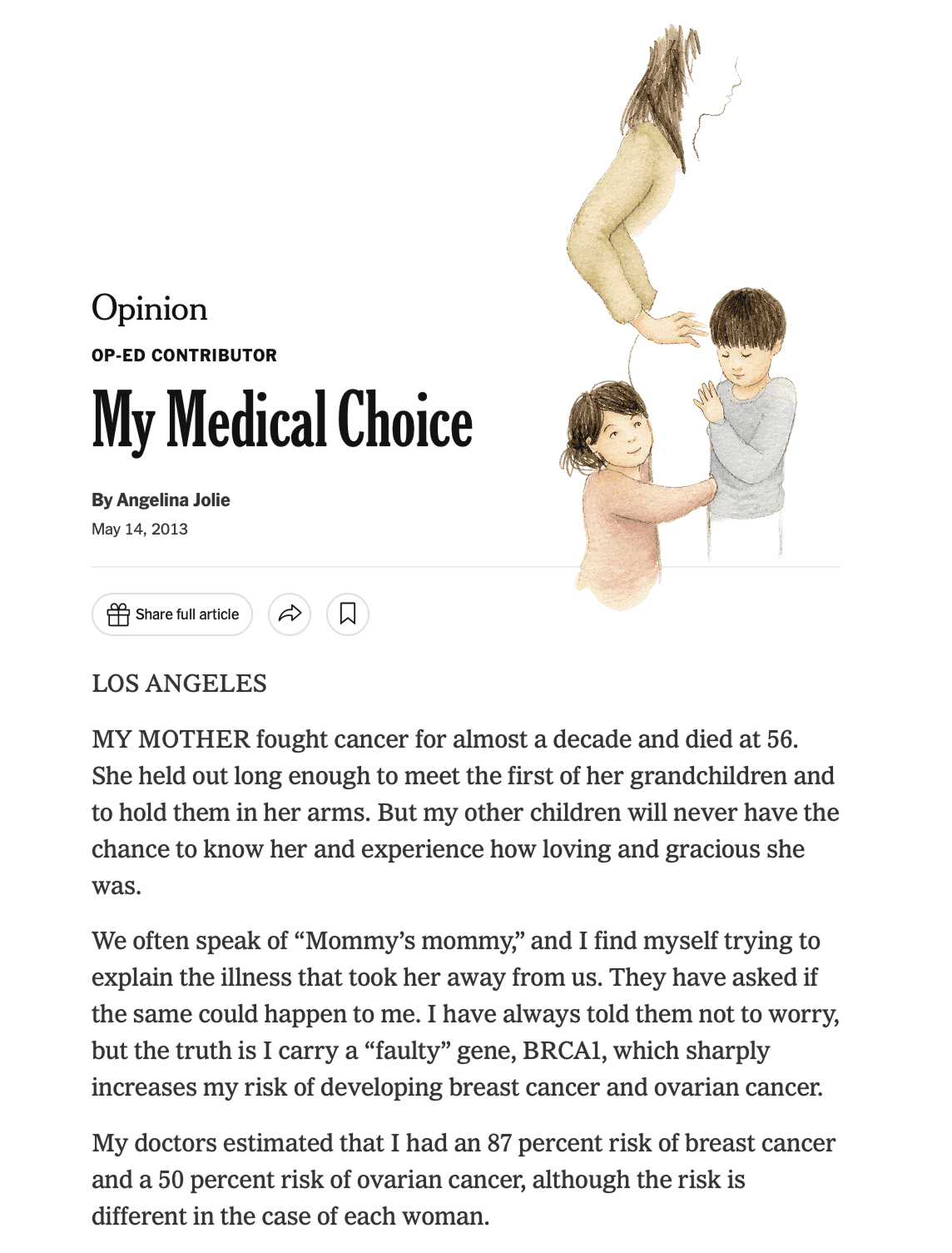
My Medical Choice — Angelina Jolie’s opinion piece in The New York Times in 2013.
Interestingly, this marker was actually highlighted in The New York Times article64 about BRIDGES-NBS63 discussed earlier in the rare disease section. Dr. Lamas writes:
“Dr. Green included screening for some treatable diseases that begin to manifest only in adulthood, with the idea that these findings could lead to useful information and better care for the rest of the family. In one case, after a baby was found to have a BRCA2 gene mutation, the baby’s mother was also tested and found to share the variant, leading her to take preventative measures to lower her own cancer risk. “Saving a mother is good for the child,” Dr. Green told me.”
Note several things here, broadly reflective of the aforementioned errors in understanding. First, the fact that the mother is screened after the baby, as if the baby didn’t receive the marker from the mother. Next, notice how BRCA2 is discussed, it is framed as if it is monogenic, as if it is actually a rare disease. Dr. Greene notes how the variant “saves” the mother. That is not accurate. “BReast CAncer gene” is a misnomer. There is no breast cancer gene. There are genes that have disproportionate effects on breast cancer risk, but this cancer risk isn’t a monogenic condition.
You see this misunderstanding play out everywhere. Recently, in The Atlantic, a journalist wrote a thoughtful essay on genetic testing. In it, they write:80
“Despite my family’s history of breast cancer, I carry no mutations known to elevate my risk for the disease. Whatever predisposition is responsible for my family’s medical history, our genes would neither determine my own destiny, nor that of my daughters.
When I talked with my mother about my test results later that same day, we were both relieved that we had not passed on to my daughters any mutations known to cause breast cancer — even though we knew that our family history likely still raised their risk of developing the disease.”
In this case, the patient is negative for the limited testing panel they ran on breast cancer-associated genes. Interestingly, you see the Mendelian assumption play out: “I carry no mutations known to elevate my risk for the disease.” You also see this idea that heredity is something inherently unactionable: “we were both relieved that we had not passed on to my daughters any mutations known to cause breast cancer.”
Heredity, once again, is uncontrollable. The author is wholly unaware that she could have actually chosen to not pass down BRCA to her daughters.
Next, you even see the hint of confusion around the black-and-white nature of the result. On the one hand, she was told she was not at risk. On the other hand, she acknowledges that “our family history likely still raised their risk of developing the disease.” So she is not at risk, but she may still may still be at risk because of “family history,” a term with a pristine level of nebulousness. It’s inherently confusing and cloudy. The author is not a physician or a scientist. She is an earnest journalist trying to figure out her and her daughter’s risk.
Not once is it mentioned anywhere in the article, by any physician or scientist, that, as we have outlined in thousands upon thousands of words, breast cancer, diabetes, heart disease, schizophrenia, bipolar disorder, Parkinson's, other cancers, autism, and virtually all other chronic conditions are polygenic. Meaning that your genetic risk for these conditions is influenced by millions of additional “common” genetic markers beyond the “high-penetrance” markers that may exist for some of them.
In the author’s case, this means she could be negative for all “high-penetrant markers,” yet still be at a substantially elevated risk for breast cancer due to the millions of other DNA markers that collectively confer breast cancer risk. A negative result, in other words, does not mean what her doctor thinks it means. Again, there is no breast cancer gene. This is one of the most damaging misunderstandings in all of clinical genomics.
A complete genetic screen for cancer must include both “high-penetrant” variants, like those in BRCA1, and the millions of other markers that confer risk. Then, and only then, can one be confident in the actual genetic risk ascertainment for both parents and embryos. Otherwise patients, like the author, may think they are not at risk for cancer, when they actually may be.
The reason why I separated out these kinds of markers in their own section is not because they are technically different. In fact, patients really only care about what their genetic risk is, not its precise genetic breakdown. These two kinds of variants are not in tension, they are one.
I separated them out, though, for two reasons. The first is that these sorts of genetic markers, due to their Mendelian nature, fit into the existing83 (wrong) worldview of clinical genomics. In turn, it’s good to contextualize polygenic screening — measuring genetic risk for disease — as the natural iteration on what has already been done for over 30 years. Indeed, BRCA screening is established to be valuable, then so must polygenic screening.
Why? Because polygenic scores can identify people whose genetic risk is comparable to that conferred by high-penetrant variants like those in the BRCA1 gene. If that level of risk has clinical utility when it comes from a single variant, why shouldn’t it when it comes from millions? In fact, the clinical utility of “high-penetrant” markers are so well established that they were even part of the CDC Tier 1 Genomics Application list,84 which were genes the CDC recommended for population level genetic screenings, i.e., genetic screenings for everyone.
It will then surprise you, getting to the second reason here, that despite how clinically established these markers are, if you go to an IVF center, you are not screened for variants in BRCA1, or any high-penetrant or dominant variants, those that increase both your risk and your children’s. This means across nearly every IVF center in the United States and around the world, you have parents not just not knowing their own risk, but unknowingly passing down the hereditary disease risk to their baby.
We have mothers like Angelina Jolie unknowingly inheriting — and potentially passing on — BRCA variants, even as medicine recognizes the substantial cancer risks those variants can confer. This gets at something that is often missed when evaluating new medical technologies. The risks of an intervention should not be considered in isolation, but against the risks of the status quo. And the status quo is not risk-free. It includes continuing to transmit known hereditary disease risks even when we can now prevent that risk in the first place.
This fact also reveals an acute logical inconsistency. One objection to GO is that technologies like polygenic prediction are comparatively new. Medical conservatism around new technologies is understandable. But that cannot explain the whole picture. BRCA1 and BRCA2 are among the most established genes in clinical genetics, yet routine IVF care does not generally begin by screening every prospective parent for BRCA variants. The limitation, in other words, cannot be that the genetics are too new or uncertain.
I think there is a deeper reason: genomics is still viewed as a predictive science, not a general-purpose medical intervention. It is therefore the job of the GO industry to educate the world on what genetics is — the generational cure.
3. Optimizing for chronic diseases, focusing on “common” disease variants
Most parents do not have a “high-penetrant” marker. This doesn’t mean, as mentioned, the patient or their baby is not at risk for a chronic condition. In fact, the vast majority of the genetic contribution for chronic disease comes from common, not rare, genetic markers.85 Accordingly, for a complete disease risk assessment, one also needs to measure polygenic risk.
From type 1 and 2 diabetes, hypertension, prostate cancer, coronary artery disease (heart disease), breast cancer, asthma, and other common diseases, the impact from these millions of common genetic markers could put you anywhere from a less than 5 percent chance of getting the condition to a greater than 50 percent chance. Common genetic markers can put people at a 10x difference in risk of getting a common disease.
What’s so fascinating here is, thanks to our updated genomics worldview, we actually now see this as an opportunity for genetic optimization. Because it means that — thanks to recombination being a central evolutionary force — the process of generating embryos is the process designed to have substantial genetic and, thus, phenotypic diversity. Even only two embryos will differ by millions of markers; hence they can have a large spread of genetic risk for chronic disease.
To get more specific, you can actually see the disease risk reductions across two, five, ten embryos on Nucleus' Genetic Optimization Hub,86 a public hub for companies, labs, and researchers to open-weight and share the accuracy of their predictors.
The hub includes the predictive accuracy of every single Nucleus predictor, the corresponding average risk reduction when picking from embryos, and the underlying model weights. On that last point, any claims made in this book (or anywhere) can be directly tested by anyone. At this point, the underlying model weights have been shared and independently evaluated by over 85 academic and medical institutions around the world, independent researchers, and even a small number of very curious citizen scientists. If you're curious, you can download them yourself here.87 Moreover, further technical details can be found in our white paper,88 co-authored by Dr. Folkersen and Dr. Treff.
On the hub you can see that, on average, when picking the lowest to highest risk embryo with just five embryos, you can get a risk reduction of 84 percent for type 1 diabetes, 75 percent for schizophrenia, 73 percent for prostate cancer, 74 percent for Alzheimer’s, 64 percent for type 2 diabetes, 60 percent for bipolar disorder, 62 percent for breast cancer, 53 percent for heart disease, 50 percent for endometriosis, and…the list goes on.
When I first saw these results after we trained and validated the models on a large increase in genetic data from biobanks, I could only think of one word. Stunning.
As it was for rare diseases, what appeared to be many different disease manifestations — schizophrenia to Alzheimer’s to cancers to diabetes — all have DNA in common. Combining our understanding of recombination with polygenic architecture, we start seeing GO as a new kind of medicine. Indeed, rare conditions are not the only kind of diseases that can help be prevented with GO, so, too, can chronic disease.
When sharing these risk reduction numbers, they no doubt feel quite substantial. That said, it is helpful to contextualize the numbers within the broader context of the most efficacious medical interventions we have as a society.
Effectively, all of longevity and preventative medicine today can be understood as fields that exist to reduce risk. In the best case, this risk reduction actually leads to disease prevention, saving a life and helping reduce the trillions of dollars89 we spend on treating chronic disease.
The number and range of these measures vary, from maintaining exceptional fitness, getting good sleep, optimizing blood pressure and cholesterol, taking statins or GLP-1s, cancer screenings, smoking cessation, and even more frontier therapies like peptides.
To evaluate the benefits of GO, we should compare it to the most effective and evidence-based of these preventative health interventions.
Let’s start with quitting smoking. For smokers, cessation over 10-15 years results in a risk reduction of 50 percent for lung cancer.90 Smoking cessation will reduce other disease risk as well, but nothing at the level of lung cancer. Note this is a probability; stopping smoking doesn’t guarantee that you won’t get lung cancer. But the benefits are obvious; a 50 percent reduction is massive. By extension, there is not a single doctor’s office in the world that wouldn’t recommend stopping smoking to their patients. In fact, it is recommended by the CDC,91 American Cancer Society,92 and U.S. Preventive Services Task Force.93 In large part because of this universally accepted intervention, lung cancer incidence in the United States has come down by about 40 percent94 since the early 1990s.
For non-smokers, the most well-accepted and researched disease-prevention measure is going from inactivity to physical activity. In this case, meeting recommended physical-activity levels is associated with roughly a 31 percent reduction95 in the risk of premature death. This is why, for roughly a one-third reduction in risk, the World Health Organization,96 CDC,97 and American Heart Association98 recommend that all kids and adults in the world exercise regularly.
This means GO can provide risk reductions across all chronic diseases for life, greater than that of both exercise and smoking cessation. In fact, among the aforementioned chronic diseases, the one with the lowest risk reduction from GO — endometriosis — is equal to the largest known risk reduction today — smoking cessation.
Given this, it is inexplicable, at best, when you read the first sentence of the limitations section in the American Society For Reproductive Medicine's99 take on applying polygenic scores in embryos. They write:
“Polygenic risk scores provide probabilistic rather than deterministic predictions of disease risk.”
There is no such thing as a “deterministic” prediction of chronic disease risk. A “risk”, by its nature, is non-deterministic. This is why the medical establishment’s national and international recommendations depend on probabilistic risk reductions. In fact, the term “polygenic risk” could be swapped out for “smoking” and “exercise” and the sentence would still be true. For both smoking and exercise “provide probabilistic rather than deterministic predictions of disease risk.” Perhaps the ASRM misunderstands this fact. It is unclear. What is clear, though, is the level of quality and understanding that went into this ethics committee opinion.
Interestingly, when I say GO can reduce risk for “all chronic diseases,” I mean that in an even more encompassing way than you may initially realize. Genetics is highly pleiotropic.
Pleiotropy refers to the phenomenon in which a single genetic variant influences multiple traits or diseases simultaneously. Rather than affecting only one biological pathway, many genetic variants have effects that ripple across numerous systems in the body.
This means, remarkably, that when you select an embryo with a lower genetic risk for one disease, you are often simultaneously selecting for lower risk across many others because the same collection of millions of genetic markers negatively associated with one disease, are often negatively associated with many diseases. When doing GO, parents selecting to reduce risk for the disease that runs in the family are also often reducing risk for numerous chronic diseases at once.
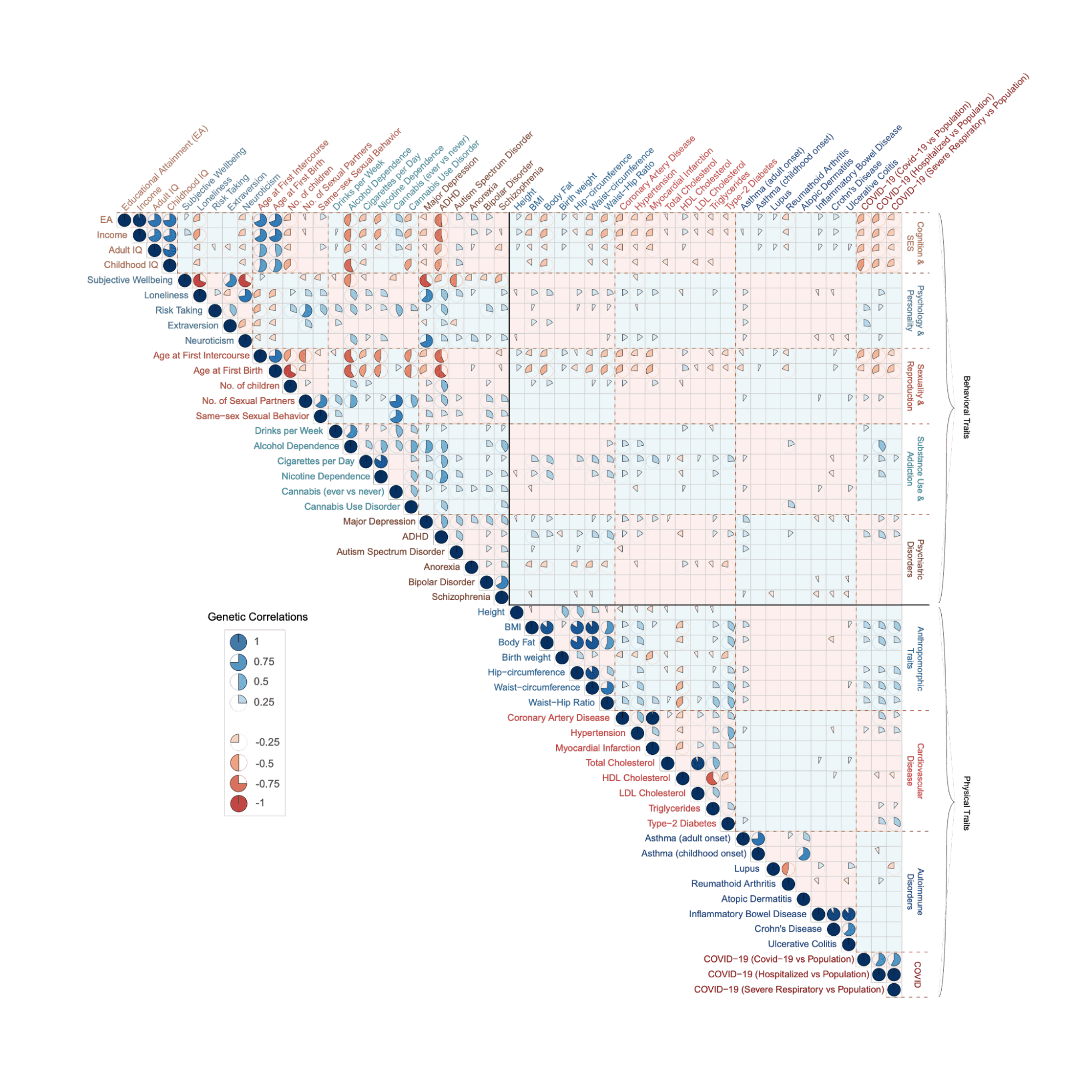
Genetic correlations between 52 phenotypes , estimated with LD score regression. A positive correlation means that genetic markers which increase one phenotype tend to also increase the other. For instance, markers which lower risk of ADHD also tend to lower risk of depression.100
This stands in stark contrast to the much more targeted interventions available in modern medicine. Barring exercise, sleep, and smoking cessation to a lesser degree, healthcare interventions generally focus on diseases associated with one organ at a time. Low-density lipoprotein (LDL) reduction, for example, reduces heart disease risk but has no impact on cancer risk.101 Even more obviously, a colonoscopy can help with preventing colon cancer but will have no impact on stopping Alzheimer’s. Similarly, an MRI scan can’t reduce schizophrenia risk. It sounds ridiculous to even write.
This is where the generalizability of GO shines. Rather than needing to constantly intervene across numerous different interventions over decades, a single selection decision helps improve 80 years of health outcomes for life.
We all know someone who seemed to do everything right. They exercised daily, ate well, never smoked, optimized every biomarker, underwent routine cancer screening, and followed every recommendation from the world's leading longevity physicians, and maybe even, within the more recent boom, took statins or GLP-1s. Yet, they still developed cancer or suffered a heart attack or died decades earlier than anyone expected. Sometimes it is simply bad luck. But often, a substantial part of the explanation is the genome they inherited.
Indeed, no matter how disciplined you are, you are still working with the genome you were born with.
Interwoven into our society is this deeply held notion, that genetics is something immutable and fixed, that our families have some “good” genes, like our mother’s eyes, and some “bad” genes, like our father’s cancer risk. Listen to any family talk about themselves and you can feel both the pride, and pain, in how they talk about their DNA.
GO now, for all families, everywhere, completely rewrites this script. It fundamentally alters one of society’s deepest held assumptions. Rather than just accepting that your child needs to spend a lifetime compensating for inherited disease risk, you can now dramatically reduce that risk before life even begins. When you do this, you are creating a healthier baseline not just for your child, but for every generation that follows.
Now, we have returned all the way back home. If you remember in The Millennium Mission, I noted:
“Curiously, of the approximately 58 million people that die globally each year, a whopping 71 percent are caused by non-communicable diseases (NCDs) or “lifestyle” diseases…like cardiovascular disease, cancer and respiratory disease…Due to their late onset…it is precisely the kind of problem that natural selection is unable to, by definition, weed out…
[Thus] the long term vision is evolution directed, in part, by us humans.”
We have finally found our answer. Man can now partake in his own evolution.
4. Optimizing for traits
This is where genetic optimization begins to feel different.
Avoiding hereditary disease fits comfortably within our existing idea of preventative medicine. Selecting between embryos based on physical traits or cognitive ability does not. It is here that much of the public conversation, and criticism, tends to focus.
Once parents have identified embryos that are comparable from both a rare and chronic disease-risk standpoint, they can then choose to optimize for the traits they care about.
What’s surprising is that parents have always optimized their child’s traits, both genetically and non-genetically, pre, during, and post conception. We just simply never put a name to what it is, an optimization.
Preconception
Let’s consider, first, how most people conceive.
When you choose your partner, you are already making choices that influence your baby’s traits. Everyone intuitively understands this. It’s why people joke about “looking for a man in finance, trust fund, 6'5", blue eyes.”102 On Hinge, one of the world’s largest dating apps, you can filter potential partners by height, politics, education, ethnicity, religion, and more.
The tall-blue-eyed-finance-man TikTok.
We accept that people are free to make choices about who they reproduce with, even when those choices, however implicit, have explicit and dramatic genetic consequences for their future children.
Take the 6'5" man with blue eyes. We would never tell someone they can’t choose him as a partner because doing so would be “eugenics.” If anything, restricting whom someone can choose as a reproductive partner comes closer to the coercive logic of eugenics of limiting reproductive autonomy rather than expanding it.
In the context of choosing a partner, we know there is no universal “best.” One person wants the 6'5" man with blue eyes. Someone else doesn’t. People value different things, make different tradeoffs, and ultimately choose differently.
It’s not unreasonable, then, to believe that the same principles should apply to genetic optimization. The technology may make these choices more explicit, but the underlying ideas of autonomy and individual preference choosing your best baby are similar to choosing your best partner.
This becomes even more explicit in donor conception.
In the IVF context, millions of babies have been born via sperm or egg donors. It goes without saying that this process of egg or sperm selection is, quite literally, the process of parents choosing the preferred traits they would like to have in their baby (remember, setting the outcome space is one kind of GO). One study of parents who conceived through egg donation found that 90 percent knew their donor’s103 hair color, eye color, height, weight, ethnicity, education, age, and medical history.
Donor selection makes something explicit that mate selection can obscure: parents are already comfortable making deliberate choices about the genetic traits they hope to pass on to their children. When choosing a donor, those preferences are not incidental to another decision. They are the decision itself.
And importantly, we don’t generally consider this strange. It is an accepted part of how families can choose to have children.
So, it’s worth repeating, again — parents have been optimizing their baby’s traits since the dawn of time through mate selection. Mate selection is actually a kind of GO.
What’s also interesting with pre-conception trait optimization, whether explicit in the case of donor selection or implicit in the form of natural conception, is that two people optimizing for the exact same characteristics could still choose entirely different partners. There are, after all, many tall men with blue eyes.
The same logic transfers remarkably well to genetics. No two couples share the same genetic outcome space for their children. That means different parents optimizing for the same trait do not converge on the same genome.
Take cognitive ability. Two embryos could have the same predicted cognitive ability through very different combinations of genetic variants. This is the beauty of polygenicity. The same phenotype can emerge from many different genetic paths.
Once you move beyond the simple Mendelian model of one gene producing one outcome, the idea that GO leads toward genetic uniformity begins to fall apart. Even if every couple in the world selected for the same phenotype — which, as we’ve already established, they wouldn’t — an unfathomable amount of genetic diversity would remain.
During conception
At this point, I’ve made clear that one way to understand GO is as a technology that makes a process that has always existed more precise. Parents have always made choices that influence their children's genetics. Now, rather than relying solely on heuristics, they can have greater information and agency over those choices.
But, while this is true, it's actually not the whole story. GO doesn’t just make an existing process more precise, it expands the amount of genetic choice currently available to parents.
There’s already a remarkably clear precedent for this in reproductive medicine. Consider biological sex. Sex is genetically determined. And for as long as people have had children, some have tried to influence it.
Before IVF, those efforts largely took the form of folk wisdom and imperfect heuristics. Perhaps the most famous example is the 1960s book How to choose the sex of your baby,104 which popularized the “Shettles method”105 that contained recommendations about the timing of intercourse and sexual positions supposedly more likely to produce a boy or girl. Its author, Dr. Landrum Shettles, was himself an OB/GYN and an IVF pioneer.
Whether the Shettles method, or any of the countless other methods people have tried, actually works is beside the point. The desire to exercise some choice over this particular trait is not new. What changed with IVF was our ability to do it precisely and reliably.
Today, parents undergoing IVF in the U.S. can electively choose between embryos based on sex. Put more starkly: parents can electively choose between entire chromosomes in their embryos. And this is not some obscure edge case. Among U.S. IVF clinics, 72.7 percent offered sex selection.106 Of those clinics, 93.6 percent said they offered it for “family balancing”.
Which makes the prevailing distinction around “trait selection” difficult to reconcile. In its assessment of polygenic scores, the American Society For Reproductive Medicine (ASRM) writes:107
“[Polygenic scores] used for trait selection (e.g., height, intelligence, eye color) is not within the scope of reproductive medicine.”
But trait selection is already offered by a majority of IVF clinics in America. And parents undergoing IVF have been permitted to make discretionary choices about the genetics of a trait in their future child for decades. When asked under what circumstance these IVF centers permit sex selection, more than 80 percent of the clinics said they follow “patient preference, regardless of the rationale of the request.”108
So the disagreement cannot simply be about whether parents should ever be permitted to select an embryo based on a trait. Reproductive medicine already permits that. The real question is which traits parents should be allowed to consider, and why.
On that point, sex is arguably a far more consequential determinant of a person’s life than eye-color, height, or many of the other traits that provoke anxiety around GO, particularly IQ. Yet we would never say that one sex is universally “better” than the other.
Parents don’t behave as though there is a “better” choice, either. In one study of 585 patients undergoing PGT-A at a U.S. academic fertility center, among those who selected the sex of their first child, roughly 51 percent chose a male embryo and 49 percent chose a female embryo.109 A flip of a coin, just like natural reproduction. Once again, more choice does not mean more convergence.
Post-conception
Of course, society doesn’t stop at optimizing for traits at conception. In fact, once a baby is born, I would go so far as to say that much of modern civilization is built around trait optimization; helping people change and improve particular physical and cognitive characteristics.
To be clear, I’m not saying I personally believe every form of optimization is morally right, I’m simply pointing out that optimization is already everywhere.
The examples are almost endless, spanning looks to longevity to lucidity: tutoring, GLP-1s, braces, private schools, glasses, growth hormones, plastic surgery, makeup, SAT prep, sunscreen, LASIK, personal trainers, acne medication, peptides, nutrition, Botox, a good school district, strength training, caffeine, longevity medicine, limb-lengthening surgery, even, fertility medicine itself. Some of these interventions are medical. Some are cosmetic. Some are educational or environmental. Some are mundane enough that we barely think of them as optimization at all.
But they share an underlying premise: we are comfortable intervening to influence the traits and capabilities of ourselves and our children.
So, to make my final point on traits, I want to focus on three in particular: BMI, height, and IQ. GO did not invent the desire to optimize for any of them. We already do so through nurture, medicine, and, as we’ve seen, mate and donor selection. What is new is the precision with which parents can now influence them genetically.
Just as with chronic disease risk, recombination can produce a meaningful spread in these traits among embryos from the same parents. The statistics I’m about to discuss can also be found in the same Genetic Optimization Hub88 I mentioned above. The science behind the models I’m about to describe can also be found in this Nucleus white paper.109
BMI
Let’s start with BMI. On the hub you can see that, on average, when choosing between the highest to lowest of just five embryos, parents can reduce the adult body weight of a male child by 32 pounds, and a female child by 35 pounds.88
Importantly, these models have been tested within-family,109 meaning the predictors aren’t merely a theoretical assessment but have shown that they can successfully stratify BMI across tens of thousands of longitudinally and independently tracked sibling pairs.
I like to quip that every person in the world is a mini-genetic experiment. Siblings are a particularly powerful test because they share both parents and much of the same environment. In that sense, they are a natural experiment for embryo selection. By that I mean since they hold much of the nurture constant, they are a great way to test whether the genetic model can still predict the differences that emerge between them (remember that the DNA you inherit stays constant your entire life, hence longitudinally tracked siblings are the best testing data because, genetically speaking, a pair of siblings are a pair of embryos). More simply, since the model can distinguish between siblings, rather than simply between unrelated people, the model is capturing robust genetic signal.
The predicted difference in adult body weight is comparable to, and in some cases even exceeds, the weight loss with some of the most consequential drugs of the last decade. In the landmark clinical trial for semaglutide,110 a widely used GLP-1, patients lost an average of roughly 34 pounds after 68 weeks of treatment.
The comparison is not that GO and GLP-1s are equivalent interventions. They obviously aren’t. The point is that society is already willing to intervene substantially, repeatedly, and at enormous cost to optimize this exact trait. With GO, parents can influence the genetic predisposition toward BMI before their child is even born.
This makes a world of difference. Unlike an intervention that must be started later in life and potentially maintained, the child’s inherited genetics are present from birth. And because those variants enter the germline, some of that genetic influence can also be passed to future generations.
The economics make the contrast even more striking. Prescription weight-loss drugs are contributing to an enormous and growing healthcare expenditure, while the success of GLP-1s has created hundreds of billions of dollars111 in value for the companies developing them. Yet BMI itself is highly heritable, with estimates around 70 percent.112
We are already spending extraordinary amounts of money trying to modify downstream what can be substantially modified upstream with genetics.
And these are the models today. As datasets grow and prediction improves, so too will the amount of phenotypic variation we can identify within families.
Height
Next let’s talk about height.
What’s interesting about height is there’s no silver-bullet equivalent to Ozempic. Height is about 80 percent heritable75 and once basics like proper nutrition and sleep are accounted for, there is no easy way to materially increase it.
Nevertheless, that doesn’t stop us from trying.
For children, one option is growth hormone therapy. And it isn’t limited to children who are actually deficient in growth hormone. It can also be prescribed for “idiopathic short stature” or children who are simply short, without a clear medical reason why.
A child gets injected with synthetic growth hormone, typically every day, while their growth plates are still open. They do this for years. The cost is exorbitant, between $10,000 and $60,000 annually.113 After all the physical and psychological ramifications, the treatment at best produces gains measured only in a few inches.
For adults unhappy with their height, the options become even more extreme. There is limb-lengthening surgery, in which surgeons break their leg bones, drawing them apart over months as new bones form in the resulting gap. The surgery is done almost entirely for elective purposes. The process can require months of rehabilitation, carries serious risks, and can cost more than $100,000. A patient might gain around 2-3 inches.114
This may sound insane until, well, you realize that plastic surgery — which certainly threads the line between medicine and optimization like no other speciality — is extraordinarily common. In fact, in 2024 alone, Americans underwent115 nearly 1.6 million cosmetic surgeries, including roughly 350,000 liposuctions, more than 300,000 breast augmentations, and around 50,000 nose jobs.
So clearly, the desire to change our physical traits is not something society categorically rejects. We are willing to accept extraordinary cost and discomfort and even medical risk in pursuit of it.
Now compare that with GO.
Today, when choosing between just five embryos, the average predicted difference in adult height between the highest- and lowest-scoring embryo is about three inches.109
There are no years of daily injections or broken bones or months of rehabilitation. The choice happens once, before birth, based on genetic variation that already exists among a couple’s embryos.
And this is where I find our collective consciousness and intuitions so fascinating.
It’s culturally acceptable for parents to pharmacologically optimize their kids' height. I even experienced this personally when my parents considered growth hormone therapy for me, though I had zero medical issues. And, as adults, people can choose to break their bones for a few extra inches.
Which raises an interesting question. Why does pursuing the same outcome through GO feel so different?
The desire itself can’t fully explain it; we already accept that people want to be taller. Nor does "naturalness" quite capture the distinction. There is very little natural about surgically breaking and lengthening bones.
The more interesting distinction, I think, is genetics. There is something about making this choice at the genetic level that feels different.
And yet, even here, the boundary is blurrier than it first appears. For, as I mentioned, a person who chooses a tall reproductive partner already changes the distribution of possible heights among their future children. Similarly, parents undergoing IVF who choose a tall sperm or egg donor do the same thing even more explicitly. In both cases, we accept not only the desire to influence height, but genetics as one means of doing so.
GO extends that continuum by making the choice more precise. Rather than only changing the genetic outcome space by choosing who contributes the DNA, parents can choose among the exceptional genetic variation that already exists within that choice.
Perhaps that is what actually unsettles us. Not that we are influencing our children’s genetics but that GO makes the influence explicit. What was once diffuse or even “left to chance,” becomes visible and intentional. The discomfort I think comes less from the choice itself than suddenly being confronted with the fact that it is now a choice.
IQ
The same is true for IQ. People are free to pick a “smarter” donor or pick an intelligent partner. And after a child is born, parents spend enormous amounts of time and money trying to develop his or her cognitive abilities.
Of course, when people say they value “intelligence,” they may actually mean a bundle of things, like determination, creativity, curiosity, or good judgement. IQ is not synonymous with any of these things, nor is it a complete measure of human potential.
Silicon Valley is an interesting example. The Valley, these days, is often associated with being obsessed with intelligence. It is sort of a strange cultural turn given Paul Graham, referenced earlier as the de facto ideological originator of contemporary Silicon Valley thought, put it simply:116
“The most important quality in a startup founder is determination. Not intelligence — determination.”
Still, IQ measures something real. It is correlated with all sorts of outcomes some people particularly value, like academic achievement117 and occupational attainment.118 And humanity spends tremendous resources developing and nurturing their children’s cognitive abilities. Including better school districts, paying for private schools, hiring tutors, enrichment programs, SAT prep, and eventually spending hundreds of thousands of dollars sending them to college.
So, just as we did with BMI and height, it is useful to contextualize the genetic IQ gain in light of education, which is the single greatest environmental intervention we have. One large study titled “How Much Does Education Improve Intelligence?”119 asked this exact question. Across 42 datasets containing more than 600,000 people, the researchers found that an additional year of education increases cognitive ability by approximately 1 to 5 IQ points. Based on the results, the authors called education:
“The most consistent, robust, and durable method yet to be identified for raising intelligence.”
That is a remarkable benchmark. Education to IQ, is what smoking and exercise is to chronic disease.
What is so remarkable about GO, then, is it addresses the same goal as the researchers but at an earlier stage of development. Today, parents can increase IQ by an average of 11 points when picking between the highest and lowest scoring embryos, with just five embryos99. This comes close to one standard deviation.
Per the researchers, then, it must be the case that, now, GO is the “most consistent, robust, and durable method yet to be identified for raising intelligence.” For it is more consistent (it’s encoded in our DNA), it is more robust (provides greater IQ gain), and is more durable (it lasts a lifetime).
One objection I often hear is that GO will create a class divide in intelligence. I always found the argument strange as education, today, is profoundly unequal; there is no system as elitist as education itself.
In fact, GO, in my opinion, will actually be a far greater driver of equality of intelligence than any possible environmental intervention. The reason is that GO is a technology. Technologies can scale. The cost of doing IVF today is more significant, but it will just get cheaper, especially once in vitro gametogenesis (IVG) is fully developed. Harvard, by design, cannot admit everyone. GO, in contrast, can be made available to anyone. Sequencing a genome, after all, is converging on costing nothing, after costing more than a billion dollars a sample. If someone comes from a family that isn’t as academically capable, GO will end up being far more impactful for them compared to a family that already has a higher IQ.
This has led us to a startling conclusion. GO doesn't just provide a universal way to reduce all chronic disease risk at the level of smoking and exercise. It also doesn’t just provide the weight reduction of ozempic, the height gain of growth hormone therapy, or an IQ gain greater than a year of education.
Humanity has attempted to solve the manifestation of these phenotypes, not their underlying driving force. A generalizable medical intervention spanning heart disease to schizophrenia to endometriosis to all 7,000+ rare diseases would seem impossible. Much less one that also is able to optimize for traits that many people value.
Indeed, as we have seen, because we haven’t historically approached the problem in the right way — because society made the same fundamentally fallacious error I made — we have built entire fields, drugs, institutions, and industries assuming we are powerless to our own DNA.
That is the case no longer.
Chapter 7
An Abstract Amplifier
Writing these words, the power of genetic optimization (GO) still feels surprising, even to me. I think the reason why is that great technologies are surprisingly inductive. What makes technology “great” is its ability to represent and, therefore, manipulate many seemingly different things through the same underlying language or principle.
A great example is the computer.
Computers store information as a “bit,” a 0 or 1. The key insight that realized the power of a computer was not only technical insight, but philosophical. It was a keen understanding that many of the activities humans do — listening to songs, reading books, setting alarm clocks, taking pictures — could all be understood as an exchange of information between the person and an object. In this way, a computer wasn’t actually merely a business tool, it was an amplifier on human creativity and potential.
This was Apple’s key insight. Steve Jobs himself noted:120
“It’s in Apple’s DNA that technology alone is not enough — it’s technology married with liberal arts, married with the humanities, that yields us the results that make our heart sing.”
This foundational insight could be even more succinctly explained:121
“Computers are a bicycle for the mind.”
Compare this to the director of engineering of IBM in 1981 who said:122
“In the future we expect to have personal computers as readily available as pocket calculators are today. It will be just another requisition within the limits of the technical budget.”
The juxtaposition is piercing. New technologies are as much about a new way of looking at the world as they are about technical breakthroughs. In the computer’s case, Jobs understood that culture itself was going to inevitably collapse into the palm of your hand. The computer, then, wasn’t each of its applications, which were and are infinite, but its deeper value to the end-user. He saw the deeper truth.
GO is no different. Today, when explaining the technology as I have just done, we attempt to explain it via its applications. We talk about reducing cancer risk, eliminating cystic fibrosis, or having a taller baby. This is akin to explaining the computer as a word processor, a web browser, or a spreadsheet. I explain it this way first because it is more understandable, more tangible. But, in doing so, it actually hides the deeper insight: man’s manifestation is now programmable.
If a computer was a bicycle for the mind, GO is an amplifier on the mind and body itself.
DNA captures the extraordinary amount of human diversity and potential into a general-purpose abstraction. In fact, the 0s and 1s that make up a computer, actually directly reflect DNA itself. The difference is that DNA has four possible units — A, T, C, and Gs — instead of two. Imagine all that computers have done. Now, imagine GO.
Computers collapsed seemingly disjointed industries into a new, higher-level abstraction. The same thing is playing out today with artificial intelligence (AI), where law firms, hedge funds, call centers, mathematicians, and more are all collapsing together into an intelligence layer. This will also play out in human medicine and optimization with GO.
Digging deeper, though, perhaps what is so surprising about GO isn’t the fact that it is so inductive, but how important genetics actually is. For, in the last several thousand words, I have overtly made the case that a huge swath of traits and diseases can now be meaningfully selected for or against.
Inextricable from that is the covert fact that these attributes are meaningfully genetic. We saw that with BMI, height and IQ, which were 70 percent,111 80 percent,75 and 50 percent123 heritable, respectively.
Heritability doesn’t mean that something like height is 80 percent caused by DNA. It also doesn’t mean that you can’t change the attribute through the environment. What it means is more precise and encompassing; that 80 percent of the differences in height between a population of people can be explained by genetic differences.
That’s a lot.
It’s also something people already know. Ask almost anyone and they will agree that height is mostly genetic. Which brings us to the fact that genes matter a lot.
Even after writing 30,000 words on the power of genetics, that feels uncomfortable to write. We readily accept that height is genetic, that disease risk runs in families, that intelligence is partly inherited. Yet when technology allows us to act on those same facts, something suddenly feels different. This discomfort reveals an even deeper tension. The central philosophical tension underlying the genomics dissonance.
Since genes matter a lot, is man free?
If genetic science is a map, we have arrived at its frontier. We are now in a liminal space. In this space, the key question reverses: if so much is genetic, what remains beyond DNA?
If we can increasingly predict and select the attributes through which a human being manifests in the world, have we thereby learned to program a human being itself?
If man's manifestation is now programmable, is man programmable?
What does it mean to be human?
Answering this question, on where the boundaries of genetic influence actually lie, is the final step in understanding GO’s impact on humanity, and where I plan to spend the remainder of this book.
To do so, we need to move from the physical world — the world of observation and science, of scores, selection, history, and optimization — to what cannot be seen, heard, or touched.
Only felt.
Chapter 8
Our Non-genetic Heart
To the untrained eye, a leaf blowing in the wind appears unrelated to the ripples spreading across a pond. One belongs to the air, the other to the water. The job of the evolved soul is to see the cause beneath the cause, to recognize seemingly discrete phenomena as One.
This is, in my view, what understanding is. The replacement of manifestations with principles. To understand something is to move backward from what we can observe to the deeper thing that produced it.
There are two core narratives in this book. One is Nucleus as a startup. The other is how genetics shapes humanity. For seven chapters, I’ve used Nucleus’ story as an explanatory vehicle for genetic optimization.
We now return to Nucleus one more time, but for the opposite reason. Not to understand what genetics can explain about a human being, but to understand what it cannot.
And to do that, we need to understand what a startup actually is.
Building a startup is the art of making the intangible tangible. I like to think of it as translating something that exists first on an intellectual or spiritual plane into the physical plane.
This necessarily means constraining an infinite vision into a finite form. The Millennium Mission, for example, must begin somewhere. And that is where the first node appears.
The first node is the first articulation and, inextricably, the first instantiation of the company. Every great Startup has one.124 When I say “great” here, I don’t mean that the startup grows fast or is clever. I mean something else entirely:
It is a manifestation of the Soul.
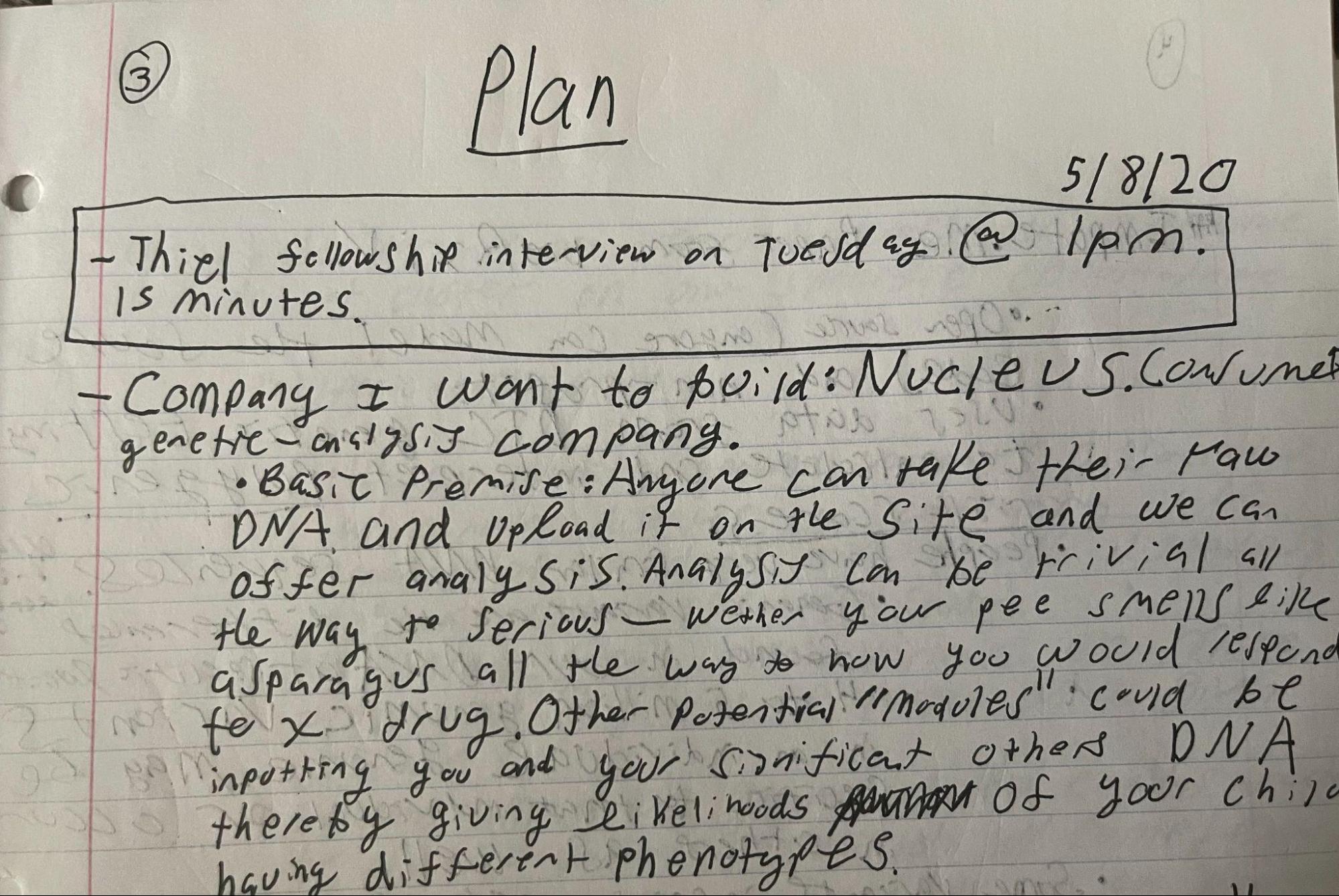
Nucleus’ first node. The last sentence feels particularly fascinating. Note, I didn’t get the Thiel Fellowship that year. It would be about a year later — on the brink — that Cory Levy would do our angel round.
I didn't think I would have the heart to show this picture. But this is the first node of Nucleus. Above is the first page of the first notebook, from when I began my journey.
Notice what I say. Nucleus is a “genetic-analysis company.” My core misunderstanding of genetics. There, right in front of me. On the first page of my first notebook.
It is only six years later that I realized how much this single sentence shaped Nucleus. Every subsequent decision was no longer made from infinite possibility, but from the motion set forth by this first sentence. This includes what to build, who to hire, how to raise capital, and even how to tell the story.
I realize now that, if the founder isn’t careful, the first decision can become every decision. This is the single most insightful lesson I have ever experienced. It is also one that contains great mystical power. In the Qur’an: Kun, fa-yakūn — Be!, and it is. In the Bible: In the beginning was the Word. In Hindu traditions, Nada Brahma: the world is sound.
Across these traditions is the same underlying idea: creation begins with Word, which is really just Sound. Sound precedes physical manifestation.
Startups obey the same law. The first words that describe your startup are its first physical manifestation. Before those words, the company exists as an infinite possibility. After them, it has a form. And once something has a physical form, physical forces can act upon it. For a startup, this central force is capitalism.
Accordingly, the first node does more than manifest a company. Its form determines how the physical forces of capitalism act upon it.
If the first form, and those that follow, are oriented toward the founder’s dream, the Startup has a chance at realizing it. Otherwise, unless the founder continually reorients the company toward that dream, the market begins to impose itself, and the company can become purely and only a reflection of its short-term economic incentives.
This also means that a Startup can fail on its first instantiation. Without the founders realizing it, the second they lay down the first brick, the second the company takes on its initial finite form, they constrain what can come next. Each subsequent decision builds upon the last, potentially orienting the company further and further away from the original dream.
This is a scary thought. It also feels deeply unintuitive, in part because it appears to go against nearly all classical startup thinking.125
When reflecting on this, though, one realizes that this happens all the time. The best example is arguably the most influential Silicon Valley startup ever built. And what I’m describing isn’t my interpretation of what happened. It is explicitly said by its founder, who also happens to be the most famous tech investor in the world.
12 years ago, Peter Thiel wrote on an AMA on Reddit:126
“PayPal built a payment system but failed in its goal in creating a ‘new world currency’ (our slogan from back in 2000).”
In some sense, PayPal succeeded spectacularly, selling to eBay for $1.5 billion in 2002. Yet here is Peter saying the opposite, that PayPal “failed [to accomplish] its goal.”
His vision, his “goal,” was a “new world currency.” They even made it their slogan. But it never materialized. Of course it didn't. PayPal’s first node was Palm Pilots and email payments. Its first node was not oriented toward its dream. Almost akin to a physical law, the first node gave the company a form that wasn’t aligned with what they actually wanted. The market then acted on that form, and PayPal became mostly a reflection of its user base: a way to buy items being auctioned on eBay.127
Peter had wanted a new world currency and got a way to buy stuff on eBay. I had proposed a new mechanism of evolution and got a better 23andMe.
This is the danger of the first node. The wrong manifestation constrains what comes next. Each subsequent form inherits something from one before it, and the original misorientation compounds. The further the company travels down that path, the harder it becomes to reorient toward the dream.
There seems to be a fundamental tradeoff here. To manifest something is to give it form, but to give it form is also to make it subject to physical forces you cannot entirely control.
Wait a second.
This isn’t just about Nucleus or Startups. This is about humanity itself. The first page of my notebook is to Nucleus what genetics is to man. Genetics is man’s first node.
Genetics, like the first page of my first notebook, is a language of creation. The letters of its alphabet are “A,” “T,” “C,” and “G.” Yes, these letters are abstractions — but they reflect an underlying, information structure that encodes man’s first physical form.
I also described Startups as needing to constrain an “infinite” vision into a finite form.
Interestingly, there’s an old Eastern story about how God created the first human being. First, God fashioned the human body out of clay. Then, He commanded the soul to enter.
The soul refused. The soul was free. It was infinite. It looked upon the human body as limitation, a kind of prison. It did not want to exchange its freedom for embodiment.
God then commanded His angels to play the most glorious song, and the soul began to fill with ecstasy. In a desire to experience the music more fully which is really a desire for Him to experience Himself more fully — the soul entered the physical body. Thus the first human was born.
To experience the dream, the dream must become embodied.
When a Founder looks deep into his soul to manifest his company, is the process any different? Thiel’s vision for a “new world currency” isn't enough. It needed to actually exist in the here and now. The Millennium Mission existing in my mind was also not enough. I wanted to see it in the world. A Founder’s dream, anyone’s dream, always wants a body.
Why does humanity have such a compulsion? Why do we want to take a dream and bring it into physical form?
For the same reason the Creator made man: to experience the dream more fully.
The parallel runs even deeper. For, as we’ve seen, embodiment comes with a price.
This entire book, in some sense, is a story about this fact. A chasm can grow between a creation and the dream that created it. We saw how the misorientation of a Startup’s first node can compound, pulling the company further and further from its dream until it becomes trapped in its physicality, shaped purely by market forces.
In this spiritual story, the soul is already inherently aware of this trade-off. Become physically embodied to better experience the divine, but in doing so become finite, constrained, subject to physical forces.
Nevertheless, the soul entered the body to experience His song. The story makes clear that the soul is different from the body. The body is a vehicle for the soul. This is what I believe. Like a Startup, a human is not its physical body and attributes anymore than a Startup is its office, code, or product. The essence of a man is his Soul. The central goal of life, in my view, is the cultivation of this Soul. It is to experience Him.
This idea can be expressed elegantly by the twentieth-century Sufi Nur Hixon128. He writes:
“The purpose of the Creation is radically spiritual…the education of the soul is the central reason for the existence of the universe…By truly knowing ourselves, we directly know the essence and purpose of the whole Creation.”
But what does “cultivation of the Soul” mean more tangibly? One answer is natural virtue. Natural virtue was formalized by the theologian Thomas Aquinas, building on Aristotle. It describes virtues that humans can cultivate toward the ultimate objective of human flourishing. And “human flourishing,” the central goal of evolution by GO, is not merely any term. It is the common translation of “eudaimonia,” the Greek concept describing a thriving life.
Natural virtue includes wisdom, justice, courage, and temperance. In my view, these are non-physical and non-genetic. Virtue is an aspect of the Soul. Genetics, for example, can make somebody smarter, but cannot make someone wise.
The central goal of evolution via GO, then, is rooted in the notion that optimizing physical attributes is not itself the goal. Physical attributes are not, in themselves, good or bad. There is no virtue inherent in a biological characteristic.
Again, the physical body and its attributes are the vehicle for spiritual development. The body is not the purpose of life. It is the instrument through which we cultivate the Soul and, ultimately, experience Him.
You may then be wondering, what then is the goal of optimizing for biological characteristics? It’s the same answer, once again, as Nucleus’ story.
Nucleus’ first node did more than physically manifest the company. Its form shaped the ability to experience my dream. The body is no different; it can help shape the degree to which the Soul can experience the world.
At the extreme end is intense physical human suffering. Anyone reading this can imagine that if they were in intense pain day in and day out, their ability to pursue their life’s purpose would be constrained.
Now imagine the constraint begins at birth. A baby born with a condition like untreated infantile spinal muscular atrophy (SMA1), a devastating genetic disease that causes progressive muscle weakness, may face profound limits on what their body allows them to experience. There is nothing wrong with their Soul, but there is something wrong with their body. A tiny error in their genetic code has constrained experiences available to their Soul.
This is the cost of embodiment. In this case, the first node imposes such severe constraints that the person has dramatically less freedom to reorient themselves toward their dream.
Less acutely and less severely, we can think of suffering from human disease as restricting someone’s ability to pursue and cultivate their Soul. GO’s goal is to help change that.
To be explicit, GO cannot eliminate biological suffering. It is also true that some of the wisest and most beautiful humans have emerged from tremendous suffering. But it does not follow that suffering is itself the objective. Man does not need to preserve suffering from disease in order to cultivate courage, or any other virtue.
Disease is the easiest case because the constraint is obvious. But the same principle extends to the rest of our biological characteristics. I’ve already mentioned that intelligence is not wisdom. The difference is true for any trait and virtue. A person can be naturally risk-seeking without having courage.
Still, parents can select the traits they believe will better enable their child to flourish, to cultivate their Soul. They can influence and orient the body of their baby. But what the child ultimately chooses to do — or not do — with those gifts is up to their Heart.
Said differently, a parent can influence the instrument that is the body, but — but! — make no mistake, only the child can learn to play the instrument.
Flourishing, then, can be substantially shaped by genetics while remaining non-genetic in its ends.
This arrives at a strange, paradoxical conclusion. The ultimate purpose of GO has nothing to do with genetics.
To think the purpose of GO has to do with DNA is to miss the cause beneath the cause. The principle beneath the manifestation. The purpose of life itself.
Expanding back out to this entire book, the detailed walkthrough of the creation of Nucleus may, at first glance, have appeared orthogonal to the throughline on evolution, genetics, life, and, most recently, my philosophy of the Soul’s cultivation as the purpose of life.
In fact, I never stopped talking about the same thing. They are all One.
Capitalism and evolution are different manifestations of the same principle: complex systems that optimize toward an objective function. The former toward economic fitness, the latter toward reproductive fitness.
In Nucleus' case, I brought something infinite in my Heart into finite physical form. But that first physical manifestation was misoriented. Once Nucleus entered the world, capitalism began doing exactly what capitalism does; selecting and pulling the company toward what was economically fit, toward what fit within the existing worldview. In doing so, Nucleus was pulled away from my dream.
Natural selection was no different. It optimized man toward reproductive fitness, not human flourishing. What survives and reproduces is not necessarily what allows the Soul to flourish. The result is a humanity still burdened by disease and biological constraints, whether it's the later-onset disease burden that kills more than half the human population each year,59 or the 150 million people born with a non-curable disease.68 Evolution, like Nucleus, was not oriented toward our dream.
The journey of this piece, then, was One.
I returned back to Nucleus’ beginning. I returned all the way back home. I returned to the Heart from which the company originated and to the physical ball of clay through which I had attempted, imperfectly, to express it. I reoriented the company back toward its dream, back toward The Millenium Mission, back towards Him.
And I returned back to evolution's beginning. I returned to the foremost assumption of man, the physical process that has shaped us for billions of years, and asked a new question.
Now that we increasingly understand and can influence this process, how can we reorient it toward a new objective function that better serves all mankind?
The only objective function — the only alignment, if you will — that can work in a complex system is the (re-)introduction of the Soul.
My evolutionary philosophy, my Startup philosophy, and my life philosophy are One.
There was only ever One story. The story of not transcending nature, but maintaining freedom within it.
This is what distinguishes Man, precisely our ability to maintain our non-physical, non-genetic Heart within all the world's forces.
Glossary
A
- Absolute risk
- A person’s percent chance of developing a disease or condition.
- Adenine (A)
- One of the four chemical letters, or nucleotides, that make up DNA.
- Adenine base editor (ABE)
- A gene-editing tool that can change an “A” in DNA to a “G” by cutting just one DNA strand.
- Allele
- One version of a genetic variant or gene.
- Aneuploidy
- Having an abnormal number of chromosomes.
- Artificial womb
- A developing technology intended to support fetal development outside the human body.
- Association
- A statistical relationship between a genetic variant and a trait or disease.
- Autosome
- Any chromosome other than the sex chromosomes.
B
- Base
- One of the four chemical letters of DNA: A, T, C, or G.
- Base editing
- A form of gene editing that changes individual DNA letters without making a full double-strand break.
- Biobank
- Genetic information linked with longitudinal health, trait, and/or other data from a large collection of people.
- Blastocyst
- An embryo at about five to six days of development.
- BMI (body mass index)
- A measure of physique based on a person’s weight relative to their height.
- BRCA1 / BRCA2
- Genes in which certain variants can substantially increase the risk of breast, ovarian, and other cancers.
C
- Carrier
- A person who carries a disease-causing genetic variant but may not have the disease themselves.
- Carrier screening
- Genetic testing used to find out whether someone carries variants that could cause inherited disease in their children.
- Cas9
- A protein used by CRISPR to cut DNA at a targeted location.
- Cas9 nickase
- A modified Cas9 protein that cuts only one strand of DNA rather than both.
- Cell
- The basic biological unit that makes up living organisms.
- Central limit theorem
- A statistical principle explaining why the combined effects of many small, independent influences often produce a bell-shaped distribution.
- Chromosome
- A long string of DNA inside a cell. Humans typically have 46 chromosomes, arranged in 23 pairs.
- Chromosomal abnormality
- A change in the number or structure of chromosomes.
- Chronic disease
- A disease that develops or persists over a long period, such as heart disease or diabetes.
- Cleavage stage
- An early stage of embryo development, around day three, when the embryo consists of several cells.
- Coding sequence
- A section of DNA containing instructions used to make a protein.
- Common variant
- A genetic difference that occurs relatively frequently in a population.
- Complex trait
- A characteristic influenced by many genetic variants as well as, often, environmental factors.
- Computational genomics
- The use of computers and software to analyze genetic information.
- Continuous phenotype
- A trait that occurs across a range, such as height, rather than in simple categories.
- CRISPR / CRISPR-Cas9
- A gene-editing technology that can target and alter DNA at specific locations.
D
- Deletion
- A genetic change in which part of the DNA sequence is missing.
- Deterministic
- Producing or guaranteeing a particular outcome. Complex disease risks are often not deterministic.
- Diploid
- Having two copies of each chromosome, one inherited from each biological parent.
- Directed evolution
- In this book, evolution in which humans intentionally influence which genetic outcomes are passed to future generations.
- Disease-causing mutation
- A change in DNA capable of leading to a disease.
- DNA (deoxyribonucleic acid)
- The molecule that carries genetic information and the biological instructions inherited from one generation to the next.
- DNA sequencing
- Reading the order of the A, T, C, and G letters in DNA across all 46 chromosomes.
- Dominant
- Describes a genetic variant that can substantially affect a trait or cause disease even when only one copy is inherited.
- Double helix
- The twisted, two-stranded structure of DNA.
- Double-strand break (DSB)
- A break through both strands of a DNA molecule.
- Duchenne muscular dystrophy (DMD)
- A serious inherited disorder that causes progressive muscle weakness.
E
- Editing efficiency
- The percentage of cells or embryos in which an intended genetic edit is successfully made.
- Effect size
- How strongly a genetic variant is associated with a trait or disease.
- Embryo
- An organism in the earliest stages of development after fertilization.
- Embryo biopsy
- The removal of a small number of cells from an embryo for testing.
- Embryo selection
- Choosing among embryos created through IVF based on available information about them.
- Environment
- Non-genetic influences on a person, including lifestyle, upbringing, surroundings, and experiences.
- Euploid
- Having the typical number of chromosomes; in humans, normally 46.
- Evolution
- Change in inherited characteristics across generations.
F
- Fertilization
- The joining of an egg and sperm to form an embryo.
- Fetal hemoglobin
- A form of hemoglobin produced primarily before birth.
- FISH (fluorescence in situ hybridization)
- An older genetic-testing technique used to examine selected chromosomes or DNA regions.
G
- Gamete
- A reproductive cell: an egg or sperm.
- Gene
- A section of DNA containing biological instructions.
- Gene editing
- Deliberately modifying a DNA sequence.
- Gene flow
- The movement of genetic variation between populations through reproduction.
- Gene pool
- The collection of genetic variants present within a population.
- Genetic association
- A statistical connection between a genetic variant and a particular trait or disease.
- Genetic engineering
- Deliberately altering an organism’s DNA.
- Genetic marker
- A measurable location or difference in DNA that can be used in genetic analysis.
- Genetic optimization (GO)
- The book’s term for using reproductive and genomic technologies to influence the genetic characteristics of future children.
- Genetic Optimization (GO) industry
- The book’s term for companies and technologies that enable parents to influence the genetic characteristics of future children.
- GO stack
- The collection of technologies that can contribute to genetic optimization, including embryo selection, carrier screening, gene editing, IVG, donor selection, and related IVF technologies.
- Genetic prediction
- Using DNA to estimate a person or embryo's likelihood of developing a disease or having a particular trait.
- Genetic risk
- A measure of a person’s disease risk associated with their inherited DNA.
- Genetic variation
- Differences in DNA between individuals.
- Genetics
- The study of heredity and variation in DNA between individuals.
- Genome
- An organism’s complete set of DNA.
- Genome-wide
- Looking across all of an organism’s DNA, their entire genome, rather than at only one gene or small region.
- Genome-wide association study (GWAS)
- A study that compares many genetic variants across many people to identify variants associated with diseases or traits.
- Genomics
- The study and analysis of genomes on a large scale.
- Genotype
- An individual’s genetic makeup at one or more locations in the genome.
- Genotyping
- Measuring selected genetic variants in a person’s DNA.
- Germline
- Genetic material in eggs, sperm, or embryos that can be passed to future generations.
- GWAS Catalog
- A database containing published associations between genetic variants and human diseases or traits.
H
- HapMap Project
- An international project that mapped common human genetic variation.
- Haplotype
- A group of nearby genetic variants that tend to be inherited together.
- Healthy lifespan
- The portion of a person’s life spent in good health.
- Heredity
- The passing of biological characteristics from parents to offspring.
- Heritability (h²)
- A statistical measure of how much of the variation in a trait within a population is attributable to genetic differences.
- High-penetrance variant
- A genetic variant that has a relatively large effect on the probability of developing a disease or trait.
- Human flourishing
- The book’s proposed goal of genetic optimization: expanding people’s opportunity to thrive in their life according to diverse human values.
- Human Genome Project
- The international scientific effort that produced the first reference sequence of the human genome.
I
- Implantation
- The process by which an embryo attaches to the lining of the uterus.
- Infinitesimal model
- R. A. Fisher’s model in which complex traits are influenced by a very large number of genetic factors, each usually having a small effect.
- Inherited
- Passed genetically from biological parents to their children.
- Intrinsic value
- Value that something has in itself, rather than because it is useful for achieving something else.
- In vitro
- Literally “in glass”; occurring outside the body in a laboratory setting.
- In vitro fertilization (IVF)
- A reproductive procedure in which eggs are fertilized with sperm outside the body and allowed to grow into an embryo which can later be transferred to the uterus.
- In vitro gametogenesis (IVG)
- An emerging technology intended to create eggs or sperm from other types of cells.
- IQ
- A score from standardized tests designed to measure certain aspects of cognitive ability. The book explicitly distinguishes IQ from the entirety of intelligence or human potential.
L
- LDL (low-density lipoprotein)
- A particle that carries cholesterol in the blood; high LDL cholesterol is associated with increased heart-disease risk.
- Locus (plural: loci)
- A particular location in the genome.
M
- Marker
- See genetic marker.
- Meiosis
- The type of cell division that produces eggs and sperm and shuffles parental DNA.
- Mendelian inheritance
- Patterns of inheritance associated with genetic factors that have relatively large, discrete effects, based on principles first described by Gregor Mendel.
- Mendelian risk
- Disease risk arising from a genetic variant with a comparatively large effect and a recognizable inheritance pattern based on principles first described by Gregor Mendel.
- Microarray / SNP chip
- A technology that measures hundreds of thousands or more selected genetic variants across the genome at once.
- Modern Synthesis
- The framework that joined Darwinian natural selection with Mendelian and population genetics into a modern theory of evolution.
- Molecular genetics
- The study of genes and heredity at the physical and molecular level.
- Monogenic
- Caused primarily by genetic variation in a single gene.
- Mosaic / mosaicism
- A condition in which not all cells in an organism or embryo have the same genetic makeup.
- Mutation
- The source of new genetic variants, but often not the source of new phenotypic variation. Previously used to refer to any DNA difference, now the term “variant” is used instead.
N
- Natural selection
- The evolutionary process through which inherited characteristics associated with reproductive success become more common over generations.
- Nucleolus
- The nucleolus is a dense, membrane-free structure inside the nucleus of cells whose main job is to make and assemble ribosomes, the structures responsible for assembling proteins.
- Nucleotide
- A basic building block of DNA containing one of the bases A, T, C, or G.
- Nucleus
- The cell nucleus is an organelle that acts as the control center of a cell by storing and protecting its DNA.
O
- Oocyte
- An egg cell.
- Offspring
- A biological child or descendant.
- Outcome space
- In the book, the range of genetically possible outcomes available to parents through reproduction.
- Ovarian stimulation
- The use of medications to encourage the ovaries to mature multiple eggs, commonly as part of IVF.
P
- PCR (polymerase chain reaction)
- A laboratory method that makes many copies of a selected piece of DNA so that it can be analyzed.
- Penetrance
- The likelihood that someone carrying a particular genetic variant will develop its associated trait or disease. The higher the penetration, the more likely someone is to develop the associated disease or trait.
- PGD (preimplantation genetic diagnosis)
- An older term for genetic testing of embryos before transfer, particularly for inherited genetic conditions.
- PGT (Preimplantation genetic testing)
- General genetic testing performed on embryos created through IVF before embryo transfer.
- PGT-A (preimplantation genetic testing for aneuploidy)
- Testing embryos for abnormal numbers of chromosomes.
- PGT-M (preimplantation genetic testing for monogenic disorders)
- Testing embryos for a specific single-gene condition.
- Phenotype
- A characteristic or trait in an organism, such as height, cholesterol level, or disease status.
- Phenotypic variation
- Differences in observable traits among individuals.
- Pleiotropy
- The phenomenon in which one genetic variant influences more than one trait or disease.
- Polygenic
- Influenced by many genetic variants rather than a single gene.
- Polygenic inheritance
- Inheritance in which many genetic variants across many genes and non-genic regions collectively influence a trait.
- Polygenic prediction
- Using the combined effects of many genetic variants to predict a disease risk or trait.
- Polygenic predictor
- A statistical model that uses many genetic variants to estimate a disease risk or trait disposition.
- Polygenic risk
- Disease risk associated with the combined effects of many genetic variants across the genome.
- Polygenic risk score (PRS)
- A numerical estimate of genetic risk for a disease based on the combined effects of many variants across the genome.
- Polygenic score (PGS)
- A number summarizing the combined effects of many genetic variants to predict a disease risk or trait. Largely identical in meaning to PRS, but useful when the predicted outcome isn’t a risk (e.g. a height).
- Polygenicity
- The degree to which a trait is influenced by many different genetic variants across the genome.
- Population genetics
- The study of genetic variation and how it changes within and between populations.
- Preventative
- Medicine aimed at reducing the chance of disease before it occurs.
- Probabilistic
- Expressed in terms of likelihood rather than certainty.
R
- Recessive
- Describes a genetic condition that generally occurs when a person inherits two disease-causing copies of a gene, one from each parent. People with one copy are carriers who do not usually have disease symptoms.
- Recombination
- The natural shuffling of parental DNA during the creation of eggs and sperm, producing new combinations of genetic variants. A key ingredient for GO.
- Relative risk
- A comparison of risk between two people or groups.
- Reproductive success
- In evolutionary biology, successfully passing genes to future generations through reproduction.
- Risk
- The probability that an event, such as developing a disease, will occur.
- Risk reduction
- A decrease in the probability of an unwanted outcome, such as developing a disease.
S
- Segregation
- The separation of chromosome copies during the formation of eggs and sperm, determining which copy is passed to an offspring.
- Selection
- Choosing among different genetic possibilities. In the book, selection is distinguished from directly modifying or editing DNA.
- Sequencing
- Determining the order of DNA letters in a DNA molecule or across the genome.
- Sex chromosome
- A chromosome involved in determining biological sex. Humans have X and/or Y chromosomes.
- Single-gene disease
- A disease caused primarily by a variant in one gene. Also called a monogenic disease.
- Single-nucleotide polymorphism (SNP)
- A genetic difference involving a single DNA letter or nucleotide at a particular position in the DNA.
- SNP chip
- See microarray.
- Soul
- In the book’s philosophical framework, the essence of a person. The Soul is non-genetic aspect and cannot be reduced to DNA, physical traits, or measurable attributes.
- Statistical genetics
- The use of mathematics and statistics to study inheritance, genetic variation, diseases, and traits.
T
- Tag SNP
- A SNP that can act as a representative marker for a larger group of nearby genetic variants that tend to be inherited together.
- Trait
- A characteristic of a person or organism, such as height, eye color, or a measurable aspect of health.
- Trait optimization
- Attempting to influence a particular characteristic toward an outcome that is preferred or valued.
- Tripronuclear (3PN) zygote
- An abnormal, non-viable fertilized egg containing three sets of chromosomes rather than the usual two.
- Trophectoderm
- The outer layer of cells in a blastocyst that later contributes to the placenta and from which cells can be taken during an embryo biopsy.
V
- Variant / genetic variant
- A difference in DNA sequence between individuals.
- Variance explained (r²)
- The share of variation in an outcome that can be accounted for by a predictive model.
W
- Whole-genome DNA
- All of an organism’s DNA. Like saying “genome”.
- Whole-genome sequencing (WGS)
- Reading essentially the complete DNA sequence, the genome, of an individual.
X
- X-linked
- Describes a genetic condition or variant located on the X chromosome. Biological males usually have a single X chromosome while biological females usually have two.
Z
- Zygote
- The single cell formed when an egg and sperm join.
Thanks to Packy McCormick, Kaitlyn Gallacher, David Sloane, Matt Lanter, Barry Starr, Nathan Treff, Stephan Cordogan, Lasse Folkersen, Editor 1, and Editor 2 for reviewing this.
Thanks to everyone at Nucleus for all the work and love you put into your work. It’s a privilege of a lifetime to be able to work alongside you.
Thanks to our early believers, the people who saw the future before anyone else did.
Thanks to our customers for your trust and allowing us to earn the opportunity to work for you.
Thanks to my parents and family.
Thanks to God.
References
- ↩
Smart, A. (2023, October 27). From a fledgling genetic science, a murky market for prediction. Undark. https://undark.org/2023/10/27/consumer-genetic-testing-science/
- ↩
MacColl, M. (2025, January 30). Controversial genetics testing startup Nucleus Genomics raises $14M Series A. TechCrunch. https://techcrunch.com/2025/01/30/controversial-genetics-testing-startup-nucleus-genomics-raises-14m-series-a/
- ↩
Nucleus Genomics. (2025). Have your best baby. https://mynucleus.com/have-your-best-baby-nyc
- ↩
Carlson, T. (2026). Tucker debates biotech CEO on baby customization, eugenics, and God's existence [Video]. YouTube. https://youtu.be/JGchqvMtvII
- ↩
Nucleus Genomics. (n.d.). Genetic optimization [Video]. YouTube. https://www.youtube.com/watch?v=yX01lLGF_qw
- ↩
Caplan, A., & Tabery, J. (2025, July 28). The myth of the designer baby - Why 'genetic optimization' is more hype than science. Scientific American. https://www.scientificamerican.com/article/why-genetically-optimizing-embryos-is-misleading-unethical-and-not-even/
- ↩
Forbes. (n.d.). Robert Duggan. Retrieved September 1, 2026, from https://www.forbes.com/profile/robert-duggan/
- ↩
Oprah.com. (2017). Oprah's favorite things 2017: DNA test ancestry personal genetic service. https://www.oprah.com/gift/oprahs-favorite-things-2017-full-list-dna-test-ancestry-personal-genetic-service
- ↩
Zimmer, C. (2026, June 4). In a first, scientists precisely edit human embryo genes. The New York Times. https://www.nytimes.com/2026/06/04/science/embryos-gene-editing-crispr.html
- ↩
Zuccaro, M. V., Xu, J., Mitchell, C., et al. (2020). Allele-specific chromosome removal after Cas9 cleavage in human embryos. Cell, 183(6), 1650-1664.e15. https://doi.org/10.1016/j.cell.2020.10.025
- ↩
Treff, N. R. (n.d.). Nathan Treff [ResearchGate profile]. ResearchGate. Retrieved September 1, 2026, from https://www.researchgate.net/profile/Nathan-Treff-2
- ↩
Basu, M., Chen, E., & Ledford, H. (2026, June 5). Precise genome editing of human embryos triggers praise and alarm. Nature, 654, 577-578. https://doi.org/10.1038/d41586-026-01827-8
- ↩
Bassuk, A. G., Zheng, A., Li, Y., et al. (2016). Precision medicine: Genetic repair of retinitis pigmentosa in patient-derived stem cells. Scientific Reports, 6, Article 19969. https://doi.org/10.1038/srep19969
- ↩
Liang, P., Xu, Y., Zhang, X., et al. (2015). CRISPR/Cas9-mediated gene editing in human tripronuclear zygotes. Protein & Cell, 6(5), 363-372. https://doi.org/10.1007/s13238-015-0153-5
- ↩
Sadeghi, K. (n.d.). Kian Sadeghi [Author page]. The AC Milan Offside. https://acmilan.theoffside.com/authors/kian-sadeghi
- ↩
Woo, M. (2017, February 26). DIY gene editing: Fast, cheap - and worrisome. The Wall Street Journal. https://www.wsj.com/articles/diy-gene-editing-fast-cheapand-worrisome-1488164820
- ↩
Sadeghi, K. (n.d.). CRISPR/Cas9 editing [Unpublished student paper]. https://drive.google.com/file/d/1tLu5tEdAL44IXCYTJ_VyDJ8T8_dEEEF1/view
- ↩
The ODIN. (n.d.). DIY bacterial gene engineering CRISPR kit. Retrieved September 1, 2026, from https://www.the-odin.com/crispr-kit/
- ↩
University of Pennsylvania. (n.d.). Roy and Diana Vagelos Program in Life Sciences and Management. Retrieved September 1, 2026, from https://lsm.upenn.edu/
- ↩
Graham, P. (n.d.). Essays. Retrieved September 1, 2026, from https://www.paulgraham.com/
- ↩
Masters, B. (2012). Peter Thiel's CS183: Startup [Course notes]. Tumblr. https://blakemasters.tumblr.com/peter-thiels-cs183-startup
- ↩
Masters, B. (2012, June 6). Peter Thiel's CS183: Startup - Class 17: Deep thought [Course notes]. Tumblr. https://blakemasters.tumblr.com/post/24464587112/peter-thiels-cs183-startup-class-17-deep
- ↩
Graham, P. (2012, November). How to get startup ideas. https://paulgraham.com/startupideas.html
- ↩
University of Pennsylvania Department of Biology. (n.d.). BIOL 221. https://www.bio.upenn.edu/node/2540
- ↩
European Bioinformatics Institute. (n.d.). GWAS Catalog. Retrieved September 1, 2026, from https://www.ebi.ac.uk/gwas/
- ↩
University of Pennsylvania Perelman School of Medicine. (n.d.). Iain Mathieson [Faculty profile]. https://www.med.upenn.edu/apps/faculty/index.php/g275/p8942206
- ↩
Columbia University Department of Biological Sciences. (n.d.). History. Retrieved September 1, 2026, from https://biology.columbia.edu/content/history
- ↩
Fisher, R. A. (1918). The correlation between relatives on the supposition of Mendelian inheritance. Transactions of the Royal Society of Edinburgh, 52(2), 399-433. https://doi.org/10.1017/S0080456800012163
- ↩
Wikipedia contributors. (n.d.). Infinitesimal model. In Wikipedia. Retrieved September 1, 2026, from https://en.wikipedia.org/wiki/Infinitesimal_model
- ↩
Wikipedia contributors. (n.d.). Photo 51. In Wikipedia. Retrieved September 1, 2026, from https://en.wikipedia.org/wiki/Photo_51
- ↩
Chang, M. C. (1959). Fertilization of rabbit ova in vitro. Nature, 184, 466-467. https://doi.org/10.1038/184466a0
- ↩
Edwards, R. G., Bavister, B. D., & Steptoe, P. C. (1969). Early stages of fertilization in vitro of human oocytes matured in vitro. Nature, 221(5181), 632-635. https://doi.org/10.1038/221632a0
- ↩
Nobel Assembly at Karolinska Institutet. (2010). The 2010 Nobel Prize in Physiology or Medicine: Robert G. Edwards - The development of in vitro fertilization. Nobel Prize Outreach. https://www.nobelprize.org/uploads/2018/06/popular-medicineprize2010.pdf
- ↩
Wikipedia contributors. (n.d.). Kary Mullis. In Wikipedia. Retrieved September 1, 2026, from https://en.wikipedia.org/wiki/Kary_Mullis
- ↩
Wired. (2006, January 16). LSD: The geek's wonder drug? https://www.wired.com/2006/01/lsd-the-geeks-wonder-drug/
- ↩
Wikipedia contributors. (n.d.). International HapMap Project. In Wikipedia. Retrieved September 1, 2026, from https://en.wikipedia.org/wiki/International_HapMap_Project
- ↩
Klein, R. J., Zeiss, C., Chew, E. Y., et al. (2005). Complement factor H polymorphism in age-related macular degeneration. Science, 308(5720), 385-389. https://doi.org/10.1126/science.1109557
- ↩
International Schizophrenia Consortium. (2009). Common polygenic variation contributes to risk of schizophrenia and bipolar disorder. Nature, 460(7256), 748-752. https://doi.org/10.1038/nature08185
- ↩
Khera, A. V., Chaffin, M., Aragam, K. G., et al. (2018). Genome-wide polygenic scores for common diseases identify individuals with risk equivalent to monogenic mutations. Nature Genetics, 50(9), 1219-1224. https://doi.org/10.1038/s41588-018-0183-z
- ↩
Treff, N. R., & Levy, B. (2010). SNP microarray-based 24 chromosome aneuploidy screening is significantly more consistent than FISH. Molecular Human Reproduction, 16(8), 583-589. https://doi.org/10.1093/molehr/gaq039
- ↩
Scott, R. T., Jr., Upham, K. M., Forman, E. J., et al. (2013). Cleavage-stage biopsy significantly impairs human embryonic implantation potential while blastocyst biopsy does not: A randomized and paired clinical trial. Fertility and Sterility, 100(3), 624-630. https://doi.org/10.1016/j.fertnstert.2013.04.039
- ↩
Daetwyler, H. D., Villanueva, B., & Woolliams, J. A. (2008). Accuracy of predicting the genetic risk of disease using a genome-wide approach. PLoS ONE, 3(10), Article e3395. https://doi.org/10.1371/journal.pone.0003395
- ↩
Nucleus Genomics. (n.d.). Genetic Optimization Hub. Retrieved September 1, 2026, from https://mynucleus.com/labs/genetic-optimization-hub
- ↩
Ancestry. (n.d.). Ancestry. Retrieved September 1, 2026, from https://www.ancestry.com/
- ↩
Myriad Genetics. (n.d.). Myriad Genetics. Retrieved September 1, 2026, from https://myriad.com/
- ↩
Natera. (n.d.). Natera. Retrieved September 1, 2026, from https://www.natera.com/
- ↩
Igenomix. (n.d.). Igenomix. Retrieved September 1, 2026, from https://www.igenomix.com/
- ↩
GeneDx. (n.d.). GeneDx. Retrieved September 1, 2026, from https://www.genedx.com/
- ↩
Impute.me. (n.d.). Impute.me. Retrieved September 1, 2026, from http://impute.me
- ↩
GenomeWeb. (n.d.). Nucleus Genomics acquires polygenic risk score tool. https://www.genomeweb.com/informatics/nucleus-genomics-acquires-polygenic-risk-score-tool
- ↩
Ultima Genomics. (n.d.). Ultima Genomics. Retrieved September 1, 2026, from https://www.ultimagenomics.com/
- ↩
Nucleus Genomics. (2022, July 12). DTC genetics company Nucleus Genomics raises $18 million in funding in one year [Press release]. PR Newswire. https://www.prnewswire.com/news-releases/dtc-genetics-company-nucleus-genomics-raises-18-million-in-funding-in-one-year-301586000.html
- ↩
Genohub. (n.d.). Illumina NovaSeq X Plus. Retrieved September 1, 2026, from https://genohub.com/ngs-sequencer/3/illumina-novaseq-x-plus/
- ↩
de Vries, H. (1919). The present position of the mutation theory. Nature, 104, 213-214. https://doi.org/10.1038/104213a0
- ↩
Nature Education. (n.d.). Mutations are the raw materials of evolution. Scitable. https://www.nature.com/scitable/knowledge/library/mutations-are-the-raw-materials-of-evolution-17395346/
- ↩
The Washington Post. (2026, June 25). DNA editing in human embryos reignites debate over designer babies. https://www.washingtonpost.com/science/2026/06/25/dna-editing-human-embryos-reignites-debate-over-designer-babies/
- ↩
Note that throughout the rest of my book, I assume that embryos do not have souls. This is what I personally believe.
- ↩
Nucleus Genomics. (n.d.). Nucleus Preview. Retrieved September 1, 2026, from https://mynucleus.com/preview
- ↩
Nguengang Wakap, S., Lambert, D. M., Olry, A., et al. (2020). Estimating cumulative point prevalence of rare diseases: Analysis of the Orphanet database. European Journal of Human Genetics, 28, 165-173. https://doi.org/10.1038/s41431-019-0508-0
- ↩
U.S. Food and Drug Administration. (n.d.). Rare diseases at FDA. Retrieved September 1, 2026, from https://www.fda.gov/patients/rare-diseases-fda
- ↩
Yang, G., Cintina, I., Pariser, A., et al. (2022). The national economic burden of rare disease in the United States in 2019. Orphanet Journal of Rare Diseases, 17, Article 163. https://doi.org/10.1186/s13023-022-02299-5
- ↩
American College of Obstetricians and Gynecologists. (2017, March). Carrier screening for genetic conditions (Committee Opinion No. 690). https://www.acog.org/clinical/clinical-guidance/committee-opinion/articles/2017/03/carrier-screening-for-genetic-conditions
- ↩
BRIDGES-NBS. (n.d.). The project. Retrieved September 1, 2026, from https://www.bridgesnbs.org/project
- ↩
Lamas, D. J. (2026, June 22). With genetic testing, how much information is too much? The New York Times. https://www.nytimes.com/2026/06/22/opinion/infants-genetic-screening.html
- ↩
Dor Yeshorim. (n.d.). Dor Yeshorim. Retrieved September 1, 2026, from https://doryeshorim.org/
- ↩
Children's Hospital of Philadelphia. (2025, May 15). World's first patient treated with personalized CRISPR gene editing therapy at Children's Hospital of Philadelphia. https://www.chop.edu/news/worlds-first-patient-treated-personalized-crispr-gene-editing-therapy-childrens-hospital
- ↩
STAT. (2025, November 12). FDA roadmap: How to scale Baby KJ's custom gene-editing treatment. https://www.statnews.com/2025/11/12/fda-roadmap-how-to-scale-baby-kj-custom-gene-editing-treatment/
- ↩
Centers for Disease Control and Prevention. (n.d.). Deaths and mortality. Retrieved September 1, 2026, from https://www.cdc.gov/nchs/fastats/deaths.htm
- ↩
Centers for Disease Control and Prevention. (n.d.). Fast facts: Health and economic costs of chronic conditions. Retrieved September 1, 2026, from https://www.cdc.gov/chronic-disease/data-research/facts-stats/index.html
- ↩
Gatz M, Reynolds CA, Fratiglioni L, et al. (2006). Role of Genes and Environments for Explaining Alzheimer Disease. Arch Gen Psychiatry. 63(2), 168–174. https://jamanetwork.com/journals/jamapsychiatry/fullarticle/209307
- ↩
Hyttinen V, Kaprio J, Kinnunen L, et al. (2003). Genetic Liability of Type 1 Diabetes and the Onset Age Among 22,650 Young Finnish Twin Pairs: A Nationwide Follow-Up Study. Diabetes 52 (4), 1052–1055. https://doi.org/10.2337/diabetes.52.4.1052
- ↩
Willemsen G, Ward KJ, Bell CG, et al. (2015). The Concordance and Heritability of Type 2 Diabetes in 34,166 Twin Pairs From International Twin Registers: The Discordant Twin (DISCOTWIN) Consortium. Twin Research and Human Genetics. 18(6), 762-771. doi:10.1017/thg.2015.83
- ↩
Mucci LA, Hjelmborg JB, Harris JR, et al. (2016) Familial Risk and Heritability of Cancer Among Twins in Nordic Countries. JAMA. 315(1):68–76. doi:10.1001/jama.2015.17703
- ↩
Zdravkovic, S., Wienke, A., Pedersen, N.L., et al. (2002). Heritability of death from coronary heart disease: a 36-year follow-up of 20,966 Swedish twins. Journal of Internal Medicine, 252, 247-254. https://doi.org/10.1046/j.1365-2796.2002.01029.x
- ↩
McEvoy BP, Visscher PM. (2009). Genetics of human height. Econ Hum Biol., 7(3), 294-306. https://www.sciencedirect.com/science/article/abs/pii/S1570677X09000793?via%3Dihub
- ↩
National Breast Cancer Foundation. (n.d.). What is BRCA? Retrieved September 1, 2026, from https://www.nationalbreastcancer.org/what-is-brca/
- ↩
Reuell, P. (2016, November 7). DNA is not destiny. The Harvard Gazette. https://news.harvard.edu/gazette/story/2016/11/dna-is-not-destiny/
- ↩
The Seattle Times. (n.d.). Is it true that genes aren't our health destiny? https://www.seattletimes.com/life/wellness/is-it-true-that-genes-arent-our-health-destiny/
- ↩
Cloud, J. (2010, January 6). Why your DNA isn't your destiny. Time. https://time.com/archive/6690329/why-your-dna-isnt-your-destiny/
- ↩
The Atlantic. (2026, July 12). The unintended consequences of genetic tests. https://www.theatlantic.com/ideas/2026/07/genetic-testing-children-diseases/687869/
- ↩
Jolie, A. (2013, May 14). My medical choice. The New York Times. https://www.nytimes.com/2013/05/14/opinion/my-medical-choice.html
- ↩
BRCA1: Cancer Risks, Facing Hereditary Cancer EMPOWERED
- ↩
Greally, J. (2026, July 21). Tell me why I'm wrong: My prediction is... [LinkedIn post]. LinkedIn. https://www.linkedin.com/posts/john-greally_tell-me-why-im-wrong-my-prediction-is-share-7485277162774831104-AA8-/
- ↩
Centers for Disease Control and Prevention. (n.d.). Tier 1 genomics applications and their importance to public health. CDC Archive. https://archive.cdc.gov/www_cdc_gov/genomics/implementation/toolkit/tier1.htm
- ↩
Wainschtein, P., Zhang, Y., Schwartzentruber, J. et al. (2026). Estimation and mapping of the missing heritability of human phenotypes. Nature 649, 1219–1227. https://doi.org/10.1038/s41586-025-09720-6
- ↩
Nucleus Genomics. (n.d.). Nucleus Labs. Retrieved September 1, 2026, from https://mynucleus.com/labs
- ↩
Request Access to Nucleus Origin, https://mynucleus.typeform.com/to/ntzvD5SM?typeform-source=mynucleus.com
- ↩
Cordogan, S., Starr, D. B., Treff, N. R., et al. (2025). Within- and between-family validation of nine polygenic risk scores developed in 1.5 million individuals: Implications for IVF, embryo selection, and reduction in lifetime disease risk [Preprint]. medRxiv. https://doi.org/10.1101/2025.10.24.25338613
- ↩
Centers for Disease Control and Prevention. (2026). Fast Facts: Health and Economic Costs of Chronic Conditions https://www.cdc.gov/chronic-disease/data-research/facts-stats/index.html
- ↩
Centers for Disease Control and Prevention. (n.d.). Benefits of quitting smoking. Retrieved September 1, 2026, from https://www.cdc.gov/tobacco/about/benefits-of-quitting.html
- ↩
Centers for Disease Control and Prevention. (n.d.). About tobacco. Retrieved September 1, 2026, from https://www.cdc.gov/tobacco/about/index.html
- ↩
American Cancer Society. (n.d.). How to quit using tobacco. Retrieved September 1, 2026, from https://www.cancer.org/cancer/risk-prevention/tobacco/guide-quitting-smoking.html
- ↩
U.S. Preventive Services Task Force. (2021, January 19). Tobacco smoking cessation in adults, including pregnant persons: Interventions. https://www.uspreventiveservicestaskforce.org/uspstf/recommendation/tobacco-use-in-adults-and-pregnant-women-counseling-and-interventions
- ↩
National Cancer Institute. (n.d.). Cancer stat facts: Lung and bronchus cancer. SEER. Retrieved September 1, 2026, from https://seer.cancer.gov/statfacts/html/lungb.html
- ↩
Arem, H., Moore, S. C., Patel, A., et al. (2015). Leisure time physical activity and mortality: A detailed pooled analysis of the dose-response relationship. JAMA Internal Medicine, 175(6), 959-967. https://doi.org/10.1001/jamainternmed.2015.0533
- ↩
World Health Organization. (2024, June 26). Physical activity. https://www.who.int/news-room/fact-sheets/detail/physical-activity
- ↩
Centers for Disease Control and Prevention. (n.d.). About physical activity. Retrieved September 1, 2026, from https://www.cdc.gov/physical-activity/php/about/index.html
- ↩
American Heart Association. (2024, January 19). American Heart Association recommendations for physical activity in adults and kids. https://www.heart.org/en/healthy-living/exercise-and-physical-activity/fitness-basics/aha-recs-for-physical-activity-in-adults
- ↩
American Society for Reproductive Medicine. (n.d.). Ethics opinions. Retrieved September 1, 2026, from https://www.asrm.org/practice-guidance/ethics-opinions/
- ↩
Abdellaoui, A., Verweij, K.J.H. (2021). Dissecting polygenic signals from genome-wide association studies on human behaviour. Nat Hum Behav 5, 686–694. https://doi.org/10.1038/s41562-021-01110-y
- ↩
Cholesterol Treatment Trialists' Collaboration. (2010). Efficacy and safety of more intensive lowering of LDL cholesterol: A meta-analysis of data from 170,000 participants in 26 randomised trials. The Lancet, 376(9753), 1670-1681. https://doi.org/10.1016/S0140-6736(10)61350-5
- ↩
Boni, M. [@girl_on_couch]. (2024, April 30). I'm looking for a man in finance [Video]. TikTok. https://www.tiktok.com/@girl_on_couch/video/7364483352545529130
- ↩
Klock, S. C., & Greenfeld, D. A. (2004). Parents' knowledge about the donors and their attitudes toward disclosure in oocyte donation. Human Reproduction, 19(7), 1575-1579. https://doi.org/10.1093/humrep/deh289
- ↩
Shettles, L. B., & Rorvik, D. M. (2006). How to choose the sex of your baby: The method best supported by scientific evidence (Rev. ed.). Broadway Books. https://www.amazon.com/dp/0767926102
- ↩
Wikipedia contributors. (n.d.). Shettles method. In Wikipedia. Retrieved September 1, 2026, from https://en.wikipedia.org/wiki/Shettles_method
- ↩
Capelouto, S. M., Archer, S. R., Morris, J. et al. (2018). Sex selection for non-medical indications: A survey of current pre-implantation genetic screening practices among U.S. ART clinics. Journal of Assisted Reproduction and Genetics, 35(3), 409-416. https://doi.org/10.1007/s10815-017-1076-2
- ↩
American Society for Reproductive Medicine Ethics Committee. (2026). Use of preimplantation genetic testing for polygenic disorders (PGT-P): An Ethics Committee opinion. https://www.asrm.org/practice-guidance/ethics-opinions/use-of-preimplantation-genetic-testing-for-polygenic-disorders-pgt-p-an-ethics-committee-opinion-2026/
- ↩
Bayefsky, M. J., Shaw, J., Hamer, D., et al. (2023). A balancing act: Sex selection after pre-implantation genetic testing for aneuploidy for first versus second baby. Human Reproduction, 38(7), 1325-1333. https://doi.org/10.1093/humrep/dead101
- ↩
Nucleus Genomics Scientific Team (2026) Polygenic prediction of height, BMI, and intelligence within families: Revisiting the limited utility of embryo screening. https://mynucleus.com/labs/traits-whitepaper
- ↩
Wilding, J. P. H., Batterham, R. L., Calanna, S., et al. (2021). Once-weekly semaglutide in adults with overweight or obesity. New England Journal of Medicine, 384(11), 989-1002. https://doi.org/10.1056/NEJMoa2032183
- ↩
Initiative for Medicines, Access & Knowledge. (n.d.). GLP-1. Retrieved September 1, 2026, from https://www.i-mak.org/glp-1/
- ↩
Min J, Chiu DT, Wang Y. (2013). Variation in the heritability of body mass index based on diverse twin studies: a systematic review. Obes Rev., 14(11), 871-82. https://www.ncbi.nlm.nih.gov/pmc/articles/PMC4346225/
- ↩
Allen DB, Cuttler L. (2013). Clinical practice. Short stature in childhood--challenges and choices. N Engl J Med., 368(13), 1220-8. https://pmc.ncbi.nlm.nih.gov/articles/PMC5754004/
- ↩
Giorgino R, Cornacchini J, Sillmann YM, et al. (2025). Aesthetic lower limb lengthening techniques: a systematic review of efficacy, complications, and patient satisfaction. J Orthop Surg Res., 20(1), 415. https://pmc.ncbi.nlm.nih.gov/articles/PMC12020155/
- ↩
American Society of Plastic Surgeons. (2025). 2024 plastic surgery statistics report. https://www.plasticsurgery.org/documents/news/statistics/2024/cosmetic-procedure-trends-2024.pdf
- ↩
Graham, P. (2006, October). The 18 mistakes that kill startups. https://www.paulgraham.com/startuplessons.html
- ↩
Lozano-Blasco, R., Quilez-Robres, A., Usan, P., et al. (2022). Types of intelligence and academic performance: A systematic review and meta-analysis. Journal of Intelligence, 10(4), Article 123. https://doi.org/10.3390/jintelligence10040123
- ↩
Austin, J. T., & Hanisch, K. A. (1990). Occupational attainment as a function of abilities and interests: A longitudinal analysis using Project TALENT data. Journal of Applied Psychology, 75(1), 77-86. https://doi.org/10.1037/0021-9010.75.1.77
- ↩
Ritchie, S. J., & Tucker-Drob, E. M. (2018). How much does education improve intelligence? A meta-analysis. Psychological Science, 29(8), 1358-1369. https://doi.org/10.1177/0956797618774253
- ↩
Levy, S. (2011, October 6). Steve Jobs: 'Technology alone is not enough.' The New Yorker. https://www.newyorker.com/news/news-desk/steve-jobs-technology-alone-is-not-enough
- ↩
Steve Jobs: A bicycle for the mind. (n.d.). [Video]. YouTube. https://www.youtube.com/watch?v=NjIhmzU0Y8Y
- ↩
IBM. (n.d.). Profs: The world's first networked business application. IBM History. Retrieved September 1, 2026, from https://www.ibm.com/history/profs-networked-business
- ↩
Polderman TJ, Benyamin B, de Leeuw CA, et al. (2015) Meta-analysis of the heritability of human traits based on fifty years of twin studies. Nat Genet., 47(7), 702-9. https://www.nature.com/articles/ng.3285.
- ↩
Musk, E. (2006, August 2). The secret Tesla Motors master plan (just between you and me). Tesla. https://www.tesla.com/secret-master-plan
- ↩
This only applies to great Startups, which I already defined as manifestations of the Soul. The goal of a Startup is to pull from the infinite well that is the founders heart, they are fixed on vision, flexible in execution. Mediocre startups, in contrast, cannot fail on their first instantiation because the measure of success of a mediocre startup is merely the most basic, it is economic — not does my dream castle get built, but does any company get built. Also, when I say “Startups can fail on their first instantiation,” I don’t mean fail commercially or economically. In fact, a first node could be placed that ends up still being a large company — just not the one you dreamed of. To the naive capitalists' eyes, it is a success, when to the founder it is a failure. It failed to accomplish the dream, to reflect the divine inside the founder. For Startups, the by-product of manifesting the dream is commercial success, it is principally secondary. For startups, the market forces will set down the bedrock of the startup, and the founder is an employee to the market. The defining feature of this kind of startup is that it cannot by its nature be a divine reflection of the founder, only, purely, the market incentives it is subject to.
- ↩
Thiel, P. [u/peterthiel]. (2014, September 11). PayPal built a payment system but failed in its goal in creating a 'new world currency' [Comment on the online forum post I'm Peter Thiel, technology entrepreneur and investor. AMA]. Reddit. https://www.reddit.com/r/IAmA/comments/2g4g95/comment/ckfjocv/
- ↩
Elon as well, another founder of PayPal, shared the same sentiment after he bought twitter:
Twitter is an accelerant to fulfilling the original X.com [PayPal] vision
It’s worth mentioning here that this is why Elon always writes out his Master Plans. These are documents of orientation. To ensure the first node is oriented toward the grand vision. He wasn’t going to make the same mistake twice.
Musk, E. [@elonmusk]. (2022, October 5). Twitter is an accelerant to fulfilling the original X.com vision [Post]. X. https://x.com/elonmusk/status/1577737664689848326
- ↩
Hixon, L. (1988). Heart of the Koran: Meditations and illuminations from the scripture of Islam. Theosophical Publishing House.